
First report of viable Toxoplasma gondii isolation from African lions (Panthera leo): Evidence for their status as intermediate hosts
IF 2.6
Q2 PARASITOLOGY
Food and Waterborne Parasitology
Pub Date : 2026-03-01
Epub Date: 2026-01-28
DOI:10.1016/j.fawpar.2026.e00317
引用次数: 0
Abstract
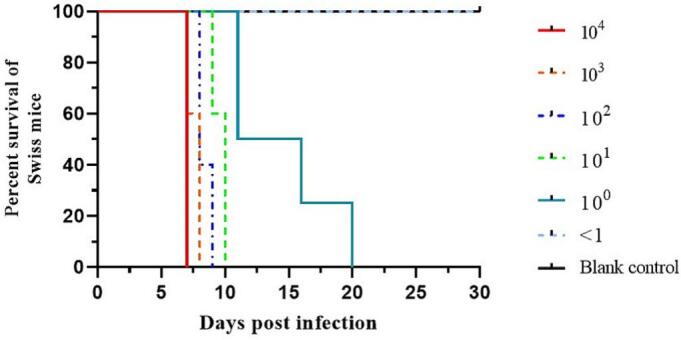
Toxoplasma gondii can cause lifelong infection in most definitive and intermediate hosts. Serological evidence of T. gondii infection has been documented in both captive and free-ranging lions. We collected samples from 40 captive African lions (Panthera leo) in China from 2017 to 2025 and investigated T. gondii in these animals via serological, bioassay, and molecular methods. The overall prevalence of T. gondii in the 40 lions was 45.0% (95% CI: 30.70–60.18%). Sex, age, phenotype, and sampling date were not risk factors for susceptibility to T. gondii infection. A viable T. gondii isolate (designated as TgLionCHn1) was obtained from the tissues of one lion via mouse bioassay and amplified by in vitro cultivation. Parasite DNA was extracted from the cell culture, and the genotype was determined by polymerase chain reaction – restriction fragment length polymorphism analysis using 10 genetic markers (SAG1, SAG2, SAG3, BTUB, GRA6, c22–8, c29–2, L358, PK1, and Apico) and two virulence genes (ROP18/ROP5). The genotype of the T. gondii isolate TgLionCHn1 (designated as ToxoDB #348) exhibited a previously unreported ROP18/ROP5 allelic combination (2/1). Mice infected with ≥1 tachyzoite died from acute toxoplasmosis at 9.2 ± 0.6 days post infection, indicating that TgLionCHn1 is virulent in mice. Our assessment of this viable isolate from the tissues of a dead lion provides the first direct evidence that a lion can serve as an intermediate host for T. gondii. Seropositive lions may shed T. gondii oocysts, highlighting zoonotic risks in zoo environments and the need for improved biosecurity measures.
首次报告从非洲狮(Panthera leo)中分离出可存活的刚地弓形虫:它们作为中间宿主地位的证据。
刚地弓形虫可在大多数终末和中间宿主中引起终身感染。圈养和自由放养的狮子中都有弓形虫感染的血清学证据。作者于2017年至2025年在中国采集了40只圈养非洲狮(Panthera leo)的样本,并通过血清学、生物测定和分子方法对这些动物的弓形虫进行了研究。40头狮子中弓形虫的总患病率为45.0% (95% CI: 30.70 ~ 60.18%)。性别、年龄、表型和取样日期不是弓形虫感染易感性的危险因素。通过小鼠生物测定从一只狮子的组织中获得了一株有活力的弓形虫分离株(命名为TgLionCHn1),并通过体外培养进行了扩增。从细胞培养中提取寄生虫DNA,利用10个遗传标记(SAG1、SAG2、SAG3、BTUB、GRA6、c22-8、c29-2、L358、PK1和Apico)和2个毒力基因(ROP18/ROP5),采用聚合酶链反应-限制性片段长度多态性分析确定寄生虫的基因型。弓形虫分离物TgLionCHn1(命名为toxodb# 348)的基因型显示了先前未报道的ROP18/ROP5等位基因组合(2/1)。感染≥1个速殖子的小鼠在感染后9.2±0.6 d死于急性弓形虫病,表明TgLionCHn1对小鼠具有毒力。我们对这种从死狮子组织中分离出来的有活力的病毒的评估提供了第一个直接证据,证明狮子可以作为弓形虫的中间宿主。血清检测呈阳性的狮子可能脱落弓形虫卵囊,这突出了动物园环境中的人畜共患风险和改进生物安全措施的必要性。
本文章由计算机程序翻译,如有差异,请以英文原文为准。
求助全文
约1分钟内获得全文
求助全文
来源期刊

Food and Waterborne Parasitology
Immunology and Microbiology-Parasitology
CiteScore
5.10
自引率
4.00%
发文量
38
审稿时长
13 weeks
期刊介绍:
Food and Waterborne Parasitology publishes high quality papers containing original research findings, investigative reports, and scientific proceedings on parasites which are transmitted to humans via the consumption of food or water. The relevant parasites include protozoa, nematodes, cestodes and trematodes which are transmitted by food or water and capable of infecting humans. Pertinent food includes products of animal or plant origin which are domestic or wild, and consumed by humans. Animals and plants from both terrestrial and aquatic sources are included, as well as studies related to potable and other types of water which serve to harbor, perpetuate or disseminate food and waterborne parasites. Studies dealing with prevalence, transmission, epidemiology, risk assessment and mitigation, including control measures and test methodologies for parasites in food and water are of particular interest. Evidence of the emergence of such parasites and interactions among domestic animals, wildlife and humans are of interest. The impact of parasites on the health and welfare of humans is viewed as very important and within scope of the journal. Manuscripts with scientifically generated information on associations between food and waterborne parasitic diseases and lifestyle, culture and economies are also welcome. Studies involving animal experiments must meet the International Guiding Principles for Biomedical Research Involving Animals as issued by the Council for International Organizations of Medical Sciences.
 求助内容:
求助内容: 应助结果提醒方式:

 京公网安备 11010802042870号


