
Evaluation of an automated sleep apnea scoring algorithm via the Wesper Lab home sleep apnea test
IF 4.1
2区 医学
Q1 CLINICAL NEUROLOGY
引用次数: 0
Abstract
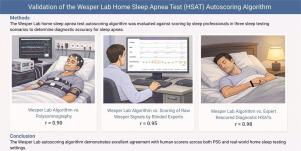
This study evaluated the performance of the Wesper Lab home sleep apnea test (HSAT) artificial intelligence (AI) automated scoring algorithm under both in-laboratory and real-world conditions. We conducted a multi-tiered validation using two datasets and three analyses. The primary analysis compared apnea–hypopnea index (AHI) and central apnea index (CAI) from Wesper Lab HSATs with simultaneous polysomnography (PSG) scored by blinded technologists (n 44). The secondary analysis evaluated blinded scoring of raw Wesper Lab signals from the same 44 patients: first by a single scorer, then by two additional scorers to assess inter-scorer consistency. The tertiary analysis examined clinical HSATs (n 139) in which algorithm-derived AHI was compared with expert rescoring across 11 independent clinics. Agreement metrics included Pearson correlation, Bland-Altman analysis, and confusion matrices. Primary analysis: the algorithm showed strong correlation with PSG for AHI (r 0.90) and CAI (r 0.82) with minimal bias on Bland-Altman analysis. Secondary analysis: the correlation was r 0.95 with minimal bias. Across three scorers, correlation remained . Tertiary analysis: correlation was r 0.98 with minimal bias. These findings demonstrate that the Wesper Lab autoscoring algorithm is a reliable tool for obstructive sleep apnea and central apnea event detection, supporting its role as an HSAT platform that enhances accessibility to sleep apnea diagnosis.
通过Wesper实验室家庭睡眠呼吸暂停测试评估自动睡眠呼吸暂停评分算法。
本研究评估了Wesper Lab家庭睡眠呼吸暂停测试(HSAT)人工智能(AI)自动评分算法在实验室和现实世界条件下的表现。我们使用两个数据集和三个分析进行了多层验证。初步分析比较了Wesper Lab HSATs的呼吸暂停低通气指数(AHI)和中枢呼吸暂停指数(CAI)与盲法技术人员同时多导睡眠图(PSG)评分(n = 44)。二次分析评估了来自相同44名患者的原始Wesper Lab信号的盲法评分:首先由单个评分者评分,然后由两个额外的评分者评分,以评估评分者之间的一致性。三级分析检查了临床hsat (n = 139),其中将算法衍生的AHI与11个独立诊所的专家评分进行比较。一致性指标包括Pearson相关性、Bland-Altman分析和混淆矩阵。初步分析:该算法与PSG的AHI (r = 0.90)和CAI (r = 0.82)相关性强,Bland-Altman分析偏差最小。二次分析:相关系数r = 0.95,偏差最小。在三个得分者中,相关性仍然≥0.93。三级分析:相关系数r = 0.98,偏差最小。这些发现表明,Wesper Lab自动评分算法是阻塞性睡眠呼吸暂停和中枢呼吸暂停事件检测的可靠工具,支持其作为HSAT平台的作用,增强了睡眠呼吸暂停诊断的可及性。
本文章由计算机程序翻译,如有差异,请以英文原文为准。
求助全文
约1分钟内获得全文
求助全文
来源期刊
Sleep medicine
医学-临床神经学
CiteScore
8.40
自引率
6.20%
发文量
1060
审稿时长
49 days
期刊介绍:
Sleep Medicine aims to be a journal no one involved in clinical sleep medicine can do without.
A journal primarily focussing on the human aspects of sleep, integrating the various disciplines that are involved in sleep medicine: neurology, clinical neurophysiology, internal medicine (particularly pulmonology and cardiology), psychology, psychiatry, sleep technology, pediatrics, neurosurgery, otorhinolaryngology, and dentistry.
The journal publishes the following types of articles: Reviews (also intended as a way to bridge the gap between basic sleep research and clinical relevance); Original Research Articles; Full-length articles; Brief communications; Controversies; Case reports; Letters to the Editor; Journal search and commentaries; Book reviews; Meeting announcements; Listing of relevant organisations plus web sites.
 求助内容:
求助内容: 应助结果提醒方式:

 京公网安备 11010802042870号


