
Investigation of serum concentration and the type of opioid used in patients with opium poisoning

Q1 Environmental Science
Toxicology Reports Pub Date : 2026-06-01 Epub Date: 2026-01-31 DOI:10.1016/j.toxrep.2026.102213
Armin Mansouri Sarabbadieh , Nazir Fattahi , Mohammad Mehdi Veisi , Afshin Almasi , Zahra Shaahmadi , Toraj Ahmadi Jouybari
{"title":"Investigation of serum concentration and the type of opioid used in patients with opium poisoning","authors":"Armin Mansouri Sarabbadieh ,&nbsp;Nazir Fattahi ,&nbsp;Mohammad Mehdi Veisi ,&nbsp;Afshin Almasi ,&nbsp;Zahra Shaahmadi ,&nbsp;Toraj Ahmadi Jouybari","doi":"10.1016/j.toxrep.2026.102213","DOIUrl":null,"url":null,"abstract":"<div><div>Opioid poisoning constitutes a major public health issue in Iran and worldwide, with increasing rates attributed to both traditional opiates and synthetic derivatives such as methadone. Reliable assessment of serum opioid concentrations is essential for clinical management and prognosis. Quantitative measurement of serum opioid concentrations determines local epidemiological patterns and identifies risk factors that guide future prevention and treatment strategies. This descriptive cross-sectional study was conducted at Imam Khomeini Hospital in Kermanshah, Iran, from March to June 2023. Fifty adult patients with confirmed opioid poisoning were clinically diagnosed based on the classic opioid toxidrome (decreased consciousness, miotic pupils, and respiratory depression) documented at emergency department admission. Clinical diagnosis was confirmed by positive response to naloxone administration. Demographic and clinical data, type and route of opioid use, clinical features, laboratory results, and patient outcomes were recorded. Serum concentrations of opioids were measured using gas chromatography–mass spectrometry (GC–MS) after administration of antidotes. Statistical analysis was performed with SPSS 26, using a significance threshold of p &lt; 0.05. Among 50 patients (86 % male, mean age 33.5 ± 9.8 years), methadone was the most common cause of poisoning (72 %), followed by opium and heroin. The principal clinical findings included apnea (44 %), miosis (44 %), and weakness/lethargy (38 %), with severe symptoms observed primarily in methadone cases. Serum methadone concentrations were significantly higher in men than women (p = 0.007), and in rural residents compared to urban (p = 0.005). Higher opioid serum levels were associated with more severe clinical presentations and increased need for intensive care. Most patients recovered with medical management; no in-hospital deaths occurred. Methadone has become the leading cause of opioid poisoning in this region, with high serum concentrations predicting increased clinical severity. Measurement of serum opioid levels is a valuable tool for risk stratification and should be integrated into standard management protocols. Attention must be given to both preventive education and tighter regulation of methadone distribution, particularly among high-risk groups.</div></div>","PeriodicalId":23129,"journal":{"name":"Toxicology Reports","volume":"16 ","pages":"Article 102213"},"PeriodicalIF":0.0000,"publicationDate":"2026-06-01","publicationTypes":"Journal Article","fieldsOfStudy":null,"isOpenAccess":false,"openAccessPdf":"","citationCount":"0","resultStr":null,"platform":"Semanticscholar","paperid":null,"PeriodicalName":"Toxicology Reports","FirstCategoryId":"1085","ListUrlMain":"https://www.sciencedirect.com/science/article/pii/S2214750026000156","RegionNum":0,"RegionCategory":null,"ArticlePicture":[],"TitleCN":null,"AbstractTextCN":null,"PMCID":null,"EPubDate":"2026/1/31 0:00:00","PubModel":"Epub","JCR":"Q1","JCRName":"Environmental Science","Score":null,"Total":0}
引用次数: 0

Abstract

Opioid poisoning constitutes a major public health issue in Iran and worldwide, with increasing rates attributed to both traditional opiates and synthetic derivatives such as methadone. Reliable assessment of serum opioid concentrations is essential for clinical management and prognosis. Quantitative measurement of serum opioid concentrations determines local epidemiological patterns and identifies risk factors that guide future prevention and treatment strategies. This descriptive cross-sectional study was conducted at Imam Khomeini Hospital in Kermanshah, Iran, from March to June 2023. Fifty adult patients with confirmed opioid poisoning were clinically diagnosed based on the classic opioid toxidrome (decreased consciousness, miotic pupils, and respiratory depression) documented at emergency department admission. Clinical diagnosis was confirmed by positive response to naloxone administration. Demographic and clinical data, type and route of opioid use, clinical features, laboratory results, and patient outcomes were recorded. Serum concentrations of opioids were measured using gas chromatography–mass spectrometry (GC–MS) after administration of antidotes. Statistical analysis was performed with SPSS 26, using a significance threshold of p < 0.05. Among 50 patients (86 % male, mean age 33.5 ± 9.8 years), methadone was the most common cause of poisoning (72 %), followed by opium and heroin. The principal clinical findings included apnea (44 %), miosis (44 %), and weakness/lethargy (38 %), with severe symptoms observed primarily in methadone cases. Serum methadone concentrations were significantly higher in men than women (p = 0.007), and in rural residents compared to urban (p = 0.005). Higher opioid serum levels were associated with more severe clinical presentations and increased need for intensive care. Most patients recovered with medical management; no in-hospital deaths occurred. Methadone has become the leading cause of opioid poisoning in this region, with high serum concentrations predicting increased clinical severity. Measurement of serum opioid levels is a valuable tool for risk stratification and should be integrated into standard management protocols. Attention must be given to both preventive education and tighter regulation of methadone distribution, particularly among high-risk groups.
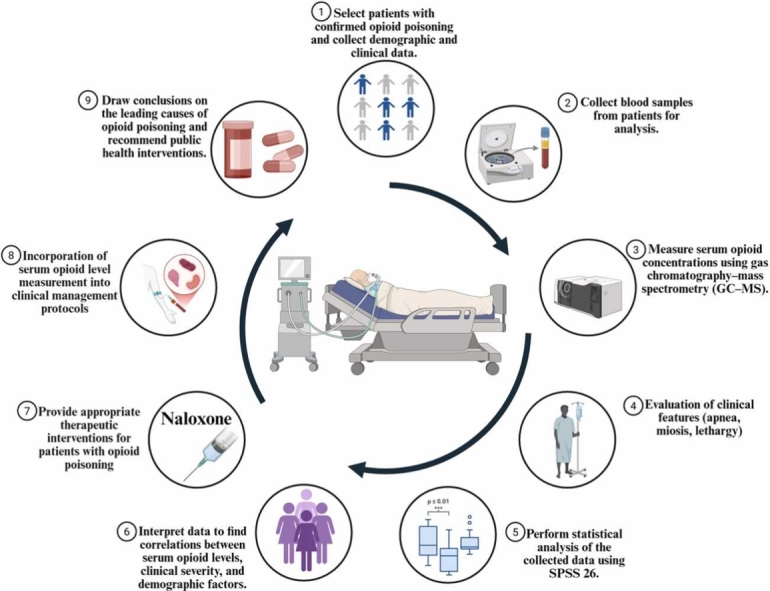
Abstract Image

鸦片中毒患者血药浓度及阿片类药物类型调查。
类阿片中毒是伊朗和世界范围内的一个重大公共卫生问题,由于传统阿片类药物和美沙酮等合成衍生物,中毒率不断上升。可靠的血清阿片类药物浓度评估对临床管理和预后至关重要。血清阿片类药物浓度的定量测量确定了当地流行病学模式,并确定了指导未来预防和治疗战略的危险因素。这项描述性横断面研究于2023年3月至6月在伊朗克尔曼沙阿的伊玛目霍梅尼医院进行。50例确诊为阿片类药物中毒的成年患者在急诊科就诊时,根据典型的阿片类药物中毒症状(意识下降、瞳孔缩小和呼吸抑制)进行临床诊断。对纳洛酮治疗有积极反应,证实临床诊断。记录了人口统计学和临床数据、阿片类药物使用类型和途径、临床特征、实验室结果和患者结局。用气相色谱-质谱联用(GC-MS)法测定给药后血清阿片类药物浓度。采用SPSS 26进行统计学分析,显著性阈值为p
本文章由计算机程序翻译,如有差异,请以英文原文为准。
求助全文
约1分钟内获得全文 求助全文
来源期刊
Toxicology Reports
Toxicology Reports Environmental Science-Health, Toxicology and Mutagenesis
CiteScore
7.60
自引率
0.00%
发文量
228
审稿时长
11 weeks

×
引用
GB/T 7714-2015
复制
MLA
复制
APA
复制
导出至
BibTeX EndNote RefMan NoteFirst NoteExpress
×
提示
您的信息不完整,为了账户安全,请先补充。
现在去补充
×
提示
您因"违规操作"
具体请查看互助需知
我知道了
×
提示
确定
请完成安全验证×
copy
已复制链接
快去分享给好友吧!
我知道了
右上角分享
点击右上角分享
0
联系我们:info@booksci.cn Book学术提供免费学术资源搜索服务,方便国内外学者检索中英文文献。致力于提供最便捷和优质的服务体验。 Copyright © 2023 布克学术 All rights reserved.
京ICP备2023020795号-1
ghs 京公网安备 11010802042870号
Book学术文献互助
Book学术文献互助群
群 号:604180095
Book学术官方微信
小红书


