
Heart-on-a-chip and vasculature-on-a-chip platforms as models of cardiovascular disease
IF 50.2
1区 医学
Q1 CARDIAC & CARDIOVASCULAR SYSTEMS
引用次数: 0
Abstract
Organ-on-a-chip platforms have revolutionized the modelling of cardiovascular pathophysiology, enabling researchers to elucidate underlying mechanisms and drug responses for a variety of inherited and acquired diseases. This emerging technology can overcome the limitations of traditional in vitro culture systems and animal models such as poor biological relevance and species-specific differences. Heart-on-a-chip and vasculature-on-a-chip models consist of 3D structures incorporating relevant cell populations (often derived from pluripotent stem cell sources) with precisely controlled electromechanical conditions and biochemical stimuli to form functional biomimetic microenvironments. These tunable platforms hold great promise in establishing patient-specific disease models and accelerating drug discovery and development, an important step in the direction of personalized cardiovascular medicine. In this Review, we highlight organ-on-a-chip models that have successfully mimicked cardiovascular disease phenotypes and contributed to the development of novel therapeutics, and summarize the technical and biological barriers to the widespread utilization of this technology. In this Review, Khosravi and Radisic highlight the use of heart-on-a-chip and vasculature-on-a-chip platforms consisting of 3D structures that incorporate relevant cell populations to model cardiovascular disease phenotypes and contribute to the development of novel therapeutics.
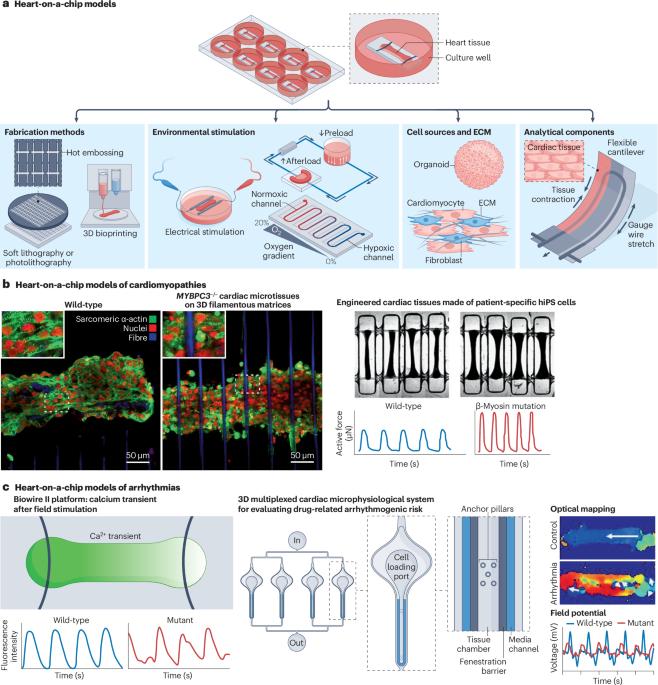
心脏芯片和血管芯片平台作为心血管疾病的模型。
器官芯片平台已经彻底改变了心血管病理生理学的建模,使研究人员能够阐明各种遗传和获得性疾病的潜在机制和药物反应。这种新兴技术可以克服传统体外培养系统和动物模型的局限性,如生物相关性差和物种特异性差异。芯片上心脏和芯片上血管模型由3D结构组成,结合相关细胞群(通常来自多能干细胞来源),具有精确控制的机电条件和生化刺激,形成功能性仿生微环境。这些可调平台在建立患者特异性疾病模型和加速药物发现和开发方面具有很大的前景,这是个性化心血管医学方向的重要一步。在这篇综述中,我们重点介绍了已经成功模拟心血管疾病表型的器官芯片模型,并对新疗法的发展做出了贡献,并总结了该技术广泛应用的技术和生物学障碍。
本文章由计算机程序翻译,如有差异,请以英文原文为准。
求助全文
约1分钟内获得全文
求助全文
来源期刊

Nature Reviews Cardiology
医学-心血管系统
CiteScore
53.10
自引率
0.60%
发文量
143
审稿时长
6-12 weeks
期刊介绍:
Nature Reviews Cardiology aims to be the go-to source for reviews and commentaries in the scientific and clinical communities it serves. Focused on providing authoritative and accessible articles enriched with clear figures and tables, the journal strives to offer unparalleled service to authors, referees, and readers, maximizing the usefulness and impact of each publication. It covers a broad range of content types, including Research Highlights, Comments, News & Views, Reviews, Consensus Statements, and Perspectives, catering to practising cardiologists and cardiovascular research scientists. Authored by renowned clinicians, academics, and researchers, the content targets readers in the biological and medical sciences, ensuring accessibility across various disciplines. In-depth Reviews offer up-to-date information, while Consensus Statements provide evidence-based recommendations. Perspectives and News & Views present topical discussions and opinions, and the Research Highlights section filters primary research from cardiovascular and general medical journals. As part of the Nature Reviews portfolio, Nature Reviews Cardiology maintains high standards and a wide reach.
 求助内容:
求助内容: 应助结果提醒方式:

 京公网安备 11010802042870号


