
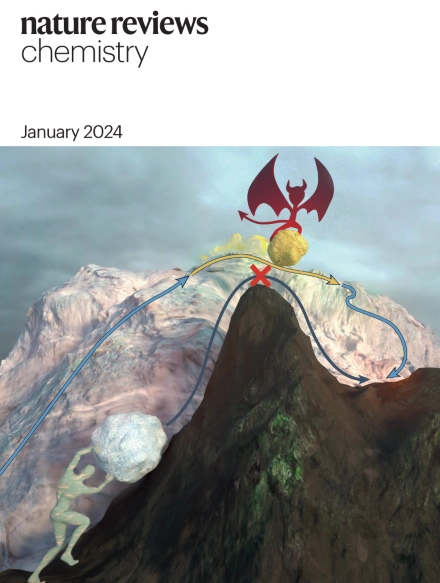
Foundation models for atomistic simulation of chemistry and materials
IF 51.7
1区 化学
Q1 CHEMISTRY, MULTIDISCIPLINARY
引用次数: 0
Abstract
Conventional computational methods for modeling chemical and materials systems are limited by system size and timescale, forcing a trade-off between quantum-mechanical accuracy and the sampling needed for realistic observables. Large language and vision foundation models — pre-trained on massive datasets using transformer architectures — have revolutionized many fields. It is thus interesting to ask whether a foundation model — subject to suitable data, parameter scaling and training — could enable learned simulations of chemistry and materials. Here, we review the field of machine-learned interatomic potentials (MLIPs) and posit that scaling up large and diverse chemical and materials datasets and highly expressive architectures using advanced training strategies should result in models that are: more efficient, transferable, robust to out-of-distribution scenarios, and easier to fine-tune to a variety of downstream physical observables than models trained from scratch on small datasets corresponding to specific, targeted atomistic simulation tasks. We provide specific criteria for creating such large-scale MLIP foundation models, coordinated strategies for their development, evaluation and deployment, and highlight potential emergent capabilities that could transform predictive simulations in chemistry and materials science and accelerate discovery across multiple technological domains. We examine the historical development and underlying principles of foundation models realized in language and vision, and propose how physics-infused machine learning interaction potentials could dramatically transform at scale to create transformative foundation models for chemistry and materials science.

化学和材料原子模拟的基础模型。
化学和材料系统建模的传统计算方法受到系统大小和时间尺度的限制,迫使在量子力学精度和实际观测所需的采样之间进行权衡。大型语言和视觉基础模型——使用transformer架构在海量数据集上进行预训练——已经彻底改变了许多领域。因此,一个有趣的问题是,一个基础模型——受制于合适的数据、参数缩放和训练——是否能够实现化学和材料的学习模拟。在这里,我们回顾了机器学习原子间势(MLIPs)领域,并假设使用先进的训练策略扩展大型和多样化的化学和材料数据集以及高度表达的架构应该产生以下模型:与在小数据集上从零开始训练的模型(对应于特定的、有针对性的原子模拟任务)相比,更有效、可转移、对非分布场景更健壮,更容易微调到各种下游物理可观察对象。我们为创建这种大规模MLIP基础模型提供了具体的标准,为其开发、评估和部署提供了协调策略,并强调了潜在的新兴能力,这些能力可以改变化学和材料科学的预测模拟,并加速跨多个技术领域的发现。
本文章由计算机程序翻译,如有差异,请以英文原文为准。
求助全文
约1分钟内获得全文
求助全文
来源期刊
Nature reviews. Chemistry
Chemical Engineering-General Chemical Engineering
CiteScore
52.80
自引率
0.80%
发文量
88
期刊介绍:
Nature Reviews Chemistry is an online-only journal that publishes Reviews, Perspectives, and Comments on various disciplines within chemistry. The Reviews aim to offer balanced and objective analyses of selected topics, providing clear descriptions of relevant scientific literature. The content is designed to be accessible to recent graduates in any chemistry-related discipline while also offering insights for principal investigators and industry-based research scientists. Additionally, Reviews should provide the authors' perspectives on future directions and opinions regarding the major challenges faced by researchers in the field.
 求助内容:
 应助结果提醒方式:


 京公网安备 11010802042870号


