{"title":"Diabetic remission in a newly diagnosed diabetic cat treated with SGLT2 inhibitor.","authors":"Filip Lodarski, Ghita Benchekroun, Mario Cervone","doi":"10.1177/20551169251399435","DOIUrl":null,"url":null,"abstract":"<p><strong>Case summary: </strong>A 13-year-old castrated male domestic shorthair cat was diagnosed with diabetes mellitus based on hyperglycaemia, glucosuria and an elevated plasma fructosamine concentration. The diagnosis followed a 1-month history of lethargy and weight loss, along with a 1-week history of polyuria and polydipsia, which developed after the patient received a long-acting methylprednisolone injection from the referring veterinarian for pruritus. Treatment with velagliflozin was initiated, resulting in excellent glucose control, weight gain and resolution of clinical signs. However, the owner reported diarrhoea that did not improve with dietary modifications, symptomatic treatments or dose reduction of velagliflozin. Consequently, velagliflozin was discontinued after 64 days. Despite discontinuation, the cat remained euglycemic, with plasma fructosamine levels within the reference interval throughout a 175-day follow-up period. According to the Agreeing Language in Veterinary Endocrinology consensus definition, diabetes mellitus remission was confirmed.</p><p><strong>Relevance and novel information: </strong>This case report highlights that diabetic remission is achievable in cats treated with SGLT2 inhibitors, as described in human patients with type 2 diabetes mellitus.</p>","PeriodicalId":36588,"journal":{"name":"Journal of Feline Medicine and Surgery Open Reports","volume":"12 1","pages":"20551169251399435"},"PeriodicalIF":0.7000,"publicationDate":"2025-11-13","publicationTypes":"Journal Article","fieldsOfStudy":null,"isOpenAccess":false,"openAccessPdf":"https://www.ncbi.nlm.nih.gov/pmc/articles/PMC12886731/pdf/","citationCount":"0","resultStr":null,"platform":"Semanticscholar","paperid":null,"PeriodicalName":"Journal of Feline Medicine and Surgery Open Reports","FirstCategoryId":"1085","ListUrlMain":"https://doi.org/10.1177/20551169251399435","RegionNum":0,"RegionCategory":null,"ArticlePicture":[],"TitleCN":null,"AbstractTextCN":null,"PMCID":null,"EPubDate":"2026/1/1 0:00:00","PubModel":"eCollection","JCR":"Q3","JCRName":"VETERINARY SCIENCES","Score":null,"Total":0}
引用次数: 0
Abstract
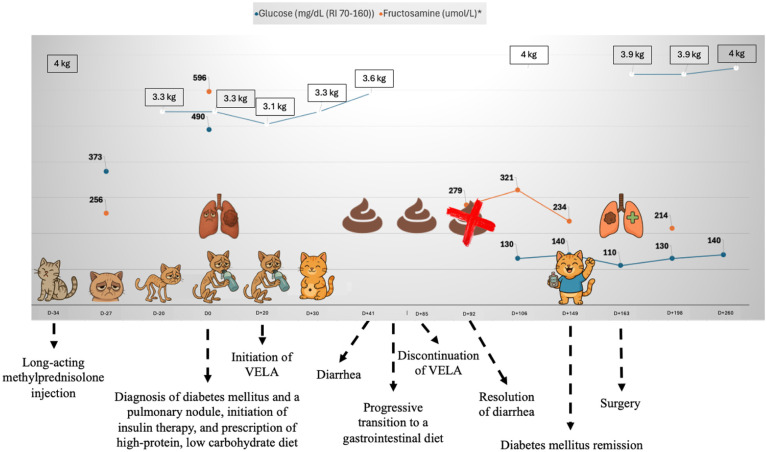
Case summary: A 13-year-old castrated male domestic shorthair cat was diagnosed with diabetes mellitus based on hyperglycaemia, glucosuria and an elevated plasma fructosamine concentration. The diagnosis followed a 1-month history of lethargy and weight loss, along with a 1-week history of polyuria and polydipsia, which developed after the patient received a long-acting methylprednisolone injection from the referring veterinarian for pruritus. Treatment with velagliflozin was initiated, resulting in excellent glucose control, weight gain and resolution of clinical signs. However, the owner reported diarrhoea that did not improve with dietary modifications, symptomatic treatments or dose reduction of velagliflozin. Consequently, velagliflozin was discontinued after 64 days. Despite discontinuation, the cat remained euglycemic, with plasma fructosamine levels within the reference interval throughout a 175-day follow-up period. According to the Agreeing Language in Veterinary Endocrinology consensus definition, diabetes mellitus remission was confirmed.
Relevance and novel information: This case report highlights that diabetic remission is achievable in cats treated with SGLT2 inhibitors, as described in human patients with type 2 diabetes mellitus.



 求助内容:
求助内容: 应助结果提醒方式:

 京公网安备 11010802042870号


