{"title":"Risk factor analysis for ceftriaxone-associated liver dysfunction in older patients.","authors":"Tomohiko Tagashira, Ryoya Odawara, Naohito Suga, Rikako Nakamura, Makoto Tagashira, Kohei Minematsu","doi":"10.1186/s40780-026-00554-6","DOIUrl":null,"url":null,"abstract":"<p><strong>Background: </strong>Information on ceftriaxone (CTRX)-associated liver dysfunction in older patients remains limited. This study, investigated the risk factors for CTRX-associated liver dysfunction in patients aged ≥65 years.</p><p><strong>Methods: </strong>We conducted a retrospective chart review of the medical records of 105 hospitalized patients aged ≥65 years who received CTRX at Innoshima-Ishikai Hospital. Variables significantly associated with liver dysfunction in univariate analyses were entered into a multivariate logistic regression model to identify independent risk factors. Cutoff values were determined using receiver operating characteristic curve analysis. The incidence of liver dysfunction was compared according to the number of identified risk factors. Fisher's exact test was used for comparisons between groups.</p><p><strong>Results: </strong>In univariate analyses, alanine aminotransferase (ALT) and C-reactive protein (CRP) levels were significantly associated with liver dysfunction (p < 0.05). Multivariate logistic regression identified ALT as an independent risk factor (odds ratio [OR] 1.14; 95% confidence interval [CI]: 1.04-1.24, p = 0.003). CRP was also significantly associated with liver dysfunction, although the effect size was small (OR 1.07; 95% CI: 1.00-1.14, p = 0.043). The optimal cutoff values were 11 U/L for ALT and 5.9 mg/dL for CRP. The incidence of liver dysfunction was 0% in patients with no risk factors, 10.7% in those with elevated ALT only, 8.3% in those with elevated CRP only, and 50% in those with both elevated ALT and CRP. Patients with both risk factors had a significantly higher incidence of liver dysfunction than those in the other groups (p < 0.001).</p><p><strong>Conclusion: </strong>Among patients aged ≥ 65 years, elevated baseline ALT (≥ 11 U/L) and CRP (≥ 5.9 mg/dL) levels were associated with an increased risk of CTRX-associated liver dysfunction. Careful monitoring of liver function during and after CTRX administration is therefore recommended in this population.</p>","PeriodicalId":16730,"journal":{"name":"Journal of Pharmaceutical Health Care and Sciences","volume":" ","pages":"20"},"PeriodicalIF":1.2000,"publicationDate":"2026-02-11","publicationTypes":"Journal Article","fieldsOfStudy":null,"isOpenAccess":false,"openAccessPdf":"https://www.ncbi.nlm.nih.gov/pmc/articles/PMC12903293/pdf/","citationCount":"0","resultStr":null,"platform":"Semanticscholar","paperid":null,"PeriodicalName":"Journal of Pharmaceutical Health Care and Sciences","FirstCategoryId":"1085","ListUrlMain":"https://doi.org/10.1186/s40780-026-00554-6","RegionNum":0,"RegionCategory":null,"ArticlePicture":[],"TitleCN":null,"AbstractTextCN":null,"PMCID":null,"EPubDate":"","PubModel":"","JCR":"Q4","JCRName":"PHARMACOLOGY & PHARMACY","Score":null,"Total":0}
引用次数: 0
Abstract
Background: Information on ceftriaxone (CTRX)-associated liver dysfunction in older patients remains limited. This study, investigated the risk factors for CTRX-associated liver dysfunction in patients aged ≥65 years.
Methods: We conducted a retrospective chart review of the medical records of 105 hospitalized patients aged ≥65 years who received CTRX at Innoshima-Ishikai Hospital. Variables significantly associated with liver dysfunction in univariate analyses were entered into a multivariate logistic regression model to identify independent risk factors. Cutoff values were determined using receiver operating characteristic curve analysis. The incidence of liver dysfunction was compared according to the number of identified risk factors. Fisher's exact test was used for comparisons between groups.
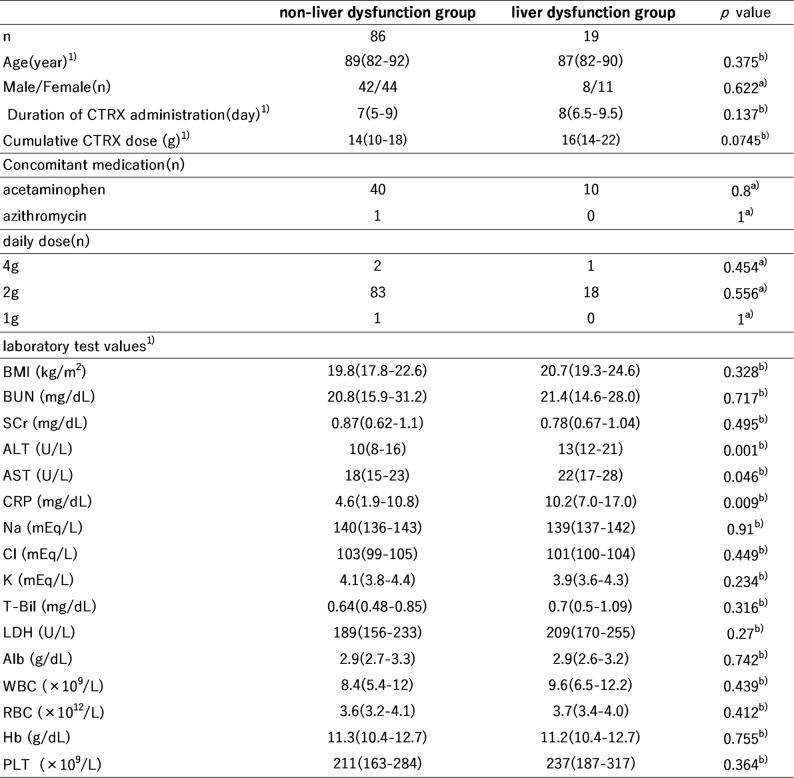
Results: In univariate analyses, alanine aminotransferase (ALT) and C-reactive protein (CRP) levels were significantly associated with liver dysfunction (p < 0.05). Multivariate logistic regression identified ALT as an independent risk factor (odds ratio [OR] 1.14; 95% confidence interval [CI]: 1.04-1.24, p = 0.003). CRP was also significantly associated with liver dysfunction, although the effect size was small (OR 1.07; 95% CI: 1.00-1.14, p = 0.043). The optimal cutoff values were 11 U/L for ALT and 5.9 mg/dL for CRP. The incidence of liver dysfunction was 0% in patients with no risk factors, 10.7% in those with elevated ALT only, 8.3% in those with elevated CRP only, and 50% in those with both elevated ALT and CRP. Patients with both risk factors had a significantly higher incidence of liver dysfunction than those in the other groups (p < 0.001).
Conclusion: Among patients aged ≥ 65 years, elevated baseline ALT (≥ 11 U/L) and CRP (≥ 5.9 mg/dL) levels were associated with an increased risk of CTRX-associated liver dysfunction. Careful monitoring of liver function during and after CTRX administration is therefore recommended in this population.




 求助内容:
求助内容: 应助结果提醒方式:

 京公网安备 11010802042870号


