{"title":"Magnitude of Stunting and Its Determinants Among Under-Five Children in Awi Zone, Northwest Ethiopia.","authors":"Nigussie Adam Birhan, Kefale Tilahun Getahun, Zelalem Meraf Wolde, Tilahun Yimanu Birhan, Tess Astatkie","doi":"10.1155/jnme/5984957","DOIUrl":null,"url":null,"abstract":"<p><strong>Introduction: </strong>Stunting is a major global health concern, with an estimated 154.8 million children under 5 years old. This study aimed to assess the prevalence and the contributing factors of stunting among children under 5 years old in Awi Zone, Northwest Ethiopia.</p><p><strong>Methods: </strong>A community-based cross-sectional study was conducted on 1388 participants selected using a multistage sampling method. Structured and pretested questionnaires were used to collect the data, and STATA software was used for analysis. Multivariable logistic regression analysis was performed to identify the factors associated with stunting.</p><p><strong>Results: </strong>The prevalence of stunting in Awi Zone was 24.9%. Rich wealth index (AOR: 0.46), health insurance (AOR: 0.45), child aged 24-59 months (AOR: 30.40), medium birth weight (AOR: 0.53), having toilet facility (AOR: 0.46), male child (AOR: 1.92), 2<sup>nd</sup> or 3<sup>rd</sup> birth order (AOR: 1.99), institutional delivery (AOR: 0.48), exclusive breastfeeding (AOR: 0.11), and ANC (AOR: 0.64) are significantly associated with stunting.</p><p><strong>Conclusion: </strong>To reduce child stunting, governmental and nongovernmental organizations should design and implement public health interventions targeting poor households and those without health insurance and should enhance institutional delivery and ANC visits.</p>","PeriodicalId":16587,"journal":{"name":"Journal of Nutrition and Metabolism","volume":"2026 ","pages":"5984957"},"PeriodicalIF":2.4000,"publicationDate":"2026-02-10","publicationTypes":"Journal Article","fieldsOfStudy":null,"isOpenAccess":false,"openAccessPdf":"https://www.ncbi.nlm.nih.gov/pmc/articles/PMC12887825/pdf/","citationCount":"0","resultStr":null,"platform":"Semanticscholar","paperid":null,"PeriodicalName":"Journal of Nutrition and Metabolism","FirstCategoryId":"1085","ListUrlMain":"https://doi.org/10.1155/jnme/5984957","RegionNum":0,"RegionCategory":null,"ArticlePicture":[],"TitleCN":null,"AbstractTextCN":null,"PMCID":null,"EPubDate":"2026/1/1 0:00:00","PubModel":"eCollection","JCR":"Q3","JCRName":"NUTRITION & DIETETICS","Score":null,"Total":0}
引用次数: 0
Abstract
Introduction: Stunting is a major global health concern, with an estimated 154.8 million children under 5 years old. This study aimed to assess the prevalence and the contributing factors of stunting among children under 5 years old in Awi Zone, Northwest Ethiopia.
Methods: A community-based cross-sectional study was conducted on 1388 participants selected using a multistage sampling method. Structured and pretested questionnaires were used to collect the data, and STATA software was used for analysis. Multivariable logistic regression analysis was performed to identify the factors associated with stunting.
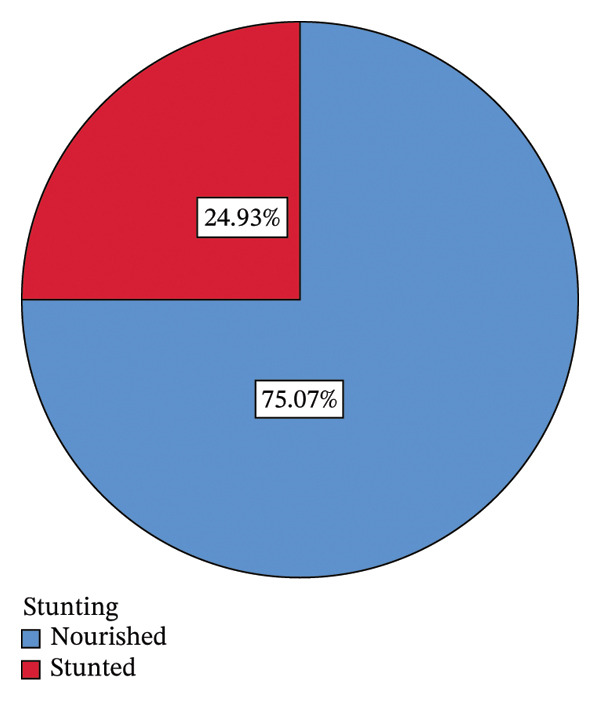
Results: The prevalence of stunting in Awi Zone was 24.9%. Rich wealth index (AOR: 0.46), health insurance (AOR: 0.45), child aged 24-59 months (AOR: 30.40), medium birth weight (AOR: 0.53), having toilet facility (AOR: 0.46), male child (AOR: 1.92), 2nd or 3rd birth order (AOR: 1.99), institutional delivery (AOR: 0.48), exclusive breastfeeding (AOR: 0.11), and ANC (AOR: 0.64) are significantly associated with stunting.
Conclusion: To reduce child stunting, governmental and nongovernmental organizations should design and implement public health interventions targeting poor households and those without health insurance and should enhance institutional delivery and ANC visits.
期刊介绍:
Journal of Nutrition and Metabolism is a peer-reviewed, Open Access journal that publishes original research articles, review articles, and clinical studies covering the broad and multidisciplinary field of human nutrition and metabolism. The journal welcomes submissions on studies related to obesity, diabetes, metabolic syndrome, molecular and cellular biology of nutrients, foods and dietary supplements, as well as macro- and micronutrients including vitamins and minerals.


 求助内容:
求助内容: 应助结果提醒方式:

 京公网安备 11010802042870号


