
Development and validation of six-parameter laboratory-based prognostic model (APHPBA score) for patients undergoing hepatectomy for hepatitis B virus-related hepatocellular carcinoma
IF 2.4
3区 医学
Q2 GASTROENTEROLOGY & HEPATOLOGY
引用次数: 0
Abstract
Purpose
HBV-related HCC shows prognostic heterogeneity not fully captured by current staging. We developed and validated the APHPBA score, a laboratory-based model for patients undergoing curative hepatectomy.
Methods
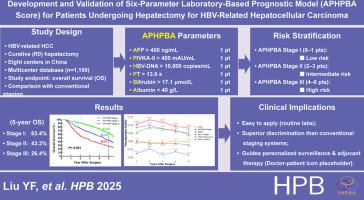
This multicenter retrospective study included patients who underwent hepatectomy for HBV-related HCC between 2018 and 2023. The APHPBA score incorporated six routine preoperative parameters: alpha-fetoprotein (AFP), protein induced by vitamin K absence-II (PIVKA-II), HBV-DNA, prothrombin time (PT), bilirubin (BIL), and albumin (ALB). Patients were stratified into three stages: Stage I (0–1 point), Stage II (2–3 points), and Stage III (4–6 points). Prognostic performance was compared with conventional systems using Cox regression and time-dependent receiver operating characteristic (ROC) analyses.
Results
Among 1100 patients, 36.7 % were Stage I, 48.5 % Stage II, and 14.8 % Stage III. After a median follow-up of 48.0 months, 5-year overall survival was 63.4 %, 43.3 %, and 26.4 % across Stages I–III (P < 0.001). The APHPBA score remained independently associated with overall survival after adjustment for clinicopathologic factors and consistently outperformed established staging systems with higher time-dependent AUCs.
Conclusion
The APHPBA score provides robust postoperative risk stratification for HBV-related HCC using routinely available laboratory parameters.
基于实验室的六参数预后模型(APHPBA评分)的开发和验证,用于乙型肝炎病毒相关肝细胞癌的肝切除术患者。
目的:hbv相关的HCC显示预后异质性,目前的分期尚未完全捕获。我们开发并验证了appba评分,这是一种基于实验室的模型,用于治疗性肝切除术患者。方法:这项多中心回顾性研究纳入了2018年至2023年间因hbv相关HCC接受肝切除术的患者。appba评分包括6个常规术前参数:甲胎蛋白(AFP)、维生素K缺失诱导蛋白(PIVKA-II)、HBV-DNA、凝血酶原时间(PT)、胆红素(BIL)和白蛋白(ALB)。患者分为3个阶段:I期(0-1分)、II期(2-3分)和III期(4-6分)。采用Cox回归和随时间变化的受试者工作特征(ROC)分析比较常规系统的预后表现。结果:1100例患者中,一期占36.7%,二期占48.5%,三期占14.8%。中位随访48.0个月后,I-III期的5年总生存率分别为63.4%、43.3%和26.4% (P < 0.001)。在调整临床病理因素后,appba评分仍然与总生存率独立相关,并且始终优于具有较高时间依赖性auc的既定分期系统。结论:利用常规实验室参数,APHPBA评分为hbv相关HCC的术后风险分层提供了强有力的依据。
本文章由计算机程序翻译,如有差异,请以英文原文为准。
求助全文
约1分钟内获得全文
求助全文
来源期刊
Hpb
GASTROENTEROLOGY & HEPATOLOGY-SURGERY
CiteScore
5.60
自引率
3.40%
发文量
244
审稿时长
57 days
期刊介绍:
HPB is an international forum for clinical, scientific and educational communication.
Twelve issues a year bring the reader leading articles, expert reviews, original articles, images, editorials, and reader correspondence encompassing all aspects of benign and malignant hepatobiliary disease and its management. HPB features relevant aspects of clinical and translational research and practice.
Specific areas of interest include HPB diseases encountered globally by clinical practitioners in this specialist field of gastrointestinal surgery. The journal addresses the challenges faced in the management of cancer involving the liver, biliary system and pancreas. While surgical oncology represents a large part of HPB practice, submission of manuscripts relating to liver and pancreas transplantation, the treatment of benign conditions such as acute and chronic pancreatitis, and those relating to hepatobiliary infection and inflammation are also welcomed. There will be a focus on developing a multidisciplinary approach to diagnosis and treatment with endoscopic and laparoscopic approaches, radiological interventions and surgical techniques being strongly represented. HPB welcomes submission of manuscripts in all these areas and in scientific focused research that has clear clinical relevance to HPB surgical practice.
HPB aims to help its readers - surgeons, physicians, radiologists and basic scientists - to develop their knowledge and practice. HPB will be of interest to specialists involved in the management of hepatobiliary and pancreatic disease however will also inform those working in related fields.
Abstracted and Indexed in:
MEDLINE®
EMBASE
PubMed
Science Citation Index Expanded
Academic Search (EBSCO)
HPB is owned by the International Hepato-Pancreato-Biliary Association (IHPBA) and is also the official Journal of the American Hepato-Pancreato-Biliary Association (AHPBA), the Asian-Pacific Hepato Pancreatic Biliary Association (A-PHPBA) and the European-African Hepato-Pancreatic Biliary Association (E-AHPBA).
 求助内容:
求助内容: 应助结果提醒方式:

 京公网安备 11010802042870号


