{"title":"Phyllosphere microbiomes uncovered: Research trends, geographic disparities, and key microbial players.","authors":"Isabel Cristina Cadavid, Érika Frydrych Capelari, Caroline Salvati, Rogerio Margis","doi":"10.1590/1678-4685-GMB-2025-0083","DOIUrl":null,"url":null,"abstract":"<p><p>In recent years, significant efforts have been made to understand the phyllosphere microbiome. To clarify current research trends and identify knowledge gaps, we conducted a systematic review of the literature and investigated the methodologies used to analyze microbiome communities associated with plants, along with the objectives of these studies. Applying systematic review principles, we assessed 333 reports from the Web of Science database for eligibility. Articles were included if they presented original research on microbiomes associated with phyllosphere tissues identified by next-generation sequencing. Of these, 268 reports, published from 2009 to March 2025, were retrieved. These reports were used to extract data in a controlled and methodical manner. The analyses identified the most frequently studied plant species and primary tissues, the geographical locations sampled, the variables investigated in the phyllosphere microbiome, and the methodologies and tools employed. A comparison of the number of studies on below-ground (n=1562) versus above-ground tissue (n=375) underscores the relatively unexplored nature of above-ground research. We notice a surprisingly low number of studies from the Southern Hemisphere. Additionally, through data mining, we identify the most dominant bacteria and fungi reported in phyllosphere studies. Based on these findings, we offer recommendations for future research on the phyllosphere.</p>","PeriodicalId":12557,"journal":{"name":"Genetics and Molecular Biology","volume":"49Suppl 1 Suppl 1","pages":"e20250083"},"PeriodicalIF":1.3000,"publicationDate":"2026-01-23","publicationTypes":"Journal Article","fieldsOfStudy":null,"isOpenAccess":false,"openAccessPdf":"https://www.ncbi.nlm.nih.gov/pmc/articles/PMC12893196/pdf/","citationCount":"0","resultStr":null,"platform":"Semanticscholar","paperid":null,"PeriodicalName":"Genetics and Molecular Biology","FirstCategoryId":"99","ListUrlMain":"https://doi.org/10.1590/1678-4685-GMB-2025-0083","RegionNum":4,"RegionCategory":"生物学","ArticlePicture":[],"TitleCN":null,"AbstractTextCN":null,"PMCID":null,"EPubDate":"2026/1/1 0:00:00","PubModel":"eCollection","JCR":"Q4","JCRName":"BIOCHEMISTRY & MOLECULAR BIOLOGY","Score":null,"Total":0}
引用次数: 0
Abstract
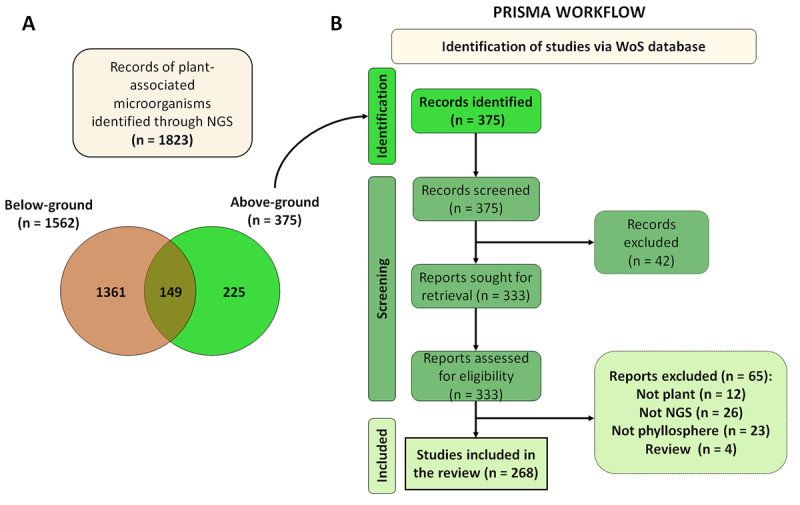
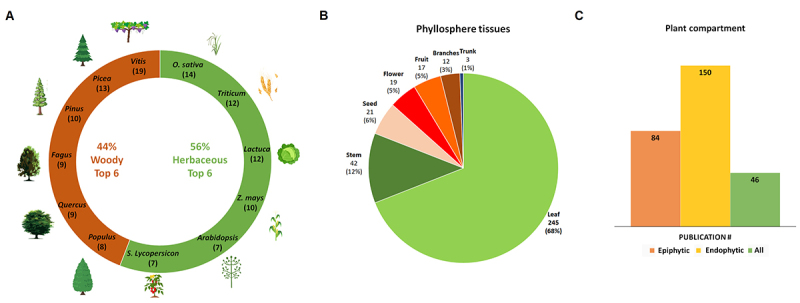
In recent years, significant efforts have been made to understand the phyllosphere microbiome. To clarify current research trends and identify knowledge gaps, we conducted a systematic review of the literature and investigated the methodologies used to analyze microbiome communities associated with plants, along with the objectives of these studies. Applying systematic review principles, we assessed 333 reports from the Web of Science database for eligibility. Articles were included if they presented original research on microbiomes associated with phyllosphere tissues identified by next-generation sequencing. Of these, 268 reports, published from 2009 to March 2025, were retrieved. These reports were used to extract data in a controlled and methodical manner. The analyses identified the most frequently studied plant species and primary tissues, the geographical locations sampled, the variables investigated in the phyllosphere microbiome, and the methodologies and tools employed. A comparison of the number of studies on below-ground (n=1562) versus above-ground tissue (n=375) underscores the relatively unexplored nature of above-ground research. We notice a surprisingly low number of studies from the Southern Hemisphere. Additionally, through data mining, we identify the most dominant bacteria and fungi reported in phyllosphere studies. Based on these findings, we offer recommendations for future research on the phyllosphere.
近年来,人们在了解层圈微生物组方面做出了重大努力。为了澄清当前的研究趋势和确定知识空白,我们对文献进行了系统的回顾,并调查了用于分析与植物相关的微生物群落的方法,以及这些研究的目标。应用系统评价原则,我们评估了来自Web of Science数据库的333份报告的合格性。通过新一代测序鉴定的与层球组织相关的微生物组的原创研究文章被纳入。其中,从2009年至2025年3月发表的268份报告被检索。这些报告被用来以一种有控制和有系统的方式提取数据。分析确定了最常研究的植物物种和初级组织、采样的地理位置、层圈微生物组中调查的变量以及所采用的方法和工具。对地下组织(n=1562)和地上组织(n=375)的研究数量的比较强调了地上研究相对未被探索的性质。我们注意到,来自南半球的研究数量少得惊人。此外,通过数据挖掘,我们确定了在层层圈研究中报告的最主要的细菌和真菌。在此基础上,提出了今后层层圈研究的建议。
期刊介绍:
Genetics and Molecular Biology (formerly named Revista Brasileira de Genética/Brazilian Journal of Genetics - ISSN 0100-8455) is published by the Sociedade Brasileira de Genética (Brazilian Society of Genetics).
The Journal considers contributions that present the results of original research in genetics, evolution and related scientific disciplines. Manuscripts presenting methods and applications only, without an analysis of genetic data, will not be considered.


 求助内容:
求助内容: 应助结果提醒方式:

 京公网安备 11010802042870号


