
A systematic review and meta-analysis of the relationship between neuroinflammation and blood-brain barrier based on in vitro models
IF 2.2
Q3 BIOCHEMISTRY & MOLECULAR BIOLOGY
Biochemistry and Biophysics Reports
Pub Date : 2026-03-01
Epub Date: 2026-02-03
DOI:10.1016/j.bbrep.2026.102479
引用次数: 0
Abstract
The blood-brain barrier (BBB) plays a crucial role in maintaining homeostasis within the central nervous system (CNS). Neuroinflammation disrupts the integrity of the BBB. However, there is a lack of comprehensive synthesis of in vitro evidence on this topic. This study aims to systematically review in vitro research examining the effects of neuroinflammatory stimuli on the structure and function of the BBB. PubMed, EMBASE, and Web of Science were searched for studies published between November 2014 and November 2024. Included studies employed in vitro BBB models to assess effects of defined neuroinflammatory on structural and functional. Pooled standardized mean differences (SMD) with 95 % confidence intervals (CI) were calculated using random effects models. Meta-analysis was performed using R. Overall, 55 studies were included. Neuroinflammation was found to significantly decrease transendothelial electrical resistance (TEER) (−2.15, 95 % CI [-2.73, −1.56]) while increasing permeability (2.75, 95 % CI [1.71, 3.79]). Subgroup analyses showed that co-culture models exhibited more severe disruptions compared to mono-cultures measured by a significant decrease in TEER (p < 0.05). Human-derived cells displayed heightened decreases in TEER and increased permeability compared to non-human derived cells (p < 0.05). Co-cultures of endothelial cells and pericytes exhibited pronounced effects of decreased TEER compared to endothelial cells alone (p < 0.05). Stimulation periods exceeding 24 h led to significant changes. Lipopolysaccharide (LPS) caused significant disruptions. Experiments conducted with transwell systems were more sensitive to changes in TEER compared to non-transwell systems (p < 0.05). In vitro evidence confirms neuroinflammation disrupts BBB integrity through reduced TEER, increased permeability. Human-derived cells, particularly hiPSC-derived models, endothelial-pericytes co-cultures, and exposure to LPS exceeding 24 h most effectively replicate pathophysiological disruption, potentially offering optimal platforms for exploring neurological disease-related mechanisms and therapeutic strategy in the future.
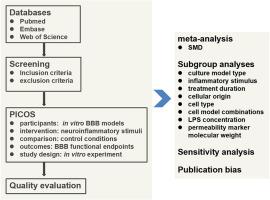
基于体外模型的神经炎症与血脑屏障关系的系统回顾和荟萃分析。
血脑屏障(BBB)在维持中枢神经系统(CNS)内的稳态中起着至关重要的作用。神经炎症会破坏血脑屏障的完整性。然而,缺乏关于这一主题的体外证据的综合。本研究旨在系统回顾神经炎症刺激对血脑屏障结构和功能影响的体外研究。检索了2014年11月至2024年11月间发表的PubMed、EMBASE和Web of Science。纳入的研究采用体外血脑屏障模型来评估定义的神经炎症对结构和功能的影响。采用随机效应模型计算95 %置信区间(CI)的合并标准化平均差(SMD)。meta分析采用r进行,共纳入55项研究。发现神经炎症显著降低跨内皮电阻(TEER)(-2.15, 95 % CI[-2.73, -1.56]),同时增加通透性(2.75,95 % CI[1.71, 3.79])。亚组分析显示,与TEER显著降低的单一培养相比,共培养模型表现出更严重的破坏(p p p p )。体外证据证实,神经炎症通过降低TEER、增加渗透性来破坏血脑屏障完整性。人类来源的细胞,特别是hipsc来源的模型,内皮-周细胞共培养,以及暴露于超过24 h的LPS最有效地复制病理生理破坏,可能为未来探索神经系统疾病相关机制和治疗策略提供最佳平台。
本文章由计算机程序翻译,如有差异,请以英文原文为准。
求助全文
约1分钟内获得全文
求助全文
来源期刊

Biochemistry and Biophysics Reports
Biochemistry, Genetics and Molecular Biology-Biophysics
CiteScore
4.60
自引率
0.00%
发文量
191
审稿时长
59 days
期刊介绍:
Open access, online only, peer-reviewed international journal in the Life Sciences, established in 2014 Biochemistry and Biophysics Reports (BB Reports) publishes original research in all aspects of Biochemistry, Biophysics and related areas like Molecular and Cell Biology. BB Reports welcomes solid though more preliminary, descriptive and small scale results if they have the potential to stimulate and/or contribute to future research, leading to new insights or hypothesis. Primary criteria for acceptance is that the work is original, scientifically and technically sound and provides valuable knowledge to life sciences research. We strongly believe all results deserve to be published and documented for the advancement of science. BB Reports specifically appreciates receiving reports on: Negative results, Replication studies, Reanalysis of previous datasets.
 求助内容:
求助内容: 应助结果提醒方式:

 京公网安备 11010802042870号


