
Improving bioleaching of Cu and Zn from e-waste with graphene and activated carbon with Acidithiobacillus bacteria
IF 8
1区 环境科学与生态学
Q1 ENVIRONMENTAL SCIENCES
Science of the Total Environment
Pub Date : 2026-02-25
Epub Date: 2026-02-10
DOI:10.1016/j.scitotenv.2026.181357
引用次数: 0
Abstract
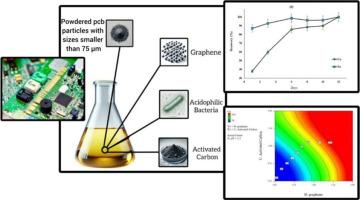
The rapid growth of e-waste generation poses significant environmental hazards and represents a potential source of valuable metals. This study investigates the bioleaching of copper (Cu) and zinc (Zn) from television printed boards (TVPCBs) using Acidithiobacillus ferrooxidans (A. ferrooxidans) and Acidithiobacillus thiooxidans (A. thiooxidans), both separately and mixture of them. The use of graphene and powdered activated carbon as catalysts was investigated to enhance metal recovery. Response surface methodology (RSM) with a central composite design (CCD) was applied to optimize critical variables, including initial pH, graphene concentration, and activated carbon concentration. The mixed bacterial culture improved Cu recovery, reaching values 18 % higher than those obtained with A. ferrooxidans alone and 15 % higher than with A. thiooxidans alone. Cu recovery increased by approximately 20 % when using graphene and powdered activated carbon as catalysts. Under optimal conditions (initial pH 2.0, 1.5 g/L graphene, and 1.5 g/L activated carbon), 100 % simultaneous recovery of Cu and Zn was achieved within 12 days. Catalysts greatly enhanced bacterial activity, which was evidenced by the increased metal recovery. This effect may be attributed to the increased concentrations of sulfate and ferric ions.
石墨烯和活性炭对酸性硫杆菌生物浸出电子垃圾中铜和锌的影响
电子垃圾产生的快速增长构成了重大的环境危害,并代表了有价金属的潜在来源。本研究研究了利用Acidithiobacillus ferrooxidans (A. ferrooxidans)和acidithiooxidans (A. thiooxidans)对电视印制板(tvpcb)中铜(Cu)和锌(Zn)的生物浸出。研究了以石墨烯和粉状活性炭为催化剂提高金属回收率的方法。采用响应面法(RSM)和中心复合设计(CCD)对初始pH、石墨烯浓度和活性炭浓度等关键变量进行优化。混合细菌培养提高了铜的回收率,比单菌株氧化亚铁杆菌高18%,比单菌株氧化亚铁杆菌高15%。当使用石墨烯和粉状活性炭作为催化剂时,铜的回收率提高了约20%。在最佳条件下(初始pH为2.0,石墨烯为1.5 g/L,活性炭为1.5 g/L),可在12天内同时100%回收铜和锌。催化剂大大提高了细菌活性,金属回收率的提高证明了这一点。这种影响可能归因于硫酸盐和铁离子浓度的增加。
本文章由计算机程序翻译,如有差异,请以英文原文为准。
求助全文
约1分钟内获得全文
求助全文
来源期刊
Science of the Total Environment
环境科学-环境科学
CiteScore
17.60
自引率
10.20%
发文量
8726
审稿时长
2.4 months
期刊介绍:
The Science of the Total Environment is an international journal dedicated to scientific research on the environment and its interaction with humanity. It covers a wide range of disciplines and seeks to publish innovative, hypothesis-driven, and impactful research that explores the entire environment, including the atmosphere, lithosphere, hydrosphere, biosphere, and anthroposphere.
The journal's updated Aims & Scope emphasizes the importance of interdisciplinary environmental research with broad impact. Priority is given to studies that advance fundamental understanding and explore the interconnectedness of multiple environmental spheres. Field studies are preferred, while laboratory experiments must demonstrate significant methodological advancements or mechanistic insights with direct relevance to the environment.
 求助内容:
求助内容: 应助结果提醒方式:

 京公网安备 11010802042870号


