Andréa S. Taschetto, Shayne McGregor, Dietmar Dommenget, Zoe E. Gillett, Neville Nicholls, Sur Sharmila, Peter van Rensch, Danielle Verdon-Kidd, Ghyslaine Boschat, Christine Chung, Ruby Lieber, Nerilie Abram, Rob Allan, Kathryn Allen, Linden Ashcroft, Josephine R. Brown, Wenju Cai, Savin Chand, Tim Cowan, Thi Lan Dao, Catherine de Burgh-Day, Mandy B. Freund, Ailie Gallant, Joelle Gergis, Neil J. Holbrook, Hanna Heidemann, Chiara Holgate, Pandora Hope, Andrew King, Eun-Pa Lim, John L. McBride, Roseanna C. McKay, Hanh Nguyen, Acacia Pepler, Sarah Perkins-Kirkpatrick, Scott Power, James S. Risbey, Agus Santoso, Caroline C. Ummenhofer, Guojian Wang, Xuebin Zhang
{"title":"Climate impacts of the El Niño–Southern Oscillation on Australia","authors":"Andréa S. Taschetto, Shayne McGregor, Dietmar Dommenget, Zoe E. Gillett, Neville Nicholls, Sur Sharmila, Peter van Rensch, Danielle Verdon-Kidd, Ghyslaine Boschat, Christine Chung, Ruby Lieber, Nerilie Abram, Rob Allan, Kathryn Allen, Linden Ashcroft, Josephine R. Brown, Wenju Cai, Savin Chand, Tim Cowan, Thi Lan Dao, Catherine de Burgh-Day, Mandy B. Freund, Ailie Gallant, Joelle Gergis, Neil J. Holbrook, Hanna Heidemann, Chiara Holgate, Pandora Hope, Andrew King, Eun-Pa Lim, John L. McBride, Roseanna C. McKay, Hanh Nguyen, Acacia Pepler, Sarah Perkins-Kirkpatrick, Scott Power, James S. Risbey, Agus Santoso, Caroline C. Ummenhofer, Guojian Wang, Xuebin Zhang","doi":"10.1038/s43017-025-00747-x","DOIUrl":null,"url":null,"abstract":"El Niño–Southern Oscillation (ENSO) profoundly affects Australian weather, climate, ecosystems and socio-economic sectors. In this Review, we summarize the advances in understanding the ENSO–Australian climate relationship, detailing the complexity beyond the traditional assumptions of El Niño-dry and La Niña-wet patterns, including mechanisms and impacts. The influence of ENSO is most coherent during austral spring, explaining about a quarter of rainfall variability over large parts of eastern Australia. La Niña typically exerts more robust rainfall changes than El Niño, and the Central Pacific El Niño has greater impacts than Eastern Pacific events. These effects are amplified by prolonged ENSO episodes and modulated by land–atmosphere feedback, surrounding sea surface temperatures, local processes and interactions with other climate modes, including multidecadal variability. El Niño-related drying generally worsens when co-occurring with positive Indian Ocean Dipole (IOD) and/or negative Southern Annular Mode (SAM), whereas La Niña rainfall intensifies with negative IOD and/or positive SAM. Although ENSO predictability has improved with advanced understanding of ocean processes and dynamical forecasting, predicting its impacts is challenging because of large internal atmospheric variability. Ongoing changes in ENSO underscore the need for strategic research, continuous in situ monitoring, reduced model biases and deeper understanding of the anthropogenically induced changes in Pacific temperatures to guide adaptation strategies. El Niño–Southern Oscillation (ENSO) profoundly affects Australian weather, climate, ecosystems and socio-economic sectors. This Review presents the progress made in understanding ENSO teleconnections to Australian weather over the past 40 years, describing the atmospheric dynamics, complexities and impacts of this climate phenomenon.","PeriodicalId":18921,"journal":{"name":"Nature Reviews Earth & Environment","volume":"7 2","pages":"103-123"},"PeriodicalIF":0.0000,"publicationDate":"2025-12-04","publicationTypes":"Journal Article","fieldsOfStudy":null,"isOpenAccess":false,"openAccessPdf":"","citationCount":"0","resultStr":null,"platform":"Semanticscholar","paperid":null,"PeriodicalName":"Nature Reviews Earth & Environment","FirstCategoryId":"1085","ListUrlMain":"https://www.nature.com/articles/s43017-025-00747-x","RegionNum":0,"RegionCategory":null,"ArticlePicture":[],"TitleCN":null,"AbstractTextCN":null,"PMCID":null,"EPubDate":"","PubModel":"","JCR":"","JCRName":"","Score":null,"Total":0}
引用次数: 0
Abstract
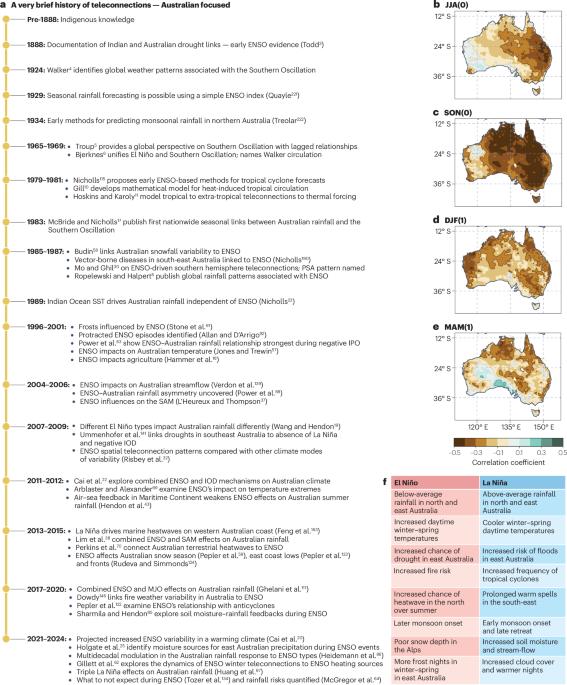
El Niño–Southern Oscillation (ENSO) profoundly affects Australian weather, climate, ecosystems and socio-economic sectors. In this Review, we summarize the advances in understanding the ENSO–Australian climate relationship, detailing the complexity beyond the traditional assumptions of El Niño-dry and La Niña-wet patterns, including mechanisms and impacts. The influence of ENSO is most coherent during austral spring, explaining about a quarter of rainfall variability over large parts of eastern Australia. La Niña typically exerts more robust rainfall changes than El Niño, and the Central Pacific El Niño has greater impacts than Eastern Pacific events. These effects are amplified by prolonged ENSO episodes and modulated by land–atmosphere feedback, surrounding sea surface temperatures, local processes and interactions with other climate modes, including multidecadal variability. El Niño-related drying generally worsens when co-occurring with positive Indian Ocean Dipole (IOD) and/or negative Southern Annular Mode (SAM), whereas La Niña rainfall intensifies with negative IOD and/or positive SAM. Although ENSO predictability has improved with advanced understanding of ocean processes and dynamical forecasting, predicting its impacts is challenging because of large internal atmospheric variability. Ongoing changes in ENSO underscore the need for strategic research, continuous in situ monitoring, reduced model biases and deeper understanding of the anthropogenically induced changes in Pacific temperatures to guide adaptation strategies. El Niño–Southern Oscillation (ENSO) profoundly affects Australian weather, climate, ecosystems and socio-economic sectors. This Review presents the progress made in understanding ENSO teleconnections to Australian weather over the past 40 years, describing the atmospheric dynamics, complexities and impacts of this climate phenomenon.


 求助内容:
求助内容: 应助结果提醒方式:

 京公网安备 11010802042870号


