
Glacier biogeochemical cycling and downstream impacts

Jon. R. Hawkings, James A. Bradley, Eva L. Doting, Noor Hassan, Katharine R. Hendry, Amy D. Holt, Eran Hood, Robert G. M. Spencer, Marek Stibal, Martyn Tranter, Ryan A. Venturelli, Jemma L. Wadham, Maya P. Bhatia
{"title":"Glacier biogeochemical cycling and downstream impacts","authors":"Jon. R. Hawkings, James A. Bradley, Eva L. Doting, Noor Hassan, Katharine R. Hendry, Amy D. Holt, Eran Hood, Robert G. M. Spencer, Marek Stibal, Martyn Tranter, Ryan A. Venturelli, Jemma L. Wadham, Maya P. Bhatia","doi":"10.1038/s43017-025-00751-1","DOIUrl":null,"url":null,"abstract":"Far from being frozen and sterile environments, glaciers are biogeochemical reactors and regulators. In this Review, we discuss the hydrology and biogeochemistry of glacierized environments and their impact on downstream ecosystems. Supraglacial meltwaters export labile organic carbon associated with active supraglacial microbial communities, as well as carbon and nutrients delivered via atmospheric deposition. Meltwaters funnelled to the glacier bed and exiting at the glacier snout transport large quantities of rock flour as well as supraglacial and subglacial-derived organic carbon and nutrients to downstream ecosystems. Subglacial water flow paths influence rock–water contact times and vary greatly, affecting weathering reactions. For instance, the hydrology of mountain glaciers and the Greenland Ice Sheet is typically dominated by seasonal melt with short (hours) to medium (weeks) water residence times, although extended biogeochemical isolation can exist in more isolated parts of the Greenland Ice Sheet. Conversely, the Antarctic Ice Sheet is dominated by basal ice melt and residence times that can exceed years and decades. As a result, the latter supports extended biogeochemical isolation and more advanced chemical weathering. Microbial processes and physical-chemical weathering can both sequester or emit greenhouse gases, but the net effect remains unknown. Meltwaters can potentially fuel biological processes in downstream ecosystems by priming glacier-fed streams, fjords, and oceans with rock flour and nutrients. The rapid reduction in glacier area projected for the next century mandates that future research provides a critical assessment of the effects of deglaciation on watershed biogeochemistry, ecology and global biogeochemical cycles. Far from frozen and sterile environments, glaciers are biogeochemical reactors and regulators. This Review outlines key biogeochemical and associated physical processes occurring in glacierized environments and the known impacts of glaciers on elemental cycling and the Earth system.","PeriodicalId":18921,"journal":{"name":"Nature Reviews Earth & Environment","volume":"7 2","pages":"124-143"},"PeriodicalIF":0.0000,"publicationDate":"2025-12-11","publicationTypes":"Journal Article","fieldsOfStudy":null,"isOpenAccess":false,"openAccessPdf":"","citationCount":"0","resultStr":null,"platform":"Semanticscholar","paperid":null,"PeriodicalName":"Nature Reviews Earth & Environment","FirstCategoryId":"1085","ListUrlMain":"https://www.nature.com/articles/s43017-025-00751-1","RegionNum":0,"RegionCategory":null,"ArticlePicture":[],"TitleCN":null,"AbstractTextCN":null,"PMCID":null,"EPubDate":"","PubModel":"","JCR":"","JCRName":"","Score":null,"Total":0}
引用次数: 0

Abstract

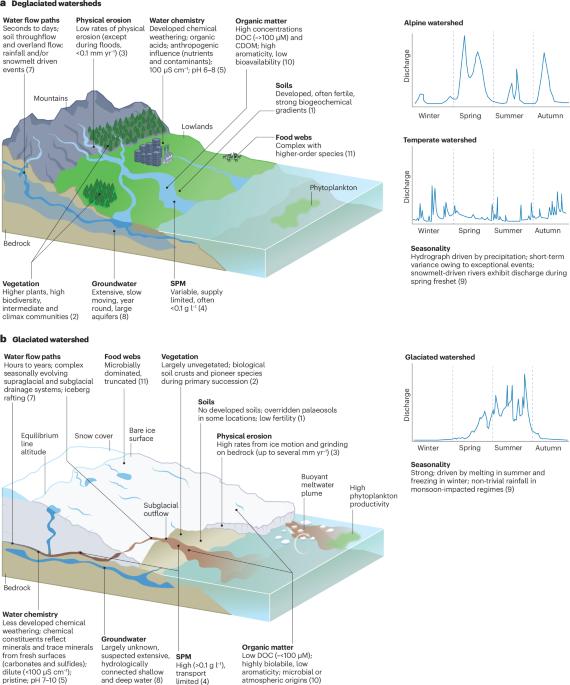
Far from being frozen and sterile environments, glaciers are biogeochemical reactors and regulators. In this Review, we discuss the hydrology and biogeochemistry of glacierized environments and their impact on downstream ecosystems. Supraglacial meltwaters export labile organic carbon associated with active supraglacial microbial communities, as well as carbon and nutrients delivered via atmospheric deposition. Meltwaters funnelled to the glacier bed and exiting at the glacier snout transport large quantities of rock flour as well as supraglacial and subglacial-derived organic carbon and nutrients to downstream ecosystems. Subglacial water flow paths influence rock–water contact times and vary greatly, affecting weathering reactions. For instance, the hydrology of mountain glaciers and the Greenland Ice Sheet is typically dominated by seasonal melt with short (hours) to medium (weeks) water residence times, although extended biogeochemical isolation can exist in more isolated parts of the Greenland Ice Sheet. Conversely, the Antarctic Ice Sheet is dominated by basal ice melt and residence times that can exceed years and decades. As a result, the latter supports extended biogeochemical isolation and more advanced chemical weathering. Microbial processes and physical-chemical weathering can both sequester or emit greenhouse gases, but the net effect remains unknown. Meltwaters can potentially fuel biological processes in downstream ecosystems by priming glacier-fed streams, fjords, and oceans with rock flour and nutrients. The rapid reduction in glacier area projected for the next century mandates that future research provides a critical assessment of the effects of deglaciation on watershed biogeochemistry, ecology and global biogeochemical cycles. Far from frozen and sterile environments, glaciers are biogeochemical reactors and regulators. This Review outlines key biogeochemical and associated physical processes occurring in glacierized environments and the known impacts of glaciers on elemental cycling and the Earth system.
Abstract Image

冰川生物地球化学循环及其下游影响
冰川远非冰冻和贫瘠的环境,而是生物地球化学的反应器和调节器。本文综述了冰川环境的水文和生物地球化学特征及其对下游生态系统的影响。冰上融水输出与活跃的冰上微生物群落相关的不稳定有机碳,以及通过大气沉降输送的碳和营养物质。融水以漏斗状流入冰川床,从冰川口流出,将大量的石粉以及冰川上和冰川下产生的有机碳和营养物质输送到下游生态系统。冰下水流路径影响岩石-水接触时间,且变化很大,影响风化反应。例如,山地冰川和格陵兰冰盖的水文通常以季节性融化为主,水停留时间较短(数小时)至中等(数周),尽管在格陵兰冰盖较孤立的部分可能存在较长的生物地球化学隔离。相反,南极冰盖主要是基底冰融化和停留时间可能超过几年和几十年。因此,后者支持扩展的生物地球化学隔离和更高级的化学风化。微生物过程和物理-化学风化作用都可以隔离或排放温室气体,但净效应尚不清楚。融水可以潜在地为下游生态系统的生物过程提供燃料,因为它为冰川补给的溪流、峡湾和海洋注入了岩粉和营养物质。预计下个世纪冰川面积将迅速减少,这要求未来的研究对冰川消融对流域生物地球化学、生态学和全球生物地球化学循环的影响进行关键评估。远离冰冻和贫瘠的环境,冰川是生物地球化学的反应器和调节器。本文概述了冰川环境中发生的主要生物地球化学和相关物理过程,以及冰川对元素循环和地球系统的已知影响。
本文章由计算机程序翻译,如有差异,请以英文原文为准。
求助全文
约1分钟内获得全文 求助全文
来源期刊
自引率
0.00%
发文量
0
×
引用
GB/T 7714-2015
复制
MLA
复制
APA
复制
导出至
BibTeX EndNote RefMan NoteFirst NoteExpress
×
提示
您的信息不完整,为了账户安全,请先补充。
现在去补充
×
提示
您因"违规操作"
具体请查看互助需知
我知道了
×
提示
确定
请完成安全验证×
copy
已复制链接
快去分享给好友吧!
我知道了
右上角分享
点击右上角分享
0
联系我们:info@booksci.cn Book学术提供免费学术资源搜索服务,方便国内外学者检索中英文文献。致力于提供最便捷和优质的服务体验。 Copyright © 2023 布克学术 All rights reserved.
京ICP备2023020795号-1
ghs 京公网安备 11010802042870号
Book学术文献互助
Book学术文献互助群
群 号:604180095
Book学术官方微信
小红书



