
Effects of Hofmeister cation series induced by different alkalizers on the production, structural and functional characteristics of low-sodium soy protein fractions
IF 13.8
1区 农林科学
Q1 CHEMISTRY, APPLIED
引用次数: 0
Abstract
The conventional production of soy protein isolate (SPI) relies on the use of sodium hydroxide (NaOH), resulting in a final product with excessively high sodium content. This study investigated a strategic approach to produce low-sodium soy protein fractions (SPFs) by replacing NaOH with alternative alkalizers during the protein neutralization step, while elucidating how Hofmeister cation series governs their structural and functional properties. The impact of these cations (Na+, K+, Ca2+, Mg2+) and their combinations on protein composition, structure, and functionalities was systematically evaluated. The cation introduced during neutralization dominated the final ionic profile, enabling a >90% reduction in sodium content. Chaotropic monovalent cations (K+, Na+) yielded SPFs with high solubility, fine particle size, and strong electrostatic repulsion, consistent with their role as charge shields. In contrast, kosmotropic divalent cations (Ca2+, Mg2+) induced significant structural alterations, promoting ionic bridging and hydrophobic interactions that led to extensive protein aggregation, a porous microstructure, and markedly reduced solubility. However, these aggregated SPFs exhibited relative higher water-holding capacity (WHC) and enhanced thermal stability. The more pronounced effects of Mg2+ highlighted the role of charge density within the series. Composite formulations enabled tailored properties of SPFs between these extremes, demonstrating the potential for ingredient design. This work established alkalizer substitution engineered by Hofmeister cation series as a practical, single-step strategy not only for sodium reduction but for rationally tailoring the techno-functional properties of soy protein. The findings provided a mechanistic foundation for developing plant-based ingredients that deliver on both health promises and technical requirements.
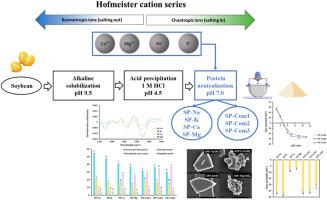
不同碱剂诱导的Hofmeister阳离子系列对低钠大豆蛋白组分生产、结构和功能特性的影响
传统的大豆分离蛋白(SPI)生产依赖于使用氢氧化钠(NaOH),导致最终产品钠含量过高。本研究探讨了在蛋白质中和步骤中用替代碱剂取代NaOH来生产低钠大豆蛋白组分(SPFs)的策略方法,同时阐明了Hofmeister阳离子系列如何控制其结构和功能特性。这些阳离子(Na+, K+, Ca2+, Mg2+)及其组合对蛋白质组成,结构和功能的影响进行了系统评估。中和过程中引入的阳离子主导了最终的离子剖面,使钠含量降低了90%。朝向的一价阳离子(K+, Na+)产生的spf值具有高溶解度、细粒度和强静电斥力,符合其电荷屏蔽的作用。相反,亲宇宙二价阳离子(Ca2+, Mg2+)诱导了显著的结构改变,促进了离子桥接和疏水相互作用,导致广泛的蛋白质聚集,多孔结构,并显着降低了溶解度。然而,这些聚集的spf表现出相对较高的持水能力(WHC)和增强的热稳定性。Mg2+的影响更加明显,突出了电荷密度在该系列中的作用。复合配方可以在这两个极端之间定制spf的特性,展示了成分设计的潜力。这项工作建立了由Hofmeister阳离子系列设计的碱剂替代作为一种实用的单步策略,不仅可以减少钠,而且可以合理地调整大豆蛋白的技术功能特性。这些发现为开发既能实现健康承诺又能满足技术要求的植物性成分提供了机制基础。
本文章由计算机程序翻译,如有差异,请以英文原文为准。
求助全文
约1分钟内获得全文
求助全文
来源期刊
Food Hydrocolloids
工程技术-食品科技
CiteScore
19.90
自引率
14.00%
发文量
871
审稿时长
37 days
期刊介绍:
Food Hydrocolloids publishes original and innovative research focused on the characterization, functional properties, and applications of hydrocolloid materials used in food products. These hydrocolloids, defined as polysaccharides and proteins of commercial importance, are added to control aspects such as texture, stability, rheology, and sensory properties. The research's primary emphasis should be on the hydrocolloids themselves, with thorough descriptions of their source, nature, and physicochemical characteristics. Manuscripts are expected to clearly outline specific aims and objectives, include a fundamental discussion of research findings at the molecular level, and address the significance of the results. Studies on hydrocolloids in complex formulations should concentrate on their overall properties and mechanisms of action, while simple formulation development studies may not be considered for publication.
The main areas of interest are:
-Chemical and physicochemical characterisation
Thermal properties including glass transitions and conformational changes-
Rheological properties including viscosity, viscoelastic properties and gelation behaviour-
The influence on organoleptic properties-
Interfacial properties including stabilisation of dispersions, emulsions and foams-
Film forming properties with application to edible films and active packaging-
Encapsulation and controlled release of active compounds-
The influence on health including their role as dietary fibre-
Manipulation of hydrocolloid structure and functionality through chemical, biochemical and physical processes-
New hydrocolloids and hydrocolloid sources of commercial potential.
The Journal also publishes Review articles that provide an overview of the latest developments in topics of specific interest to researchers in this field of activity.
 求助内容:
求助内容: 应助结果提醒方式:

 京公网安备 11010802042870号


