
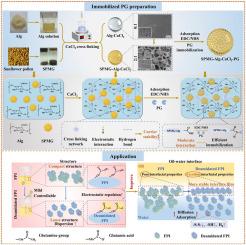
Sunflower pollen microgel-reinforced Ca-alginate hydrogel beads for protein glutaminase immobilization: Gelation and colloidal behavior and insights into flaxseed protein deamidation modification
IF 13.8
1区 农林科学
Q1 CHEMISTRY, APPLIED
引用次数: 0
Abstract
Protease immobilization is often confronted with issues such as activity loss and mass transfer resistance. This study developed a novel composite gel carrier based on sunflower pollen microgel (SPMG) and Ca-alginate hydrogel beads for immobilizing protein glutaminase (PG). SPMG addition significantly enhanced the activity of PG immobilized on the composite gel carrier, and the optimal SPMG-to-alginate (Alg) volume ratio was 2:1. The immobilized PG demonstrated markedly improved pH and temperature tolerance, as well as enhanced storage stability compared with free PG. These effects may result from the action of SPMG on the carrier microstructure and water distribution through hydrogen bonding interaction with Alg, as well as their interactions with Ca2+, thereby regulating the performance of immobilized PG. Subsequently, the carrier-immobilized PG was employed for the deamidation modification of flaxseed protein isolate (FPI) to enhance its functional properties and flavor. At appropriate deamidation levels, the immobilized PG improved the solubility, foaming, and emulsifying properties of FPI by nearly 100%, 50%, and 70%, respectively, while significantly reduced its bitterness. Furthermore, SDS-PAGE, particle size, zeta potential, microstructure, and spectral characteristics were analyzed to characterize the molecular structural changes in the modified FPI, and the underlying mechanisms were analyzed by combining with interfacial rheology. This study elucidates the impact of SPMG incorporation on the properties of gel carrier, which may help regulate the performance of immobilized PG and offer a novel perspective for enzyme immobilization.
用于谷氨酰胺酶蛋白固定化的向日葵花粉微凝胶增强海藻酸钙水凝胶珠:凝胶和胶体行为以及对亚麻籽蛋白脱酰胺改性的见解
蛋白酶固定化常面临活性损失和传质阻力等问题。以向日葵花粉微凝胶(SPMG)和海藻酸钙水凝胶珠为载体,制备了一种固定化蛋白谷氨酰胺酶(PG)的复合凝胶载体。SPMG的加入显著提高了复合凝胶载体上固定化PG的活性,SPMG与海藻酸盐(Alg)的最佳体积比为2:1。与游离PG相比,固定化PG的耐pH、耐温性明显提高,储存稳定性也明显增强,这可能是由于SPMG通过与Alg的氢键作用以及与Ca2+的相互作用,改变了载体的微观结构和水分分布,从而调节了固定化PG的性能。采用载体固定化PG对亚麻籽分离蛋白(FPI)进行脱酰胺改性,提高其功能特性和风味。在适当的脱酰胺水平下,固定化PG使FPI的溶解性、起泡性和乳化性分别提高了近100%、50%和70%,同时显著降低了其苦味。通过SDS-PAGE、粒径、zeta电位、微观结构和光谱特征表征改性后FPI分子结构的变化,并结合界面流变学分析改性后FPI分子结构变化的机理。本研究阐明了SPMG掺入对凝胶载体性能的影响,这可能有助于调节固定化PG的性能,并为酶固定化提供新的视角。
本文章由计算机程序翻译,如有差异,请以英文原文为准。
求助全文
约1分钟内获得全文
求助全文
来源期刊
Food Hydrocolloids
工程技术-食品科技
CiteScore
19.90
自引率
14.00%
发文量
871
审稿时长
37 days
期刊介绍:
Food Hydrocolloids publishes original and innovative research focused on the characterization, functional properties, and applications of hydrocolloid materials used in food products. These hydrocolloids, defined as polysaccharides and proteins of commercial importance, are added to control aspects such as texture, stability, rheology, and sensory properties. The research's primary emphasis should be on the hydrocolloids themselves, with thorough descriptions of their source, nature, and physicochemical characteristics. Manuscripts are expected to clearly outline specific aims and objectives, include a fundamental discussion of research findings at the molecular level, and address the significance of the results. Studies on hydrocolloids in complex formulations should concentrate on their overall properties and mechanisms of action, while simple formulation development studies may not be considered for publication.
The main areas of interest are:
-Chemical and physicochemical characterisation
Thermal properties including glass transitions and conformational changes-
Rheological properties including viscosity, viscoelastic properties and gelation behaviour-
The influence on organoleptic properties-
Interfacial properties including stabilisation of dispersions, emulsions and foams-
Film forming properties with application to edible films and active packaging-
Encapsulation and controlled release of active compounds-
The influence on health including their role as dietary fibre-
Manipulation of hydrocolloid structure and functionality through chemical, biochemical and physical processes-
New hydrocolloids and hydrocolloid sources of commercial potential.
The Journal also publishes Review articles that provide an overview of the latest developments in topics of specific interest to researchers in this field of activity.
 求助内容:
求助内容: 应助结果提醒方式:

 京公网安备 11010802042870号


