
Pure-green top-emitting organic light-emitting diodes toward REC.2020 standard with ultra-narrow full-width at half-maximum
IF 3.9
3区 工程技术
Q2 CHEMISTRY, APPLIED
引用次数: 0
Abstract
Thermally activated delayed fluorescence (TADF) materials facilitate reverse intersystem crossing (RISC) by enhancing the intramolecular charge transfer (ICT) process, thereby increasing exciton utilization and significantly improving the efficiency of organic light-emitting diodes (OLEDs). However, the ICT process also results in considerable spectral broadening and diminished color purity in the devices. Here, a top-emission structure is employed to narrow the emission spectrum and improve the light extraction rate. The experimental results reveal that the full-width at half-maximum (FWHM) and color purity based on the first-order microcavity device are significantly optimized compared with the bottom-emitting organic light-emitting diodes (BE-OLEDs). The FWHM decreases from 93 to 33 nm with the external quantum efficiency (EQE) significantly increasing by 61%, indicating superior device efficiency. The FWHM of second-order microcavity devices is further reduced to 21 nm, achieving Commission Internationale de l'Eclairage coordinates of (0.164, 0.761), which is very close to the REC.2020 standard. Our strategy is simple and can significantly improve color purity of the prepared devices, which promotes the applications of OLEDs in high-gamut displays.
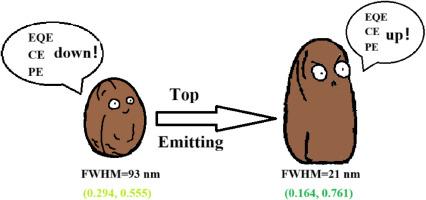
纯绿色顶光有机发光二极管,符合REC.2020标准,半最大全宽超窄
热激活延迟荧光(TADF)材料通过增强分子内电荷转移(ICT)过程促进反向系统间交叉(RISC),从而增加激子利用率,显著提高有机发光二极管(oled)的效率。然而,ICT工艺也会导致器件中的光谱展宽和颜色纯度降低。本文采用顶发射结构来缩小发射光谱,提高光提取率。实验结果表明,与底发光有机发光二极管(be - oled)相比,基于一阶微腔器件的半最大值全宽度(FWHM)和颜色纯度显著优化。FWHM从93 nm减小到33 nm,外量子效率(EQE)显著提高61%,表明器件效率较高。二阶微腔器件的FWHM进一步减小到21 nm,达到国际eclairage委员会坐标(0.164,0.761),非常接近REC.2020标准。我们的策略简单,可以显著提高所制备器件的颜色纯度,从而促进oled在高色域显示中的应用。
本文章由计算机程序翻译,如有差异,请以英文原文为准。
求助全文
约1分钟内获得全文
求助全文
来源期刊
Dyes and Pigments
工程技术-材料科学:纺织
CiteScore
8.20
自引率
13.30%
发文量
933
审稿时长
33 days
期刊介绍:
Dyes and Pigments covers the scientific and technical aspects of the chemistry and physics of dyes, pigments and their intermediates. Emphasis is placed on the properties of the colouring matters themselves rather than on their applications or the system in which they may be applied.
Thus the journal accepts research and review papers on the synthesis of dyes, pigments and intermediates, their physical or chemical properties, e.g. spectroscopic, surface, solution or solid state characteristics, the physical aspects of their preparation, e.g. precipitation, nucleation and growth, crystal formation, liquid crystalline characteristics, their photochemical, ecological or biological properties and the relationship between colour and chemical constitution. However, papers are considered which deal with the more fundamental aspects of colourant application and of the interactions of colourants with substrates or media.
The journal will interest a wide variety of workers in a range of disciplines whose work involves dyes, pigments and their intermediates, and provides a platform for investigators with common interests but diverse fields of activity such as cosmetics, reprographics, dye and pigment synthesis, medical research, polymers, etc.
 求助内容:
求助内容: 应助结果提醒方式:

 京公网安备 11010802042870号


