
From UAV imagery to mapping: Detecting sunflower heads in fields using a novel lightweight deep learning network
IF 6.7
1区 农林科学
Q1 AGRONOMY
European Journal of Agronomy
Pub Date : 2026-05-01
Epub Date: 2026-02-13
DOI:10.1016/j.eja.2026.128018
引用次数: 0
Abstract
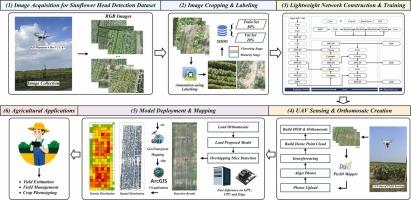
Efficient and non-invasive field-scale detection and localization of sunflower heads (SHs), together with spatial distribution mapping, can support pre-harvest yield prediction, optimization of mechanical harvesting, field management, and high-throughput phenotyping. Unmanned aerial vehicle (UAV) imagery, with its low cost and high spatiotemporal resolution, makes such field-scale monitoring practically feasible. However, accurately detecting and mapping individual SHs from high-resolution UAV images remains challenging, especially under resource-constrained computing environments. To address this, we used UAV RGB imagery to construct a sunflower head detection dataset covering both flowering and maturity stages. Furthermore, a lightweight deep learning network, built upon YOLOv8n improvements, was proposed to enable efficient head detection and mapping. First, the DWCSP module is introduced, utilizing depthwise convolution and multi-branch feature fusion for feature extraction, thereby significantly reducing the network complexity. Additionally, a lightweight detection head integrating partial convolution was designed to further accelerate inference speed, and the WIoU loss function was adopted to enhance detection performance. Experimental results revealed that, when compared to the baseline, the computational complexity and parameters of the proposed model were reduced by 60.5 % and 49.5 %, respectively, with values reaching 3.2 GFLOPs and 1.52 M and a model size of only 3.1 MB. This model achieved an impressive 96.2 % [email protected]. When deployed on a CPU and the Jetson Orin Nano platform, inference speeds of 16 FPS and 67 FPS were attained, representing improvements of 33.3 % and 24.1 % over the baseline. Additionally, the model was employed to perform overlapping slice detection on UAV orthomosaic images from two sample fields, mapping individual SHs locations to geographic coordinates and generating spatial and density distribution maps of the heads. This produces an end-to-end workflow from UAV imagery to geospatial data, which provides an effective approach for pre-harvest yield estimation and analysis of agronomic variability in sunflowers, with the potential to reduce resource waste and labor demands, while providing cost-effective tools for breeding evaluation and decision-making.
从无人机图像到测绘:使用新型轻量级深度学习网络检测田间向日葵头
向日葵籽粒的高效、无创田间检测和定位,以及向日葵籽粒的空间分布图谱,可为收获前产量预测、机械收获优化、田间管理和高通量表型分析提供支持。无人机(UAV)图像以其低成本和高时空分辨率,使这种野外规模的监测在现实中可行。然而,从高分辨率无人机图像中准确检测和绘制单个SHs仍然具有挑战性,特别是在资源受限的计算环境下。为了解决这个问题,我们使用无人机RGB图像构建了一个涵盖开花和成熟阶段的向日葵头部检测数据集。此外,提出了基于YOLOv8n改进的轻量级深度学习网络,以实现高效的头部检测和映射。首先,引入DWCSP模块,利用深度卷积和多分支特征融合进行特征提取,显著降低了网络复杂度;设计了轻量化的部分卷积检测头,进一步加快了推理速度,采用WIoU损失函数提高了检测性能。实验结果表明,与基线相比,该模型的计算复杂度和参数分别降低了60.5 %和49.5 %,分别达到3.2 GFLOPs和1.52 M,模型大小仅为3.1 MB。该模型达到了令人印象深刻的96.2 % [email protected]。当部署在CPU和Jetson Orin Nano平台上时,推理速度达到了16 FPS和67 FPS,比基线提高了33.3% %和24.1% %。此外,利用该模型对来自两个采样场的无人机正射影像进行重叠切片检测,将单个SHs位置映射到地理坐标,生成头部的空间和密度分布图。这产生了从无人机图像到地理空间数据的端到端工作流程,为向日葵收获前产量估算和农艺变异分析提供了有效方法,有可能减少资源浪费和劳动力需求,同时为育种评估和决策提供具有成本效益的工具。
本文章由计算机程序翻译,如有差异,请以英文原文为准。
求助全文
约1分钟内获得全文
求助全文
来源期刊
European Journal of Agronomy
农林科学-农艺学
CiteScore
8.30
自引率
7.70%
发文量
187
审稿时长
4.5 months
期刊介绍:
The European Journal of Agronomy, the official journal of the European Society for Agronomy, publishes original research papers reporting experimental and theoretical contributions to field-based agronomy and crop science. The journal will consider research at the field level for agricultural, horticultural and tree crops, that uses comprehensive and explanatory approaches. The EJA covers the following topics:
crop physiology
crop production and management including irrigation, fertilization and soil management
agroclimatology and modelling
plant-soil relationships
crop quality and post-harvest physiology
farming and cropping systems
agroecosystems and the environment
crop-weed interactions and management
organic farming
horticultural crops
papers from the European Society for Agronomy bi-annual meetings
In determining the suitability of submitted articles for publication, particular scrutiny is placed on the degree of novelty and significance of the research and the extent to which it adds to existing knowledge in agronomy.
 求助内容:
求助内容: 应助结果提醒方式:

 京公网安备 11010802042870号


