
Phase transformation of BaAl2Si2O8 through metastable phase-growth in a kaolinite system containing minor impurities
IF 3.2
3区 化学
Q2 CHEMISTRY, INORGANIC & NUCLEAR
Journal of Solid State Chemistry
Pub Date : 2026-06-01
Epub Date: 2026-02-11
DOI:10.1016/j.jssc.2026.125888
引用次数: 0
Abstract
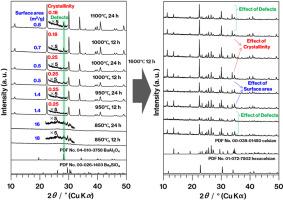
Hexacelsian, the metastable phase of BaAl2Si2O8, is composed of stacked tetrahedral aluminosilicate layers; however, practical utilization of this layered structure is hindered by impurity-driven transformation to celsian, the stable phase of BaAl2Si2O8 with a three-dimensional framework crystal structure. In this study, the hexacelsian-to-celsian transformation prepared from kaolinite containing relatively small amounts of by-products was examined by varying a pre-heating step to grow the hexacelsian phase prior to calcination at 1600 °C as the main heating step. X-ray diffraction patterns and solid-state 27Al nuclear magnetic resonance spectra revealed the formation of poorly crystalline and then crystalline hexacelsian, accompanied by small amounts of BaAl2O4 and Ba2SiO4 originating from the by-products. Although defect signals were not detected by electron spin resonance, the presence of BaAl2O4 and Ba2SiO4, together with the sharpening and intensity changes of the 27Al signals, were used as qualitative indicators of defect-related factors, which correlate with an accelerated transformation to celsian. Comparisons among specimens with nearly constant crystallinity and surface area confirm this correlation. Comparisons at nearly constant surface area show that increased crystallinity retards the transformation, whereas comparisons at similar crystallinity indicate that surface area still influences the transformation. Therefore, the results indicate that defect-related factors, crystallinity, and surface area dominate the transformation from hexacelsian to celsian, and their individual influences can be qualitatively distinguished through the present comparisons. Thus, this study provides practical guidelines for stabilizing hexacelsian in impurity-bearing raw materials and for exploiting metastable layered aluminosilicates in high-temperature ceramic applications.
含少量杂质高岭石体系中亚稳相生长的BaAl2Si2O8相变
六正相是BaAl2Si2O8的亚稳相,由堆叠的四面体铝硅酸盐层组成;然而,这种层状结构的实际利用受到杂质驱动转变为celsian(具有三维框架晶体结构的BaAl2Si2O8的稳定相)的阻碍。在本研究中,从含有相对少量副产物的高岭石制备的六方相到六方相的转变是通过改变预热步骤来生长的,然后在1600°C下作为主要加热步骤进行煅烧。x -射线衍射图和固态27Al核磁共振谱显示,该反应先形成弱晶,再形成六方晶,并伴有少量的BaAl2O4和Ba2SiO4副产品。虽然没有通过电子自旋共振检测到缺陷信号,但BaAl2O4和Ba2SiO4的存在以及27Al信号的锐化和强度变化作为缺陷相关因素的定性指标,与加速向celsian转变有关。在结晶度和表面积几乎恒定的样品之间的比较证实了这种相关性。在接近恒定表面积下的比较表明,结晶度的增加延缓了转变,而在相似结晶度下的比较表明,表面积仍然影响转变。因此,结果表明,缺陷相关因素、结晶度和表面积主导了从六直角向直角的转变,并且通过目前的比较可以定性地区分它们各自的影响。因此,该研究为稳定含杂质原料中的六晶硅以及在高温陶瓷应用中开发亚稳层状硅铝酸盐提供了实用指南。
本文章由计算机程序翻译,如有差异,请以英文原文为准。
求助全文
约1分钟内获得全文
求助全文
来源期刊
Journal of Solid State Chemistry
化学-无机化学与核化学
CiteScore
6.00
自引率
9.10%
发文量
848
审稿时长
25 days
期刊介绍:
Covering major developments in the field of solid state chemistry and related areas such as ceramics and amorphous materials, the Journal of Solid State Chemistry features studies of chemical, structural, thermodynamic, electronic, magnetic, and optical properties and processes in solids.
 求助内容:
求助内容: 应助结果提醒方式:

 京公网安备 11010802042870号


