
Insight into the activation mechanism of methylene C–H bond over Ce–Al composite oxide
IF 6
1区 化学
Q2 CHEMISTRY, PHYSICAL
引用次数: 0
Abstract
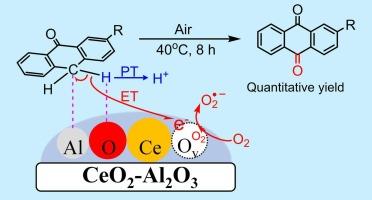
Oxidation of methylene compounds remains a critical challenge due to the difficult activation of C–H bond. Herein, Ce–Al composite oxide was prepared and employed for oxidation of 2-alkyl-anthrone and anthracene to corresponding anthraquinone (AQ) which is used widely in the H2O2 production by the anthraquinone process and fine chemical industries, with air at mild conditions. Characterization results show that incorporation of Ce, existing partially in CeAlO3 phase, results in the generation of oxygen vacancies and enhancement of reducibility. The optimal Ce–Al composite oxide (10%CeAl) exhibits superior performance in oxidation of 2-alkyl-anthrone and anthracene to AQ. The conversion of 100% could be achieved for 2-alkyl-anthrone to AQ at reaction time of 8 h and for 2-alkyl-anthracene to AQ at 15 h over 10%CeAl, with 100% selectivity. In-situ electron paramagnetic resonance measurements and DFT calculations reveal that the Ce–O–Al structure in CeAlO3 phase promotes the formation of carbon-centered radical R• through altering the C–H cleavage mechanism from hydrogen atom transfer to proton-coupled electron transfer (PCET), and superoxide anion radicals (O2•−) formed on oxygen vacancies promote oxidation of R•.
Ce-Al复合氧化物上亚甲基C-H键活化机理的探讨
由于C-H键难以激活,亚甲基化合物的氧化仍然是一个关键的挑战。本文制备了Ce-Al复合氧化物,并将其用于在温和空气条件下将2-烷基蒽酮和蒽酮氧化为蒽醌(AQ),蒽醌在蒽醌工艺和精细化工生产H2O2中广泛使用。表征结果表明,部分存在于CeAlO3相中的Ce的掺入导致了氧空位的生成和还原性的增强。最佳的Ce-Al复合氧化物(10%CeAl)在2-烷基蒽醌和蒽醌的氧化反应中表现出优异的性能,反应时间为8 h, 2-烷基蒽醌的转化率为100%,反应时间为15 h, 2-烷基蒽醌的转化率为100%,选择性为100%。原位电子顺磁共振测量和DFT计算表明,CeAlO3相中的Ce-O-Al结构通过改变C-H裂解机制,从氢原子转移到质子耦合电子转移(PCET),促进了碳中心自由基R•的形成,氧空位上形成的超氧阴离子自由基(O2•−)促进了R•的氧化。
本文章由计算机程序翻译,如有差异,请以英文原文为准。
求助全文
约1分钟内获得全文
求助全文
来源期刊
Journal of Catalysis
工程技术-工程:化工
CiteScore
12.30
自引率
5.50%
发文量
447
审稿时长
31 days
期刊介绍:
The Journal of Catalysis publishes scholarly articles on both heterogeneous and homogeneous catalysis, covering a wide range of chemical transformations. These include various types of catalysis, such as those mediated by photons, plasmons, and electrons. The focus of the studies is to understand the relationship between catalytic function and the underlying chemical properties of surfaces and metal complexes.
The articles in the journal offer innovative concepts and explore the synthesis and kinetics of inorganic solids and homogeneous complexes. Furthermore, they discuss spectroscopic techniques for characterizing catalysts, investigate the interaction of probes and reacting species with catalysts, and employ theoretical methods.
The research presented in the journal should have direct relevance to the field of catalytic processes, addressing either fundamental aspects or applications of catalysis.
 求助内容:
求助内容: 应助结果提醒方式:

 京公网安备 11010802042870号


