
Stablizing the oxygen redox and crystal structure of O3-type layered oxides for sodium-ion batteries under Harsh conditions
IF 20.2
1区 材料科学
Q1 CHEMISTRY, PHYSICAL
引用次数: 0
Abstract
O3-NaNi1/3Fe1/3Mn1/3O2 (NFM) layered oxides have shown promise as cost-effective cathode materials for sodium-ion batteries (SIBs). However, under harsh operational conditions such as high-voltage cycling (>4.2 V), elevated temperature, and humid environments, the practical application of NFM cathode is hindered by significant performance degradation caused by irreversible oxygen oxidation, detrimental phase transitions, and moisture-induced surface degradation. To address these issues, we propose a one-step Gd-doping strategy to address these challenges synergistically. The unique electronic configuration of Gd3+ can effectively regulate charge distribution, enhance oxygen redox reversibility and suppress irreversible oxygen release. Simultaneously, its appropriate ionic radius helps to reduce interlayer spacing and mitigate phase transition strain to stabilize the layered structure. The optimized Gd-doped NFM cathode delivers a high capacity of 180.47 mAh/g at 0.1 C (1 C = 150 mA/g), outstanding rate capability (130.10 mAh/g at 5 C), and exceptional cycling stability (87.5% retention after 200 cycles at 5 C). More importantly, it demonstrates remarkable resilience under high-temperature and humid conditions, offering a practical design strategy for high-performance SIBs operable under realistic harsh environments.
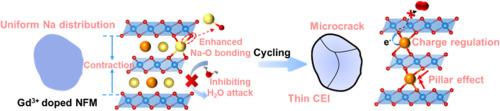
恶劣条件下稳定钠离子电池用o3型层状氧化物的氧氧化还原和晶体结构
O3-NaNi1/3Fe1/3Mn1/3O2 (NFM)层状氧化物作为钠离子电池(sib)的极具成本效益的正极材料具有广阔的前景。然而,在高压循环(>4.2 V)、高温和潮湿环境等恶劣操作条件下,不可逆的氧氧化、有害的相变和水分引起的表面降解会导致性能显著下降,从而阻碍了NFM阴极的实际应用。为了解决这些问题,我们提出了一个一步式的兴奋剂策略来协同解决这些挑战。Gd3+独特的电子构型能有效调节电荷分布,增强氧的氧化还原可逆性,抑制不可逆氧释放。同时,适当的离子半径有助于减小层间距,减轻相变应变,稳定层状结构。优化后的gd掺杂NFM阴极在0.1 C (1 C = 150 mA/g)下提供180.47 mAh/g的高容量,出色的倍率能力(5 C时130.10 mAh/g),以及出色的循环稳定性(5 C下200次循环后保持87.5%)。更重要的是,它在高温和潮湿条件下表现出卓越的弹性,为在现实恶劣环境下可操作的高性能sib提供了实用的设计策略。
本文章由计算机程序翻译,如有差异,请以英文原文为准。
求助全文
约1分钟内获得全文
求助全文
来源期刊
Energy Storage Materials
Materials Science-General Materials Science
CiteScore
33.00
自引率
5.90%
发文量
652
审稿时长
27 days
期刊介绍:
Energy Storage Materials is a global interdisciplinary journal dedicated to sharing scientific and technological advancements in materials and devices for advanced energy storage and related energy conversion, such as in metal-O2 batteries. The journal features comprehensive research articles, including full papers and short communications, as well as authoritative feature articles and reviews by leading experts in the field.
Energy Storage Materials covers a wide range of topics, including the synthesis, fabrication, structure, properties, performance, and technological applications of energy storage materials. Additionally, the journal explores strategies, policies, and developments in the field of energy storage materials and devices for sustainable energy.
Published papers are selected based on their scientific and technological significance, their ability to provide valuable new knowledge, and their relevance to the international research community.
 求助内容:
求助内容: 应助结果提醒方式:

 京公网安备 11010802042870号


