
Model-informed design of microcrack-tolerant cathodes for fast-charging lithium-ion batteries
IF 20.2
1区 材料科学
Q1 CHEMISTRY, PHYSICAL
引用次数: 0
Abstract
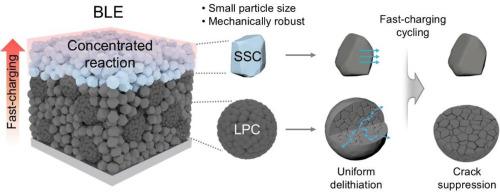
Boosting the fast-charging capability of lithium-ion batteries (LIBs) is essential for the widespread adoption of electric vehicles. However, nickel-rich layered oxides—the leading cathode materials for high-energy LIBs—suffer from microcracking during fast-charge cycling, resulting in severe capacity fading. Here, we propose an advanced design strategy for mechanically robust bimodal Ni-rich layered oxide cathodes guided by three-dimensional (3D) electrochemo-mechanical modeling. The 3D models, constructed with realistic particle morphologies and electrode microstructures, resolve the evolution of reaction heterogeneity and mechanical stress in the cathodes upon fast charging. Combined with experimental validation, we reveal that the dominant degradation pathway is microcracking of large cathode particles (diameter ∼12 µm) near the separator driven by coupled electrode- and particle-level reaction heterogeneity—namely, sluggish electrolyte-phase ionic transport in densely packed electrodes and diffusion limitation within large particles. To address these issues, we develop a bilayer cathode architecture featuring a ∼10 µm-thick top layer of small single-crystalline particles (∼3 µm). Due to their uniform small size and mechanical robustness, the single-crystalline particles enable fast, homogeneous reactions in the current-concentrated region near the separator and simultaneously act as a mechanical buffer that suppresses localized stress in the underlying large particles. As a result, the bilayer cathode effectively suppresses microcrack formation and subsequent parasitic reactions, delivering a high capacity retention of 76.2% after 300 cycles at 3C, compared with 62.4% for a conventional cathode. This work establishes a practical electrode design principle for enabling durable, high-energy, fast-charging LIBs.
基于模型的快充锂离子电池微裂纹阴极设计
提高锂离子电池(LIBs)的快速充电能力对于电动汽车的广泛采用至关重要。然而,富镍层状氧化物——高能锂离子电池的主要正极材料——在快速充电循环过程中会发生微裂纹,导致严重的容量衰减。在这里,我们提出了一种先进的设计策略,在三维(3D)电化学-力学建模的指导下,机械坚固的双峰富镍层状氧化物阴极。三维模型构建了真实的粒子形态和电极微观结构,解决了快速充电时阴极反应非均质性和机械应力的演变。结合实验验证,我们发现主要的降解途径是由电极和颗粒级反应非均质耦合驱动的分离器附近大阴极颗粒(直径~ 12µm)的微开裂,即密集排列的电极中缓慢的电解质相离子传输和大颗粒内的扩散限制。为了解决这些问题,我们开发了一种双层阴极结构,其特征是有一个约10微米厚的小单晶颗粒(约3微米)顶层。由于其均匀的小尺寸和机械稳健性,单晶颗粒可以在分离器附近的电流集中区域进行快速,均匀的反应,同时作为机械缓冲,抑制底层大颗粒的局部应力。因此,双层阴极有效地抑制了微裂纹的形成和随后的寄生反应,在3C下循环300次后,其容量保持率高达76.2%,而传统阴极的容量保持率为62.4%。这项工作建立了一个实用的电极设计原则,使耐用,高能量,快速充电的lib。
本文章由计算机程序翻译,如有差异,请以英文原文为准。
求助全文
约1分钟内获得全文
求助全文
来源期刊
Energy Storage Materials
Materials Science-General Materials Science
CiteScore
33.00
自引率
5.90%
发文量
652
审稿时长
27 days
期刊介绍:
Energy Storage Materials is a global interdisciplinary journal dedicated to sharing scientific and technological advancements in materials and devices for advanced energy storage and related energy conversion, such as in metal-O2 batteries. The journal features comprehensive research articles, including full papers and short communications, as well as authoritative feature articles and reviews by leading experts in the field.
Energy Storage Materials covers a wide range of topics, including the synthesis, fabrication, structure, properties, performance, and technological applications of energy storage materials. Additionally, the journal explores strategies, policies, and developments in the field of energy storage materials and devices for sustainable energy.
Published papers are selected based on their scientific and technological significance, their ability to provide valuable new knowledge, and their relevance to the international research community.
 求助内容:
求助内容: 应助结果提醒方式:

 京公网安备 11010802042870号


