
PFeMo polyoxometalate interlayer boosts BiVO4 light harvesting and charge separation for tandem photoelectrochemical water splitting
IF 11.6
Q1 CHEMISTRY, PHYSICAL
引用次数: 0
Abstract
Photoelectrochemical (PEC) water splitting offers low-cost, sustainable hydrogen fuel production, but the insufficient photoanode performance limits overall water splitting efficiency. Herein, PFeMo polyoxometalate nanoparticles embedded into a BiVO4 (bismuth vanadate [BVO]) photoanode boost the photon utilization efficiency by employing a novel strategy of enhancing the interfacial electric field and broadening light absorption pathways. Additionally, it can accelerate hole extraction by facilitating the dissociation of self-trapped excitons and reducing transmission voltage loss to achieve efficient charge separation. As a result, the BVO/PFeMo/NiFeOx photoanode demonstrates light absorption exceeding 90% in the 300–450 nm wavelength range, with charge separation efficiency approaching 100% at 1.23 VRHE. Furthermore, a perovskite solar cell with photoanodes in tandem delivers a remarkable solar-to-hydrogen efficiency of 7.23%. Overall, this work proposes a new light absorption strategy on the basis of increasing BVO charge carrier separation, providing a new perspective for further improving the performance of photoanodes.
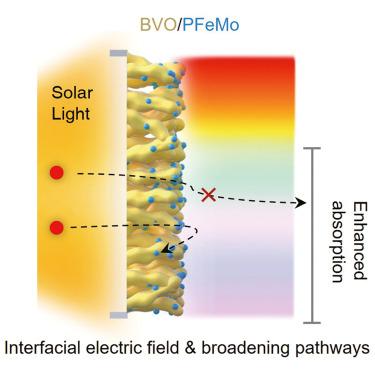
PFeMo多金属氧酸盐夹层促进BiVO4光收集和电荷分离,用于串联光电化学水分解
光电化学(PEC)水分解提供了低成本、可持续的氢燃料生产,但光阳极性能不足限制了整体水分解效率。在此,PFeMo多金属氧酸盐纳米颗粒嵌入到BiVO4(钒酸铋[BVO])光阳极中,通过采用增强界面电场和拓宽光吸收途径的新策略提高了光子利用效率。此外,它可以通过促进自困激子的解离和减少传输电压损失来加速空穴提取,从而实现有效的电荷分离。结果表明,BVO/PFeMo/NiFeOx光阳极在300-450 nm波长范围内的光吸收率超过90%,在1.23 VRHE时电荷分离效率接近100%。此外,具有光阳极串联的钙钛矿太阳能电池可提供7.23%的太阳能制氢效率。综上所述,本工作在提高BVO载流子分离度的基础上提出了一种新的光吸收策略,为进一步提高光阳极的性能提供了新的视角。
本文章由计算机程序翻译,如有差异,请以英文原文为准。
求助全文
约1分钟内获得全文
求助全文
来源期刊
CiteScore
10.50
自引率
6.40%
发文量
0
期刊介绍:
Chem Catalysis is a monthly journal that publishes innovative research on fundamental and applied catalysis, providing a platform for researchers across chemistry, chemical engineering, and related fields. It serves as a premier resource for scientists and engineers in academia and industry, covering heterogeneous, homogeneous, and biocatalysis. Emphasizing transformative methods and technologies, the journal aims to advance understanding, introduce novel catalysts, and connect fundamental insights to real-world applications for societal benefit.
 求助内容:
求助内容: 应助结果提醒方式:

 京公网安备 11010802042870号


