
Probing the energy dissipation mechanisms of shear thickening gel at molecular level
IF 5.1
2区 化学
Q2 POLYMER SCIENCE
引用次数: 0
Abstract
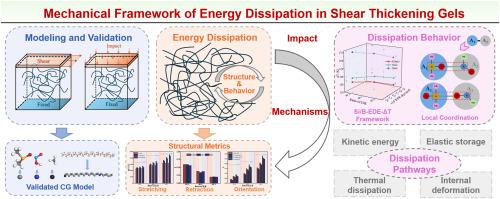
Shear thickening gels (STGs) exhibit remarkable impact resistance and energy absorption properties owing to the non-linear and reversible mechanical properties. However, the molecular-level mechanisms underlying their dissipation behavior remain unclear due to the limited understanding of how crosslinking density and local coordination influence energy redistribution and structural relaxation during impact. In this work, we developed a coarse-grained molecular dynamics model to investigate the impact induced energy conversion in STGs with different Si/B molar ratios. The simulations were validated by rheological experiments and accurately reproduced the nonlinear viscoelastic and shear thickening responses of system. The results show that energy evolution revealed a rapid transformation of kinetic energy into potential and internal deformation energy, followed by relaxation driven stabilization. Three coupled molecular processes-reversible coordination, chain conformational change, and orientational relaxation-were identified as key pathways that govern the dissipation efficiency and reversibility by regulating the partitioning of mechanical energy is partitioned between elastic storage, structural reconfiguration, and irreversible deformation. This work modulates the balance between elastic energy storage and irreversible deformation, thereby establishing a unified molecular framework that links network architecture to macroscopic impact performance.
从分子水平探讨剪切增稠凝胶的能量耗散机制
剪切增稠凝胶具有非线性和可逆的力学性能,具有良好的抗冲击和吸能性能。然而,由于对交联密度和局部配位如何影响碰撞过程中的能量再分配和结构松弛的理解有限,其耗散行为的分子水平机制仍然不清楚。在这项工作中,我们建立了一个粗粒度的分子动力学模型来研究不同Si/B摩尔比的STGs中撞击引起的能量转换。通过流变实验验证了仿真结果,准确再现了系统的非线性粘弹性和剪切增厚响应。结果表明:能量演化过程表现为动能快速转化为位能和内部变形能,随后出现松弛驱动稳定;三个耦合的分子过程——可逆配位、链构象变化和取向弛豫——通过调节机械能在弹性储存、结构重构和不可逆变形之间的分配来控制耗散效率和可逆性的关键途径。这项工作调节了弹性能量储存和不可逆变形之间的平衡,从而建立了一个统一的分子框架,将网络结构与宏观冲击性能联系起来。
本文章由计算机程序翻译,如有差异,请以英文原文为准。
求助全文
约1分钟内获得全文
求助全文
来源期刊
Polymer
化学-高分子科学
CiteScore
7.90
自引率
8.70%
发文量
959
审稿时长
32 days
期刊介绍:
Polymer is an interdisciplinary journal dedicated to publishing innovative and significant advances in Polymer Physics, Chemistry and Technology. We welcome submissions on polymer hybrids, nanocomposites, characterisation and self-assembly. Polymer also publishes work on the technological application of polymers in energy and optoelectronics.
The main scope is covered but not limited to the following core areas:
Polymer Materials
Nanocomposites and hybrid nanomaterials
Polymer blends, films, fibres, networks and porous materials
Physical Characterization
Characterisation, modelling and simulation* of molecular and materials properties in bulk, solution, and thin films
Polymer Engineering
Advanced multiscale processing methods
Polymer Synthesis, Modification and Self-assembly
Including designer polymer architectures, mechanisms and kinetics, and supramolecular polymerization
Technological Applications
Polymers for energy generation and storage
Polymer membranes for separation technology
Polymers for opto- and microelectronics.
 求助内容:
求助内容: 应助结果提醒方式:

 京公网安备 11010802042870号


