
CuO/carbon spheres/g-C3N4 with 3D hierarchical porous structure and functional carbon bridge for efficient CO2 adsorption and photocatalytic reduction
IF 9
1区 工程技术
Q1 ENGINEERING, CHEMICAL
Separation and Purification Technology
Pub Date : 2026-06-19
Epub Date: 2026-02-12
DOI:10.1016/j.seppur.2026.137212
引用次数: 0
Abstract
Utilizing photocatalysis to reduce CO2 into value-added products is a promising and sustainable pathway. This study reports the fabrication of a low-cost CuO/carbon spheres/g-C3N4 composite material without the use of precious metals, featuring a p-n heterojunction between CuO and g-C3N4 interconnected by a conductive carbon bridge. The optimal sample has suitable CO2 adsorption capacity (1.4 mmol/g at 1 bar, 25 °C) and exceptional CO2 photocatalytic performance. The optimal sample achieves CO and CH4 production yields of 110.95 and 9.9 μmol/g h−1, respectively, with 73.7% CO selectivity. Photoelectrochemical tests reveal that the CuO/g-C3N4 heterojunction facilitates rapid electron transfer via the carbon medium, achieving effective electrons(e−)-holes(h+) separation. In-situ Diffuse Reflectance Infrared Fourier Transform Spectroscopy (in-situ DRIFTS) analysis and Density Functional Theory (DFT) calculations collaboratively verify the efficient reaction pathway via key intermediates (COOH*, CHO*, CH2O*, and CH3O*) and elucidate the electronic structure driving the enhanced charge dynamics. Furthermore, property-performance correlation analysis indicates that the charge separation efficiency is the main performance driving factor. A life cycle assessment (LCA) demonstrates that avoiding the use of precious metals during catalyst preparation leads to a significant reduction in the environmental footprint of CuO/carbon spheres/g-C3N4. The main environmental impact comes from electricity consumption during production. This work provides a sustainable blueprint for designing efficient photocatalysts by integrating interfacial engineering with mechanistic understanding for solar-driven CO2 valorization.
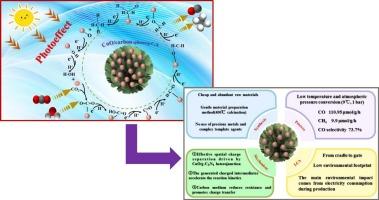
具有三维分层多孔结构和功能碳桥的CuO/碳球/g-C3N4用于高效CO2吸附和光催化还原
利用光催化将二氧化碳转化为增值产品是一种有前途的可持续途径。本研究报道了一种不使用贵金属的低成本CuO/碳球/g-C3N4复合材料的制备,其特点是CuO和g-C3N4之间的p-n异质结通过导电碳桥连接。最佳样品具有合适的CO2吸附量(1 bar, 25°C时为1.4 mmol/g)和优异的CO2光催化性能。最优样品CO和CH4的产率分别为110.95和9.9 μmol/g h−1,CO选择性为73.7%。光电化学测试表明,CuO/g-C3N4异质结促进了电子通过碳介质的快速转移,实现了电子(e−)和空穴(h+)的有效分离。原位漫反射红外傅立叶变换光谱(原位DRIFTS)分析和密度泛函理论(DFT)计算共同验证了通过关键中间体(COOH*、CHO*、CH2O*和ch30 *)的有效反应途径,并阐明了驱动电荷动力学增强的电子结构。此外,性能相关性分析表明,电荷分离效率是驱动性能的主要因素。生命周期评估(LCA)表明,在催化剂制备过程中避免使用贵金属可以显著减少CuO/碳球/g-C3N4的环境足迹。主要的环境影响来自生产过程中的电力消耗。这项工作为设计高效的光催化剂提供了一个可持续的蓝图,通过将界面工程与太阳能驱动二氧化碳增值的机制理解相结合。
本文章由计算机程序翻译,如有差异,请以英文原文为准。
求助全文
约1分钟内获得全文
求助全文
来源期刊
Separation and Purification Technology
工程技术-工程:化工
CiteScore
14.00
自引率
12.80%
发文量
2347
审稿时长
43 days
期刊介绍:
Separation and Purification Technology is a premier journal committed to sharing innovative methods for separation and purification in chemical and environmental engineering, encompassing both homogeneous solutions and heterogeneous mixtures. Our scope includes the separation and/or purification of liquids, vapors, and gases, as well as carbon capture and separation techniques. However, it's important to note that methods solely intended for analytical purposes are not within the scope of the journal. Additionally, disciplines such as soil science, polymer science, and metallurgy fall outside the purview of Separation and Purification Technology. Join us in advancing the field of separation and purification methods for sustainable solutions in chemical and environmental engineering.
 求助内容:
求助内容: 应助结果提醒方式:

 京公网安备 11010802042870号


