
Optimization of thermal storage characteristics in molten salt phase change thermal storage units: A numerical analysis based on heat pipe arrangement patterns
IF 6.4
2区 工程技术
Q1 THERMODYNAMICS
Case Studies in Thermal Engineering
Pub Date : 2026-04-01
Epub Date: 2026-02-11
DOI:10.1016/j.csite.2026.107815
引用次数: 0
Abstract
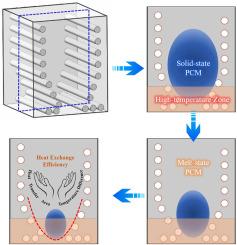
The application of thermal storage units is one approach to mitigate the intermittency of clean energy, where heat transfer efficiency and thermal storage capacity are critical parameters. To enhance heat transfer and thermal storage performance, three models—Uniform-type, U-type, and V-type—were constructed, using NaNO3-KNO3-NaNO2 (7:53:40 wt%) as the phase change material (PCM). The impact of these different arrangements on the PCM melting process was investigated through computational fluid dynamics simulations. The results indicate that the model with the Uniform-type arrangement requires 91.76 min to achieve complete melting of the PCM. The optimal V-type arrangement achieved a phase change completion time of 45.16% relative to the Uniform-type arrangement with no significant increase in cost for the thermal storage unit component. After 40 min of thermal storage, its energy storage capacity reaches 24.14 × 10³ kJ, which is 1.38 times that of the Uniform-type model. Mechanism analysis revealed that the temperature difference between the heat source and the PCM, along with their contact area, are two critical factors affecting the system's heat transfer efficiency. These findings provide a basis for the structural optimization of the thermal energy storage unit.
熔盐相变蓄热装置蓄热特性优化:基于热管布置方式的数值分析
蓄热装置的应用是缓解清洁能源间歇性的一种方法,其中传热效率和蓄热能力是关键参数。以NaNO3-KNO3-NaNO2 (7:53:40 wt%)为相变材料(PCM),构建了均匀型、u型和v型三种相变材料模型。通过计算流体动力学模拟研究了这些不同排列对PCM熔化过程的影响。结果表明:均匀型模型实现PCM完全熔化所需时间为91.76 min;与均匀型布置相比,v型布置的最佳相变完成时间缩短了45.16%,且储热单元组件的成本没有显著增加。蓄热40 min后,其储能容量达到24.14 × 10³ kJ,是均匀型模型的1.38倍。机理分析表明,热源与PCM之间的温差及其接触面积是影响系统传热效率的两个关键因素。这些研究结果为蓄热装置的结构优化提供了依据。
本文章由计算机程序翻译,如有差异,请以英文原文为准。
求助全文
约1分钟内获得全文
求助全文
来源期刊
Case Studies in Thermal Engineering
Chemical Engineering-Fluid Flow and Transfer Processes
CiteScore
8.60
自引率
11.80%
发文量
812
审稿时长
76 days
期刊介绍:
Case Studies in Thermal Engineering provides a forum for the rapid publication of short, structured Case Studies in Thermal Engineering and related Short Communications. It provides an essential compendium of case studies for researchers and practitioners in the field of thermal engineering and others who are interested in aspects of thermal engineering cases that could affect other engineering processes. The journal not only publishes new and novel case studies, but also provides a forum for the publication of high quality descriptions of classic thermal engineering problems. The scope of the journal includes case studies of thermal engineering problems in components, devices and systems using existing experimental and numerical techniques in the areas of mechanical, aerospace, chemical, medical, thermal management for electronics, heat exchangers, regeneration, solar thermal energy, thermal storage, building energy conservation, and power generation. Case studies of thermal problems in other areas will also be considered.
 求助内容:
求助内容: 应助结果提醒方式:

 京公网安备 11010802042870号


