Yao-Nan Wang, Ko-Tung Chang, Jui-Kai Liu, Chang-Hsien Tai
{"title":"Cell culture platform fabrication methods and applications.","authors":"Yao-Nan Wang, Ko-Tung Chang, Jui-Kai Liu, Chang-Hsien Tai","doi":"10.4103/tcmj.TCMJ-D-25-00004","DOIUrl":null,"url":null,"abstract":"<p><p>Cell culture technologies are fundamental tool in biological research. Traditional two-dimensional (2D) cell culture methods, despite their widespread use and simplicity, fail to accurately replicate the physiological conditions of native tissues, leading to altered cellular behavior. Recent advancements in 3D culture techniques, combined with innovative fabrication methods such as photolithography, paper-based, and 3D printing, have substantially improved the fidelity of cell culture models. In parallel, numerical simulations have become indispensable for optimizing the design and performance of these systems, offering precise control microenvironmental factors such as fluid dynamics, nutrient and oxygen gradients, and shear stress within microfluidic platforms. These approaches for integration facilitate accurate modeling of cell-to-cell and cell-to-matrix interactions essential for physiological relation. Concurrently, the integration of multimaterial fabrication techniques provides scalable and customizable solutions for developing sophisticated microfluidic and cell culture systems. This review discusses recent developments in these fabrication methods and highlights their integration with numerical simulation for optimization design, explores their collective potential to advance biomedical research and applications.</p>","PeriodicalId":45873,"journal":{"name":"Tzu Chi Medical Journal","volume":"38 1","pages":"21-30"},"PeriodicalIF":1.6000,"publicationDate":"2026-01-13","publicationTypes":"Journal Article","fieldsOfStudy":null,"isOpenAccess":false,"openAccessPdf":"https://www.ncbi.nlm.nih.gov/pmc/articles/PMC12885461/pdf/","citationCount":"0","resultStr":null,"platform":"Semanticscholar","paperid":null,"PeriodicalName":"Tzu Chi Medical Journal","FirstCategoryId":"1085","ListUrlMain":"https://doi.org/10.4103/tcmj.TCMJ-D-25-00004","RegionNum":0,"RegionCategory":null,"ArticlePicture":[],"TitleCN":null,"AbstractTextCN":null,"PMCID":null,"EPubDate":"2026/1/1 0:00:00","PubModel":"eCollection","JCR":"Q2","JCRName":"MEDICINE, GENERAL & INTERNAL","Score":null,"Total":0}
引用次数: 0
Abstract
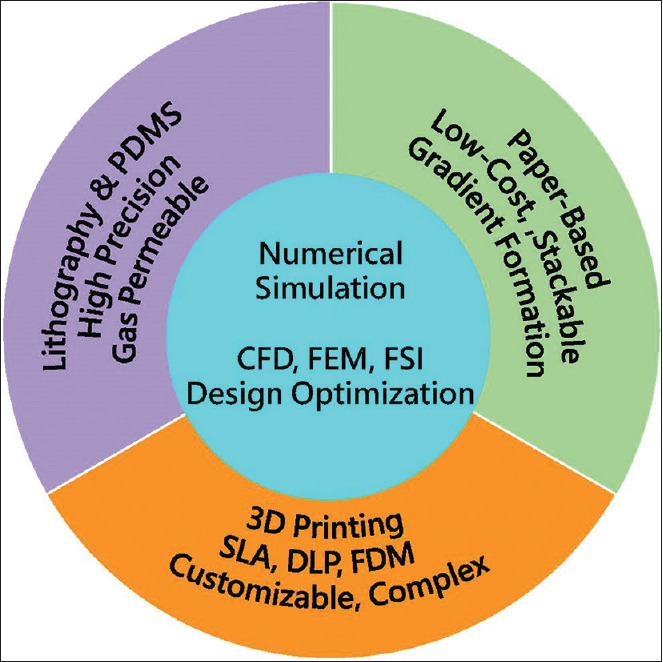
Cell culture technologies are fundamental tool in biological research. Traditional two-dimensional (2D) cell culture methods, despite their widespread use and simplicity, fail to accurately replicate the physiological conditions of native tissues, leading to altered cellular behavior. Recent advancements in 3D culture techniques, combined with innovative fabrication methods such as photolithography, paper-based, and 3D printing, have substantially improved the fidelity of cell culture models. In parallel, numerical simulations have become indispensable for optimizing the design and performance of these systems, offering precise control microenvironmental factors such as fluid dynamics, nutrient and oxygen gradients, and shear stress within microfluidic platforms. These approaches for integration facilitate accurate modeling of cell-to-cell and cell-to-matrix interactions essential for physiological relation. Concurrently, the integration of multimaterial fabrication techniques provides scalable and customizable solutions for developing sophisticated microfluidic and cell culture systems. This review discusses recent developments in these fabrication methods and highlights their integration with numerical simulation for optimization design, explores their collective potential to advance biomedical research and applications.
期刊介绍:
The Tzu Chi Medical Journal is the peer-reviewed publication of the Buddhist Compassion Relief Tzu Chi Foundation, and includes original research papers on clinical medicine and basic science, case reports, clinical pathological pages, and review articles.


 求助内容:
求助内容: 应助结果提醒方式:

 京公网安备 11010802042870号


