
SOMAS – an open-source software for the analysis of muscle activity during sleep
IF 3.4
2区 医学
Q1 CLINICAL NEUROLOGY
引用次数: 0
Abstract
Study objectives
While several algorithms exist for analyzing muscle activity during sleep, none provides information on both muscle tone and movements as open-source software. We aimed to overcome this limitation by developing SOMAS (Sleep Open-source Muscle activity Analysis System).
Methods
SOMAS processes European Data Format+ (EDF+) files with wake-sleep state and candidate leg movement annotations without online data sharing, quantifies muscle tone using the atonia index and the distribution of normalized electromyography values (DNE), and calculates leg movement indices based on the 2016 World Association of Sleep Medicine criteria. To demonstrate that SOMAS achieves its intended purpose, we analyzed recordings from eight patients with isolated REM sleep behavior disorder (iRBD), five with restless legs syndrome (RLS), seven with sleep breathing disorders, and five controls. SOMAS-derived atonia index and leg movement indices were compared with those from Hypnolab, a non-open access software. Additionally, SOMAS-derived indices were used to differentiate patients with iRBD or with RLS from other patients and/or controls.
Results
SOMAS-derived atonia index and leg movement indices strongly correlated with Hypnolab results (Spearman coefficients >0.97) with minimal bias. The DNE and atonia index in REM sleep effectively differentiated patients with iRBD from other patients and controls (AUC 0.89–1.00). The periodic leg movement and periodicity indices differentiated patients with RLS from controls (AUC 0.71–0.75).
Conclusions
SOMAS reliably quantifies muscle tone and movements during sleep from EDF+ files using open-source algorithms, with the potential of enhancing reproducibility and collaboration in research on sleep-related movement disorders.
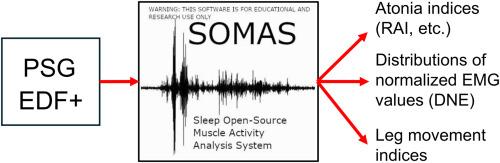
SOMAS -一个用于分析睡眠期间肌肉活动的开源软件。
研究目标:虽然有几种算法可以分析睡眠期间的肌肉活动,但没有一种算法能像开源软件那样同时提供肌肉张力和运动的信息。我们的目标是通过开发SOMAS(睡眠开源肌肉活动分析系统)来克服这一限制。方法:SOMAS处理欧洲数据格式+ (EDF+)文件,其中包含清醒-睡眠状态和候选腿部运动注释,没有在线数据共享,使用张力指数和归一化肌电图值(DNE)分布量化肌肉张力,并根据2016年世界睡眠医学协会标准计算腿部运动指数。为了证明SOMAS达到了预期的目的,我们分析了8例孤立的快速眼动睡眠行为障碍(iRBD)患者、5例不宁腿综合征(RLS)患者、7例睡眠呼吸障碍患者和5例对照患者的记录。将somas衍生的张力指数和腿部运动指数与非开放获取软件Hypnolab进行比较。此外,somas衍生的指标用于区分iRBD或RLS患者与其他患者和/或对照组。结果:somas衍生的张力指数和腿部运动指数与Hypnolab结果密切相关(Spearman系数>0.97),偏差极小。快速眼动睡眠的DNE和张力指数能有效区分iRBD患者与其他患者和对照组(AUC 0.89-1.00)。周期性腿部运动和周期性指数将RLS患者与对照组区分开来(AUC为0.71-0.75)。结论:SOMAS使用开源算法可靠地从EDF+文件中量化睡眠期间的肌肉张力和运动,具有增强睡眠相关运动障碍研究的可重复性和协作性的潜力。
本文章由计算机程序翻译,如有差异,请以英文原文为准。
求助全文
约1分钟内获得全文
求助全文
来源期刊
Sleep medicine
医学-临床神经学
CiteScore
8.40
自引率
6.20%
发文量
1060
审稿时长
49 days
期刊介绍:
Sleep Medicine aims to be a journal no one involved in clinical sleep medicine can do without.
A journal primarily focussing on the human aspects of sleep, integrating the various disciplines that are involved in sleep medicine: neurology, clinical neurophysiology, internal medicine (particularly pulmonology and cardiology), psychology, psychiatry, sleep technology, pediatrics, neurosurgery, otorhinolaryngology, and dentistry.
The journal publishes the following types of articles: Reviews (also intended as a way to bridge the gap between basic sleep research and clinical relevance); Original Research Articles; Full-length articles; Brief communications; Controversies; Case reports; Letters to the Editor; Journal search and commentaries; Book reviews; Meeting announcements; Listing of relevant organisations plus web sites.
 求助内容:
求助内容: 应助结果提醒方式:

 京公网安备 11010802042870号


