
Characterization and environmental stress-induced expression profiling of transient receptor potential vanilloid (TRPV) channels in the Pacific oyster (Magallana gigas) following short-heatwave and silver exposure
IF 4.3
3区 环境科学与生态学
Q2 BIOCHEMISTRY & MOLECULAR BIOLOGY
Comparative Biochemistry and Physiology C-toxicology & Pharmacology
Pub Date : 2026-06-01
Epub Date: 2026-02-09
DOI:10.1016/j.cbpc.2026.110477
引用次数: 0
Abstract
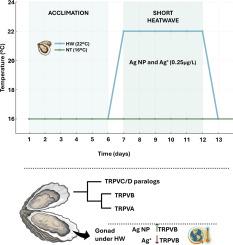
Marine ecosystems are increasingly threatened by the rising frequency of thermal anomalies, such as marine heatwaves (HW), and by the presence of emerging contaminants, including silver nanoparticles (Ag NPs) and its dissociated form into silver ions (Ag+). In this context, the present study provides an integrative analysis of the molecular basis of Transient Receptor Potential Vanilloid (TRPV), a family of sensitive channels, under environmentally realistic conditions in the gonad of the Pacific oyster (Magallana gigas). In this study, environmentally relevant concentrations of silver (0.25 μg/L) and a temperature increase of up to 6 °C above natural temperature (16.30 ± 0.82 °C) were applied for 7 days to simulate a realistic short-HW scenario. Four TRPV sequences were identified and, based on phylogenetic analyses, reclassified as TRPVA, TRPVB, and two TRPVC/D paralogs. Among these, TRPVB emerged as the most stress-responsive isoform in the gonad, displaying contrasting expression profiles under HW conditions, with Ag NPs upregulating TRPVB expression whereas Ag+ caused its downregulation. Although preliminary, these results suggest that Ag NPs and Ag+ activate different signalling pathways, which may be differentially expressed under thermal stress, highlighting the complexity of combined contaminants and climate-related pressures in the Pacific oyster. These findings provide basic knowledge and novel insights into environmental stress responses in marine invertebrates.
短热浪和银暴露后太平洋牡蛎(Magallana gigas)瞬时受体电位香草蛋白(TRPV)通道的表征和环境胁迫诱导的表达谱
海洋生态系统正日益受到越来越频繁的热异常的威胁,例如海洋热浪(HW),以及新出现的污染物的存在,包括银纳米颗粒(Ag NPs)及其解离成银离子(Ag+)。在此背景下,本研究综合分析了太平洋牡蛎(Magallana gigas)生殖腺中瞬时受体电位Vanilloid (Transient Receptor Potential Vanilloid, TRPV)敏感通道家族的分子基础。在本研究中,环境相关银浓度(0.25 μg/L)和温度比自然温度(16.30 ± 0.82 °C)升高高达6 °C,持续7 天,模拟真实的短hw情景。鉴定出4个TRPV序列,并根据系统发育分析将其重新分类为TRPVA、TRPVB和两个TRPVC/D相似序列。其中,TRPVB是性腺中最具应激反应的异构体,在HW条件下表现出截然不同的表达谱,Ag NPs上调TRPVB的表达,而Ag+导致其下调。虽然是初步的,但这些结果表明,Ag NPs和Ag+激活不同的信号通路,这些信号通路可能在热胁迫下差异表达,突出了太平洋牡蛎中污染物和气候相关压力组合的复杂性。这些发现为海洋无脊椎动物的环境应激反应提供了基础知识和新的见解。
本文章由计算机程序翻译,如有差异,请以英文原文为准。
求助全文
约1分钟内获得全文
求助全文
来源期刊
CiteScore
7.50
自引率
5.10%
发文量
206
审稿时长
30 days
期刊介绍:
Part C: Toxicology and Pharmacology. This journal is concerned with chemical and drug action at different levels of organization, biotransformation of xenobiotics, mechanisms of toxicity, including reactive oxygen species and carcinogenesis, endocrine disruptors, natural products chemistry, and signal transduction with a molecular approach to these fields.
 求助内容:
求助内容: 应助结果提醒方式:

 京公网安备 11010802042870号


