
Phase diagrams for electrodeposition of alloys from molten chlorides

IF 5.6 3区 材料科学 Q1 ELECTROCHEMISTRY
Electrochimica Acta Pub Date : 2026-05-01 Epub Date: 2026-02-10 DOI:10.1016/j.electacta.2026.148411
Eli Brosh , Erez Boukobza
{"title":"Phase diagrams for electrodeposition of alloys from molten chlorides","authors":"Eli Brosh ,&nbsp;Erez Boukobza","doi":"10.1016/j.electacta.2026.148411","DOIUrl":null,"url":null,"abstract":"<div><div>The optimization of the electrochemical co-deposition of alloys from molten salts can be facilitated by CALculation of PHase Diagrams (CALPHAD) using appropriate software and databases. An electrochemical phase diagram (EPD) is a phase diagram in which the ordinate is the electrical potential relative to a reference electrode and the abscissa is a composition variable; it can be used to predict the deposited phases under potentiostatic conditions. The electrochemical diagram (ECD), recently introduced by Kaptay [Electrochim. Acta 484 (2024) 144,002], relates the salt composition to the composition of the electrodeposited alloy under galvanostatic conditions in the limit of vanishing current. In this study, we develop a method to calculate both types of diagrams for electrodeposition from chloride salts using CALPHAD software, compatible with any CALPHAD-type model for the participating phases, including the molten salt. We also establish the relationship between the phase diagram and ECD. The electrodeposition of Co-Ni, Ce-La, Al-Sc and Co-Sn alloys on inert cathodes from a KCl-LiCl eutectic melt is analyzed and compared with experimental results reported in the literature. For Ce-La containing salts, electrodeposition on a reactive nickel cathode is also considered. Additional potential applications of EPDs and ECDs are discussed.</div></div>","PeriodicalId":305,"journal":{"name":"Electrochimica Acta","volume":"557 ","pages":"Article 148411"},"PeriodicalIF":5.6000,"publicationDate":"2026-05-01","publicationTypes":"Journal Article","fieldsOfStudy":null,"isOpenAccess":false,"openAccessPdf":"","citationCount":"0","resultStr":null,"platform":"Semanticscholar","paperid":null,"PeriodicalName":"Electrochimica Acta","FirstCategoryId":"88","ListUrlMain":"https://www.sciencedirect.com/science/article/pii/S001346862600304X","RegionNum":3,"RegionCategory":"材料科学","ArticlePicture":[],"TitleCN":null,"AbstractTextCN":null,"PMCID":null,"EPubDate":"2026/2/10 0:00:00","PubModel":"Epub","JCR":"Q1","JCRName":"ELECTROCHEMISTRY","Score":null,"Total":0}
引用次数: 0

Abstract

The optimization of the electrochemical co-deposition of alloys from molten salts can be facilitated by CALculation of PHase Diagrams (CALPHAD) using appropriate software and databases. An electrochemical phase diagram (EPD) is a phase diagram in which the ordinate is the electrical potential relative to a reference electrode and the abscissa is a composition variable; it can be used to predict the deposited phases under potentiostatic conditions. The electrochemical diagram (ECD), recently introduced by Kaptay [Electrochim. Acta 484 (2024) 144,002], relates the salt composition to the composition of the electrodeposited alloy under galvanostatic conditions in the limit of vanishing current. In this study, we develop a method to calculate both types of diagrams for electrodeposition from chloride salts using CALPHAD software, compatible with any CALPHAD-type model for the participating phases, including the molten salt. We also establish the relationship between the phase diagram and ECD. The electrodeposition of Co-Ni, Ce-La, Al-Sc and Co-Sn alloys on inert cathodes from a KCl-LiCl eutectic melt is analyzed and compared with experimental results reported in the literature. For Ce-La containing salts, electrodeposition on a reactive nickel cathode is also considered. Additional potential applications of EPDs and ECDs are discussed.
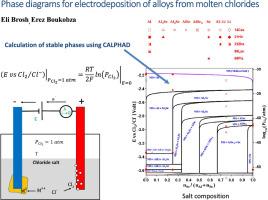
Abstract Image

用熔融氯化物电沉积合金的相图
使用合适的软件和数据库计算相图(CALPHAD)可以促进熔盐合金电化学共沉积的优化。电化学相图(EPD)是一种相图,其中纵坐标是相对于参考电极的电势,横坐标是组成变量;它可用于恒电位条件下沉积相的预测。电化学图(ECD),最近由Kaptay [Electrochim]介绍。[j] . Acta 484(2024) 144,002],将盐成分与消失电流极限下恒流条件下电沉积合金的成分联系起来。在本研究中,我们开发了一种使用CALPHAD软件计算氯化物盐电沉积两种类型图的方法,该软件与参与相(包括熔盐)的任何CALPHAD类型模型兼容。建立了相图与ECD之间的关系。分析了Co-Ni、Ce-La、Al-Sc和Co-Sn合金在KCl-LiCl共晶熔体惰性阴极上的电沉积过程,并与文献报道的实验结果进行了比较。对于含铈镧的盐,也考虑在活性镍阴极上电沉积。讨论了EPDs和ECDs的其他潜在应用。
本文章由计算机程序翻译,如有差异,请以英文原文为准。
求助全文
约1分钟内获得全文 求助全文
来源期刊
Electrochimica Acta
Electrochimica Acta 工程技术-电化学
CiteScore
11.30
自引率
6.10%
发文量
1634
审稿时长
41 days
期刊介绍: Electrochimica Acta is an international journal. It is intended for the publication of both original work and reviews in the field of electrochemistry. Electrochemistry should be interpreted to mean any of the research fields covered by the Divisions of the International Society of Electrochemistry listed below, as well as emerging scientific domains covered by ISE New Topics Committee.

×
引用
GB/T 7714-2015
复制
MLA
复制
APA
复制
导出至
BibTeX EndNote RefMan NoteFirst NoteExpress
×
提示
您的信息不完整,为了账户安全,请先补充。
现在去补充
×
提示
您因"违规操作"
具体请查看互助需知
我知道了
×
提示
确定
请完成安全验证×
copy
已复制链接
快去分享给好友吧!
我知道了
右上角分享
点击右上角分享
0
联系我们:info@booksci.cn Book学术提供免费学术资源搜索服务,方便国内外学者检索中英文文献。致力于提供最便捷和优质的服务体验。 Copyright © 2023 布克学术 All rights reserved.
京ICP备2023020795号-1
ghs 京公网安备 11010802042870号
Book学术文献互助
Book学术文献互助群
群 号:604180095
Book学术官方微信
小红书


