
Organic frameworks-based optical sensors for uranyl ions: Unveiling mechanisms and applications
IF 25.6
1区 化学
Q1 CHEMISTRY, INORGANIC & NUCLEAR
Coordination Chemistry Reviews
Pub Date : 2026-06-01
Epub Date: 2026-02-11
DOI:10.1016/j.ccr.2026.217685
引用次数: 0
Abstract
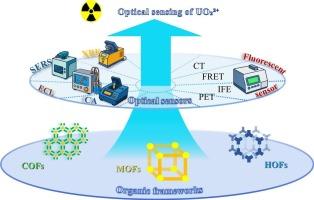
Uranyl ions (UO₂2+), significant nuclear contaminants, pose severe risks to ecosystems and human health. Although conventional detection techniques such as radiochemical analysis and instrumental methods provide high accuracy, they are often hindered by large equipment size and prolonged analysis time, limiting their suitability for rapid environmental screening and emergency scenarios. In response, optical sensing technologies have attracted significant attention due to their high sensitivity and signal visibility. Among them, organic frameworks—including metal-organic frameworks (MOFs), covalent organic frameworks (COFs), and hydrogen-bonded organic frameworks (HOFs)—offer suitable platforms for constructing high-performance UO₂2+ optical sensors, owing to their high surface areas, tunable pores, and tailorable optical properties. This review systematically summarizes advances from 2021 to 2025 in UO₂2+ optical sensors based on such materials, with a focus on underlying sensing mechanisms. In fluorescence sensing, “turn-off” designs based on photoinduced electron transfer (PET), fluorescence resonance energy transfer (FRET), inner filter effect (IFE), and charge transfer (CT) mechanisms are detailed, along with refined “turn-on” and self-calibrating ratiometric sensors. Beyond fluorescence, the review also addresses colorimetric sensing via nanozyme activity, electrochemiluminescence (ECL) sensing using organic frameworks as co-reaction promoters, and surface-enhanced Raman spectroscopy (SERS) and X-ray fluorescence (XRF) techniques enhanced by substrate preconcentration. While laboratory-scale detection has reached high sensitivity and selectivity, real-world applications remain challenging due to material instability in complex media, slow mass transfer, and difficulties in device integration. Future development should prioritize stable composites, multimodal sensing platforms, and AI-assisted systems to enable intelligent, on-site, real-time UO₂2+ monitoring.
基于有机框架的铀酰离子光学传感器:揭示机制和应用
铀酰离子(uo2 +)是一种重要的核污染物,对生态系统和人类健康构成严重威胁。虽然传统的检测技术,如放射化学分析和仪器方法提供了很高的准确性,但它们往往受到设备尺寸大和分析时间长的阻碍,限制了它们对快速环境筛选和紧急情况的适用性。因此,光学传感技术因其高灵敏度和信号可见性而备受关注。其中,有机骨架——包括金属有机骨架(mof)、共价有机骨架(COFs)和氢键有机骨架(HOFs)——由于其高表面积、可调孔和可定制的光学性质,为构建高性能的UO₂2+光学传感器提供了合适的平台。本文系统总结了2021年至2025年基于此类材料的UO₂2+光学传感器的进展,重点介绍了潜在的传感机制。在荧光传感中,详细介绍了基于光致电子转移(PET)、荧光共振能量转移(FRET)、内部过滤效应(IFE)和电荷转移(CT)机制的“关闭”设计,以及改进的“打开”和自校准比例传感器。除荧光外,本文还讨论了通过纳米酶活性进行的比色传感、使用有机框架作为共反应促进剂的电化学发光(ECL)传感、以及通过底物预浓缩增强的表面增强拉曼光谱(SERS)和x射线荧光(XRF)技术。虽然实验室规模的检测已经达到了高灵敏度和选择性,但由于复杂介质中的材料不稳定、传质缓慢以及设备集成困难,实际应用仍然具有挑战性。未来的发展应优先考虑稳定的复合材料、多模态传感平台和人工智能辅助系统,以实现智能、现场、实时的UO₂2+监测。
本文章由计算机程序翻译,如有差异,请以英文原文为准。
求助全文
约1分钟内获得全文
求助全文
来源期刊
Coordination Chemistry Reviews
化学-无机化学与核化学
CiteScore
34.30
自引率
5.30%
发文量
457
审稿时长
54 days
期刊介绍:
Coordination Chemistry Reviews offers rapid publication of review articles on current and significant topics in coordination chemistry, encompassing organometallic, supramolecular, theoretical, and bioinorganic chemistry. It also covers catalysis, materials chemistry, and metal-organic frameworks from a coordination chemistry perspective. Reviews summarize recent developments or discuss specific techniques, welcoming contributions from both established and emerging researchers.
The journal releases special issues on timely subjects, including those featuring contributions from specific regions or conferences. Occasional full-length book articles are also featured. Additionally, special volumes cover annual reviews of main group chemistry, transition metal group chemistry, and organometallic chemistry. These comprehensive reviews are vital resources for those engaged in coordination chemistry, further establishing Coordination Chemistry Reviews as a hub for insightful surveys in inorganic and physical inorganic chemistry.
 求助内容:
求助内容: 应助结果提醒方式:

 京公网安备 11010802042870号


