
Deep-learning-based optimal auction design in electricity markets
IF 14.2
2区 经济学
Q1 ECONOMICS
引用次数: 0
Abstract
Auctions are widely used in electricity markets as a mechanism for central operators to ensure demand is satisfied in a cost-effective manner. Recently, the RegretNet framework has been proposed to tackle the optimal auction design problem with a deep learning approach. In this paper, we extend this framework to discover nearly optimal designs for electricity auctions. This is achieved by: (i) altering the neural network architecture to determine the number of units to allocate and to incorporate demand constraints; (ii) representing the information rent as part of the generator’s cost to capture individual rationality; (iii) introducing unbounded profit functions to handle capacity constrained generators; (iv) relaxing the learning problem to handle the capacity and incentive compatibility constraints; and (v) augmenting the constraints in the learning problem to handle correlated unit-costs. These extensions enable us to consider: (i) uncertain capacity and demand, possibly due to supply failures or wind–solar integration; (ii) correlated unit costs, caused by seasonal effects or shocks; and (iii) heterogeneous multi-time slot dispatch, capturing time-varying generation costs. Through experimentation we demonstrate that the method is able to recover known analytical solutions, achieving precise cost-level approximations (with errors ) and minimal constraint violations (). Finally, we employ the method to assess the effect of renewable power integration in the Colombian wholesale electricity market. These results highlight the ability of the method to support the design of electricity markets considering the technical characteristics of the generators, the uncertainty around their capacities and costs, as well as their strategic behavior.
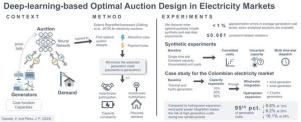
基于深度学习的电力市场最优竞价设计
拍卖是电力市场广泛采用的一种机制,可让中央营运商确保以具成本效益的方式满足电力需求。最近,悔恨网框架被提出用深度学习方法来解决最优拍卖设计问题。在本文中,我们扩展了这个框架来发现电力拍卖的近最优设计。这可以通过以下方式实现:(i)改变神经网络架构,以确定分配的单元数量并纳入需求约束;(ii)将信息租金作为生产者获取个人理性的成本的一部分;(iii)引入无界利润函数来处理容量受限的发电机组;(iv)放宽学习问题,以处理能力和激励相容的限制;(5)在学习问题中增加约束来处理相关的单位成本。这些扩展使我们能够考虑:(1)不确定的产能和需求,可能是由于供应故障或风能-太阳能整合;(ii)季节性影响或冲击造成的相关单位成本;(iii)异构多时隙调度,捕捉时变发电成本。通过实验,我们证明该方法能够恢复已知的解析解,实现精确的成本级近似(误差<;1%)和最小的约束违反(≤0.001)。最后,我们运用该方法对哥伦比亚批发电力市场的可再生能源整合效果进行了评估。这些结果强调了该方法支持电力市场设计的能力,该设计考虑了发电机的技术特性、其容量和成本的不确定性以及其战略行为。
本文章由计算机程序翻译,如有差异,请以英文原文为准。
求助全文
约1分钟内获得全文
求助全文
来源期刊
Energy Economics
ECONOMICS-
CiteScore
18.60
自引率
12.50%
发文量
524
期刊介绍:
Energy Economics is a field journal that focuses on energy economics and energy finance. It covers various themes including the exploitation, conversion, and use of energy, markets for energy commodities and derivatives, regulation and taxation, forecasting, environment and climate, international trade, development, and monetary policy. The journal welcomes contributions that utilize diverse methods such as experiments, surveys, econometrics, decomposition, simulation models, equilibrium models, optimization models, and analytical models. It publishes a combination of papers employing different methods to explore a wide range of topics. The journal's replication policy encourages the submission of replication studies, wherein researchers reproduce and extend the key results of original studies while explaining any differences. Energy Economics is indexed and abstracted in several databases including Environmental Abstracts, Fuel and Energy Abstracts, Social Sciences Citation Index, GEOBASE, Social & Behavioral Sciences, Journal of Economic Literature, INSPEC, and more.
 求助内容:
求助内容: 应助结果提醒方式:

 京公网安备 11010802042870号


