
Thermal curing of Tung oil for hydrophobic and recyclable cellulose-based packaging
IF 6.2
1区 农林科学
Q1 AGRICULTURAL ENGINEERING
Industrial Crops and Products
Pub Date : 2026-03-15
Epub Date: 2026-02-11
DOI:10.1016/j.indcrop.2026.122858
引用次数: 0
Abstract
The extensive use of synthetic plastic-based materials in packaging raises serious environmental and health concerns, driving the search for sustainable alternatives. Cellulose, as a renewable bio-based polymer, presents a promising solution; however, its hydrophilicity restricts its application in moisture-sensitive environments. The incorporation of bio-based coatings can enhance water resistance, yet scalable and efficient strategies remain a challenge in the food and beverage packaging sector. In this study, we present a fully bio-based coating system based on thermally polymerized Tung oil for producing functional cellulose-based materials with enhanced hydrophobicity. The influence of coating thickness, curing temperature, and curing time was investigated through ATR-FTIR, DSC, and TGA analyses, identifying 170 °C for 20 min as the optimal condition to achieve total crosslinking. After dispersion in dimethyl carbonate, Tung oil was applied to cellulose sheets and thermally cured, resulting in significantly improved water repellence while complying with European food contact regulations, as demonstrated by migration tests. Notably, the system was successfully integrated into commercial cellulose substrates, enabling the thermo-forming of 3D structures. Even at only 1 w/w % Tung oil loading, the water absorption of cellulose cups decreased by over 90 % compared to uncoated samples. Furthermore, recyclability tests confirmed that the thermo-formed cellulose objects treated with Tung oil remain completely recyclable into the paper stream. This study proposes a sustainable and potentially scalable strategy for the production of fully bio-based, recyclable, food compliant, and hydrophobic cellulose-based materials, offering a promising alternative to conventional plastic-based materials.
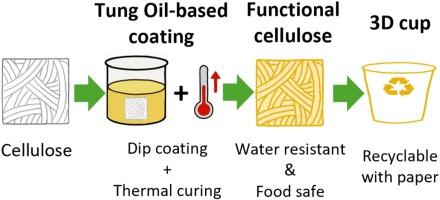
疏水和可回收纤维素基包装用桐油的热固化
在包装中广泛使用合成塑料基材料引起了严重的环境和健康问题,促使人们寻找可持续的替代品。纤维素作为一种可再生的生物基聚合物,是一种很有前途的解决方案;然而,其亲水性限制了其在水分敏感环境中的应用。生物基涂料的结合可以增强耐水性,但可扩展和高效的策略仍然是食品和饮料包装领域的一个挑战。在这项研究中,我们提出了一种基于热聚合桐油的全生物基涂层体系,用于生产具有增强疏水性的功能性纤维素基材料。通过ATR-FTIR、DSC和TGA分析,考察了涂层厚度、固化温度和固化时间的影响,确定170°C、20 min是实现全交联的最佳条件。在碳酸二甲酯中分散后,将桐油涂在纤维素片上并进行热固化,结果显着提高了拒水性,同时符合欧洲食品接触法规,这是由迁移测试证明的。值得注意的是,该系统成功地集成到商用纤维素基质中,实现了3D结构的热成型。即使只有1 w/w %的桐油负荷,纤维素杯的吸水率也比未涂覆的样品下降了90% %以上。此外,可回收性测试证实,用桐油处理的热形成的纤维素物体仍然完全可回收到纸流中。这项研究提出了一种可持续的、潜在的可扩展策略,用于生产完全生物基的、可回收的、符合食品要求的、疏水的纤维素基材料,为传统的塑料基材料提供了一种有前途的替代品。
本文章由计算机程序翻译,如有差异,请以英文原文为准。
求助全文
约1分钟内获得全文
求助全文
来源期刊
Industrial Crops and Products
农林科学-农业工程
CiteScore
9.50
自引率
8.50%
发文量
1518
审稿时长
43 days
期刊介绍:
Industrial Crops and Products is an International Journal publishing academic and industrial research on industrial (defined as non-food/non-feed) crops and products. Papers concern both crop-oriented and bio-based materials from crops-oriented research, and should be of interest to an international audience, hypothesis driven, and where comparisons are made statistics performed.
 求助内容:
求助内容: 应助结果提醒方式:

 京公网安备 11010802042870号


