
An information-motivation-behavioral skills model-based intervention for Parkinson's Disease Patients
IF 4.3
3区 医学
Q2 CLINICAL NEUROLOGY
Parkinsonism & related disorders
Pub Date : 2026-04-01
Epub Date: 2026-02-10
DOI:10.1016/j.parkreldis.2026.108231
引用次数: 0
Abstract
Background
Intervention based on the information-motivation-behavioral skills (IMB) model have been applied in the self-management of patients with chronic diseases and achieved ideal results, but there were few reports on the application of this model in PD patients.
Objective
To evaluate the effectiveness of the IMB model-based intervention in improving medication adherence, self-health management abilities, and quality of life (QoL) in PD patients.
Methods
A total of 70 patients were randomly divided into the control group and the intervention group. The intervention group received IMB model-based health education, while the control group received routine health education only. The effectiveness of the intervention was evaluated by measuring medication adherence, self-management ability and QoL at 3 months and 6 months after the intervention.
Results
For medication adherence, at 3 months, medication adherence improved in both groups but showed no significant inter-group difference (P > 0.05). At 6 months, medication adherence in the intervention group was significantly higher than in the control group (P < 0.05). Self-health management scores significantly increased over time in both groups, and the intervention group demonstrated significantly greater improvement at both 3 months and 6 months (P < 0.05). While PDQ-39 scores showed no significant difference at 3 months (P > 0.05), the intervention group exhibited significantly greater improvement in QoL at 6 months (P < 0.05).
Conclusion
IMB model-based health education takes into account patients' knowledge, motivation and behavioral skills, providing a structured and individualized intervention. It is a valuable approach for improving long-term medication adherence, enhancing self-management abilities, and ultimately boosting the QoL in PD patients.
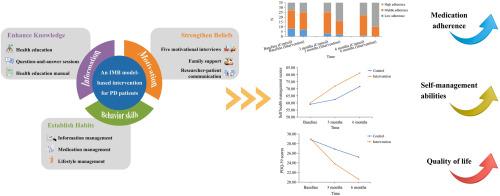
基于信息-动机-行为技能模型的帕金森病患者干预研究
基于信息-动机-行为技能(IMB)模型的干预已被应用于慢性疾病患者的自我管理并取得了理想的效果,但该模型在PD患者中的应用报道较少。目的评价基于IMB模型的干预对改善PD患者服药依从性、自我健康管理能力和生活质量的效果。方法将70例患者随机分为对照组和干预组。干预组接受基于IMB模型的健康教育,对照组仅接受常规健康教育。通过干预后3个月和6个月的药物依从性、自我管理能力和生活质量来评估干预的有效性。结果在药物依从性方面,3个月时,两组患者的药物依从性均有所改善,但组间差异无统计学意义(P > 0.05)。6个月时,干预组药物依从性显著高于对照组(P < 0.05)。两组患者的自我健康管理评分均随时间推移而显著提高,干预组在3个月和6个月时均有显著提高(P < 0.05)。3个月时PDQ-39评分差异无统计学意义(P > 0.05), 6个月时干预组生活质量改善显著(P < 0.05)。结论基于imb模型的健康教育考虑了患者的知识、动机和行为技能,提供了结构化和个性化的干预。对于改善PD患者的长期服药依从性,提高自我管理能力,最终提高PD患者的生活质量是一种有价值的途径。
本文章由计算机程序翻译,如有差异,请以英文原文为准。
求助全文
约1分钟内获得全文
求助全文
来源期刊
Parkinsonism & related disorders
医学-临床神经学
CiteScore
6.20
自引率
4.90%
发文量
292
审稿时长
39 days
期刊介绍:
Parkinsonism & Related Disorders publishes the results of basic and clinical research contributing to the understanding, diagnosis and treatment of all neurodegenerative syndromes in which Parkinsonism, Essential Tremor or related movement disorders may be a feature. Regular features will include: Review Articles, Point of View articles, Full-length Articles, Short Communications, Case Reports and Letter to the Editor.
 求助内容:
求助内容: 应助结果提醒方式:

 京公网安备 11010802042870号


