
When to stop? A single center experience on vacuum-assisted deliveries
IF 1.9
4区 医学
Q2 OBSTETRICS & GYNECOLOGY
European journal of obstetrics, gynecology, and reproductive biology
Pub Date : 2026-03-25
Epub Date: 2026-02-06
DOI:10.1016/j.ejogrb.2026.114983
引用次数: 0
Abstract
Objective
To evaluate the association between vacuum-assisted vaginal delivery (VAVD) duration and procedural failure and neonatal morbidity, including major neonatal birth trauma, and to assess independent predictors of failed VAVD.
Methods
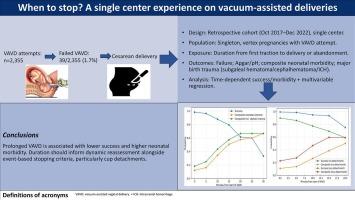
Retrospective cohort study of singleton, vertex pregnancies undergoing a trial of VAVD at a single center. VAVD duration was defined as time from first traction to delivery (successful VAVD) or to the decision to abandon the attempt (failed VAVD). Neonatal morbidity included Apgar scores and arterial pH, and major birth trauma outcomes were extracted from neonatal records. Multivariable logistic regression was performed to identify independent predictors of failed VAVD.
Results
Among 2,355 VAVD attempts, 39 (1.7%) failed and all were delivered by cesarean. Failed VAVD had substantially higher cup detachment rates (61.5% vs 9%, p < 0.001) and longer duration (median 12 vs 4 min, p < 0.001). Neonatal outcomes were worse in failed VAVD, including higher rates of low 1-minute Apgar, low 5-minute Apgar, low arterial pH, and composite neonatal morbidity. Major birth trauma extraction identified higher subgaleal hematoma rates in failed VAVD, while intracranial bleeding was not documented. In time-dependent analyses, success declined from 98.3% at commencement to 61.5% at 20 min, whereas composite neonatal morbidity increased from 12.2% to 57.7%. In multivariable analysis, cup detachment, induction of labor, lower head station, and longer duration independently predicted failure.
Conclusion
Prolonged VAVD is associated with lower success and higher neonatal morbidity. Duration should inform dynamic reassessment alongside event-based stopping criteria, particularly cup detachments.
什么时候停止?真空辅助分娩的单中心体验
目的评价真空辅助阴道分娩(VAVD)持续时间与手术失败和新生儿发病率(包括新生儿重大分娩创伤)的关系,并评估VAVD失败的独立预测因素。方法回顾性队列研究单中心单胎、顶点妊娠的VAVD试验。VAVD持续时间定义为从第一次牵引到分娩(VAVD成功)或决定放弃尝试(VAVD失败)的时间。新生儿发病率包括阿普加评分和动脉pH值,并从新生儿记录中提取主要的分娩创伤结局。采用多变量逻辑回归来确定VAVD失败的独立预测因素。结果2355例VAVD尝试中,39例(1.7%)失败,均为剖宫产。失败的VAVD有更高的杯脱离率(61.5% vs 9%, p < 0.001)和更长的持续时间(中位12 vs 4分钟,p < 0.001)。VAVD失败的新生儿结局更差,包括低1分钟Apgar、低5分钟Apgar、低动脉pH和新生儿综合发病率更高。重大出生创伤提取术发现失败的VAVD的galeal下血肿率较高,而颅内出血未见记录。在时间依赖性分析中,成功率从开始时的98.3%下降到20分钟时的61.5%,而新生儿综合发病率从12.2%上升到57.7%。在多变量分析中,胎杯脱离、引产、较低的头位和较长的持续时间独立预测了失败。结论延长VAVD成功率低,新生儿发病率高。持续时间应告知动态重新评估与事件为基础的停止标准,特别是杯分离。
本文章由计算机程序翻译,如有差异,请以英文原文为准。
求助全文
约1分钟内获得全文
求助全文
来源期刊
CiteScore
4.60
自引率
3.80%
发文量
898
审稿时长
8.3 weeks
期刊介绍:
The European Journal of Obstetrics & Gynecology and Reproductive Biology is the leading general clinical journal covering the continent. It publishes peer reviewed original research articles, as well as a wide range of news, book reviews, biographical, historical and educational articles and a lively correspondence section. Fields covered include obstetrics, prenatal diagnosis, maternal-fetal medicine, perinatology, general gynecology, gynecologic oncology, uro-gynecology, reproductive medicine, infertility, reproductive endocrinology, sexual medicine and reproductive ethics. The European Journal of Obstetrics & Gynecology and Reproductive Biology provides a forum for scientific and clinical professional communication in obstetrics and gynecology throughout Europe and the world.
 求助内容:
求助内容: 应助结果提醒方式:

 京公网安备 11010802042870号


