
Molecularly imprinted “on-off” ratiometric fluorescence paper-based sensor for rapid and visual detection of sulfamethoxazole
IF 4.6
2区 化学
Q1 SPECTROSCOPY
Spectrochimica Acta Part A: Molecular and Biomolecular Spectroscopy
Pub Date : 2026-05-15
Epub Date: 2026-02-05
DOI:10.1016/j.saa.2026.127556
引用次数: 0
Abstract
The overuse of sulfonamide drugs has led to serious ecological problems. A “on-off” ratiometric fluorescence paper-based sensor was developed based on molecularly imprinted polymers (MIPs).This sensor integrates the high specificity of the MIP with the high sensitivity and visual detection capabilities of ratiometric fluorescence and has significant advantages in terms of detection limit and anti-interference ability for the detection of sulfamethoxazole (SMZ) residues in animal-derived foods. A visual detection system was established by coupling the sensor with a smartphone. The results showed that a linear relationship was observed between the SMZ concentration in the range of 0.01–20.00 μM and the fluorescence intensity ratio (F630/F550) (R2 = 0.9970). The detection limit was determined to be 67.9 nM. The spiked recovery rates ranged from 94.30% to 101.06%, with a relative standard deviation of less than 3.02%. The developed method has the advantages of simple operation and low cost, providing a feasible solution for the rapid detection of sulfonamide drug residues and having a promising practical application prospect.
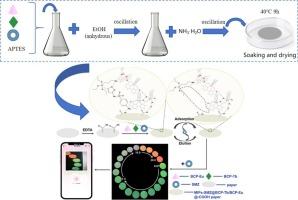
用于磺胺甲恶唑快速和视觉检测的分子印迹“开-关”比率荧光纸传感器
磺胺类药物的过度使用导致了严重的生态问题。研制了一种基于分子印迹聚合物(MIPs)的“开关”比率荧光纸传感器。该传感器将MIP的高特异性与比例荧光的高灵敏度和视觉检测能力相结合,在动物源性食品中磺胺甲恶唑(SMZ)残留检测的检出限和抗干扰能力方面具有显著优势。通过将传感器与智能手机耦合,建立了视觉检测系统。结果表明,SMZ浓度在0.01 ~ 20.00 μM范围内与荧光强度比(F630/F550)呈线性关系(R2 = 0.9970)。检测限为67.9 nM。加标回收率为94.30% ~ 101.06%,相对标准偏差小于3.02%。该方法操作简单,成本低,为磺胺类药物残留的快速检测提供了可行的解决方案,具有良好的实际应用前景。
本文章由计算机程序翻译,如有差异,请以英文原文为准。
求助全文
约1分钟内获得全文
求助全文
来源期刊
CiteScore
8.40
自引率
11.40%
发文量
1364
审稿时长
40 days
期刊介绍:
Spectrochimica Acta, Part A: Molecular and Biomolecular Spectroscopy (SAA) is an interdisciplinary journal which spans from basic to applied aspects of optical spectroscopy in chemistry, medicine, biology, and materials science.
The journal publishes original scientific papers that feature high-quality spectroscopic data and analysis. From the broad range of optical spectroscopies, the emphasis is on electronic, vibrational or rotational spectra of molecules, rather than on spectroscopy based on magnetic moments.
Criteria for publication in SAA are novelty, uniqueness, and outstanding quality. Routine applications of spectroscopic techniques and computational methods are not appropriate.
Topics of particular interest of Spectrochimica Acta Part A include, but are not limited to:
Spectroscopy and dynamics of bioanalytical, biomedical, environmental, and atmospheric sciences,
Novel experimental techniques or instrumentation for molecular spectroscopy,
Novel theoretical and computational methods,
Novel applications in photochemistry and photobiology,
Novel interpretational approaches as well as advances in data analysis based on electronic or vibrational spectroscopy.
 求助内容:
求助内容: 应助结果提醒方式:

 京公网安备 11010802042870号


