
Coupling Ni exposure with interfacial oxygen on Zr-doped CeO₂ for stable dry reforming of methane
IF 9
1区 工程技术
Q1 ENGINEERING, CHEMICAL
Separation and Purification Technology
Pub Date : 2026-06-19
Epub Date: 2026-02-09
DOI:10.1016/j.seppur.2026.137164
引用次数: 0
Abstract
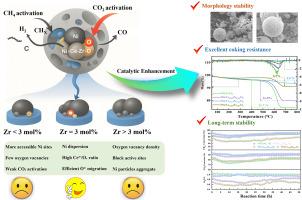
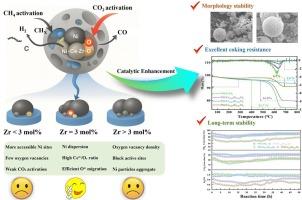
Dry reforming of methane (DRM) co-converts CH₄ and CO₂ but is limited by Ni sintering and carbon deposition at high temperature. CeO₂-based supports with oxygen vacancies can mitigate these issues, and Zr doping further tunes defect chemistry and basicity, yet the combined roles of Zr content, Ni exposure and pore architecture in governing interfacial oxygen supply and stability remain unclear. Spherical CeO₂ with interconnected through-pores and narrow mesopores is used as a common scaffold to prepare 5Ni/Ce₁₋ₓZrₓO₂ catalysts (Zr = 0, 1, 3 and 7 mol%) at fixed Ni loading and morphology. XRD, Raman and XPS confirm homogeneous Ce₁₋ₓZrₓO₂ solid solutions and show that, within the investigated Zr range, 3 mol% Zr gives the highest Ce3+ fraction and defect related surface oxygen while maintaining a moderate Ni particle size. CO₂ TPD, O₂ TPD, H₂ TPR and H₂ TPD further indicate that medium strength basic sites, interfacial reducible oxygen and accessible Ni sites are best balanced at 3 mol% Zr among the studied compositions. Under DRM at 800 °C, 5Ni/Ce₀․₉₇Zr₀․₀₃O₂ shows the highest CH₄ and CO₂ conversions, the lowest apparent activation energy, an H₂/CO ratio near 1.0 and the lowest coke amount over 50 h. Post-reaction XRD, TG–DTG, Raman and SEM suggest reduced Ni sintering and a larger fraction of filamentous or weakly bound carbon. These results are consistent with the importance of the Ni–Ce–Zr–O interfacial structure in balancing Ni exposure and oxygen supply, enabling high activity with low coking.
zr掺杂CeO 2上Ni与界面氧耦合暴露对甲烷稳定干重整的影响
甲烷(DRM)干法重整可将CH₄和CO₂共转化,但在高温下受Ni烧结和碳沉积的限制。含氧空位的ce2基支架可以缓解这些问题,Zr掺杂进一步调节缺陷的化学性质和碱度,但Zr含量、Ni暴露和孔隙结构在控制界面氧供应和稳定性中的综合作用尚不清楚。采用具有连通通孔和窄介孔的球形CeO₂作为普通支架,制备了固定Ni负载和形态下的5Ni/Ce₁(0、1、3和7 mol%)催化剂(Zr = 0、1、3和7)。XRD、Raman和XPS证实了Ce₁₁ₓZrₓO₂固溶体均相,并表明在所研究的Zr范围内,3 mol% Zr给出了最高的Ce3+分数和与缺陷相关的表面氧,同时保持了中等的Ni粒度。CO₂TPD、O₂TPD、H₂TPR和H₂TPD进一步表明,在3 mol% Zr时,所研究的组分中中等强度碱性位点、界面可还原氧位点和可接近Ni位点的平衡效果最好。在800 ℃的DRM条件下,5Ni/Ce₀。₉₇Zr₀。₀₃O₂转化率最高,表观活化能最低,H₂/CO比接近1.0,焦炭量最低,≥50 H。反应后的XRD, TG-DTG, Raman和SEM表明,Ni烧结还原,丝状或弱结合碳的比例较大。这些结果与Ni - ce - zr - o界面结构在平衡Ni暴露和氧供应方面的重要性相一致,从而实现高活性和低结焦。
本文章由计算机程序翻译,如有差异,请以英文原文为准。
求助全文
约1分钟内获得全文
求助全文
来源期刊
Separation and Purification Technology
工程技术-工程:化工
CiteScore
14.00
自引率
12.80%
发文量
2347
审稿时长
43 days
期刊介绍:
Separation and Purification Technology is a premier journal committed to sharing innovative methods for separation and purification in chemical and environmental engineering, encompassing both homogeneous solutions and heterogeneous mixtures. Our scope includes the separation and/or purification of liquids, vapors, and gases, as well as carbon capture and separation techniques. However, it's important to note that methods solely intended for analytical purposes are not within the scope of the journal. Additionally, disciplines such as soil science, polymer science, and metallurgy fall outside the purview of Separation and Purification Technology. Join us in advancing the field of separation and purification methods for sustainable solutions in chemical and environmental engineering.
 求助内容:
求助内容: 应助结果提醒方式:

 京公网安备 11010802042870号


