
Microbiota modulate metformin phytoremediation and stress responses in Lemna minor
IF 11.3
1区 环境科学与生态学
Q1 ENGINEERING, ENVIRONMENTAL
Journal of Hazardous Materials
Pub Date : 2026-03-01
Epub Date: 2026-02-10
DOI:10.1016/j.jhazmat.2026.141427
引用次数: 0
Abstract
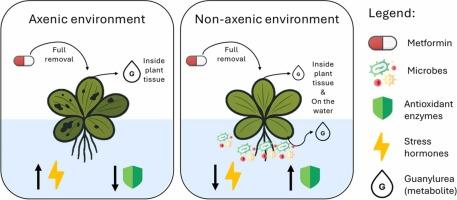
The phytoremediation of pharmaceuticals by aquatic plants is influenced by both plant physiology and microbial interactions. This study investigated how microbial symbiosis modulates the uptake, transformation, and physiological responses of Lemna minor to metformin. Plants were cultivated under axenic and non-axenic conditions and exposed to 10, 50, and 100 µg/L metformin for 7 days. Both systems removed > 99 % of metformin from water, but exhibited distinct accumulation patterns, stress biomarkers, and metabolic profiles. Axenic plants accumulated 2.1-fold more metformin and 1.7-fold more guanylurea, a key metformin metabolite, at 100 µg/L, along with increased oxidative stress (↑MDA) and elevated cytochrome P450 activity. Non-axenic systems exhibited extracellular guanylurea concentrations up to 0.9 µg/L, indicating a reliance on intrinsic detoxification pathways. Guanylurea was detected in both plant types, but appeared in water only under non-axenic conditions, suggesting microbial-mediated excretion. Principal component analysis revealed that guanylurea accumulation was correlated with elevated P450 activity, lipid peroxidation, and hormonal shifts, especially in axenic plants. These results confirmed that L. minor can biotransform metformin independently of microbes, albeit with a greater physiological burden. Microbial presence mitigates stress and enhances extracellular degradation. Overall, the data demonstrate complementary roles of plants and microbiota, with microbiota reducing internal contaminant load and protecting plant homeostasis.
微生物群调节二甲双胍的植物修复和小柠檬的胁迫反应
水生植物对药物的植物修复受到植物生理和微生物相互作用的双重影响。本研究探讨了微生物共生如何调节小茴香对二甲双胍的摄取、转化和生理反应。植物在无氧和非无氧条件下培养,分别暴露于10、50和100µg/L二甲双胍中7天。两种系统都能从水中去除99%的二甲双胍,但表现出不同的积累模式、应激生物标志物和代谢谱。当浓度为100µg/L时,无性系植物的二甲双胍累积量增加2.1倍,鸟嘌呤累积量增加1.7倍,同时氧化应激(↑MDA)增加,细胞色素P450活性升高。非无菌系统显示胞外胍脲浓度高达0.9 μ g/L,表明依赖于内在解毒途径。冠脲是二甲双胍的关键代谢物,在两种植物中均检测到,但仅在非无菌条件下出现在水中,提示微生物介导的排泄。主成分分析表明,冠脲醛积累与P450活性升高、脂质过氧化和激素变化有关,特别是在不育植物中。这些结果证实,小乳杆菌可以独立于微生物生物转化二甲双胍,尽管生理负担更大。微生物的存在减轻了压力,增强了细胞外降解。总的来说,数据表明植物和微生物群的互补作用,微生物群减少内部污染物负荷和保护植物体内平衡。
本文章由计算机程序翻译,如有差异,请以英文原文为准。
求助全文
约1分钟内获得全文
求助全文
来源期刊
Journal of Hazardous Materials
工程技术-工程:环境
CiteScore
25.40
自引率
5.90%
发文量
3059
审稿时长
58 days
期刊介绍:
The Journal of Hazardous Materials serves as a global platform for promoting cutting-edge research in the field of Environmental Science and Engineering. Our publication features a wide range of articles, including full-length research papers, review articles, and perspectives, with the aim of enhancing our understanding of the dangers and risks associated with various materials concerning public health and the environment. It is important to note that the term "environmental contaminants" refers specifically to substances that pose hazardous effects through contamination, while excluding those that do not have such impacts on the environment or human health. Moreover, we emphasize the distinction between wastes and hazardous materials in order to provide further clarity on the scope of the journal. We have a keen interest in exploring specific compounds and microbial agents that have adverse effects on the environment.
 求助内容:
求助内容: 应助结果提醒方式:

 京公网安备 11010802042870号


