
Spectral-band-selective multidimensional nuclear magnetic resonance spectroscopy using broadband dipolar recoupling schemes
IF 2.1
3区 化学
Q3 BIOCHEMICAL RESEARCH METHODS
Journal of magnetic resonance
Pub Date : 2026-03-01
Epub Date: 2026-02-04
DOI:10.1016/j.jmr.2026.108022
引用次数: 0
Abstract
Nuclear magnetic resonance (NMR) spectroscopy is an important analytical tool for probing molecular structures and interactions. For high complexity samples, multidimensional spectroscopy is essential for improving the resolution of NMR data. However, multidimensional experiments cost significant experimental time which scales with the number of indirect points. This is particularly challenging when dealing with highly dispersed nuclei, such as 13C, due to the large chemical shift range, with large regions that are spectrally empty. Herein, we describe a method for limiting the spectral width of dipolar based multidimensional NMR experiments in the indirect dimension in a manner that can be easily integrated into relaxation and distance measuring schemes. We demonstrate the acquisition of narrow strips of broadband homonuclear recoupling 13C-13C correlation spectra on a range of biomolecular and cellular samples, allowing targeted acquisition of high-resolution spectra of the region of interest with a significant reduction in the acquisition time. We also demonstrate the use of the spectral-band-selective method for allowing fast acquisition of RFDR build-up experiments. The band-selective method is easy to implement in any dipolar-based multidimensional pulse sequence by an addition of one pulse per band-selected indirect dimension and a slight modification of the phase cycle.
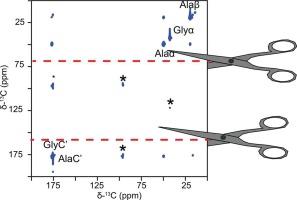
使用宽带偶极重耦合方案的光谱带选择性多维核磁共振波谱学。
核磁共振波谱是探测分子结构和相互作用的重要分析工具。对于高复杂性的样品,多维光谱技术对于提高核磁共振数据的分辨率至关重要。然而,多维实验耗费大量的实验时间,且实验时间与间接点的数量成正比。这在处理高度分散的原子核(如13C)时尤其具有挑战性,因为化学位移范围大,光谱上的大区域是空的。在此,我们描述了一种在间接维度上限制基于偶极子的多维核磁共振实验光谱宽度的方法,这种方法可以很容易地集成到弛豫和距离测量方案中。我们展示了在一系列生物分子和细胞样品上获取宽带同核重耦合13C-13C相关光谱的窄带,允许有针对性地获取感兴趣区域的高分辨率光谱,同时显著减少了采集时间。我们还演示了使用频谱波段选择方法来允许快速获取RFDR构建实验。在任何基于偶极子的多维脉冲序列中,通过在每个带选间接维中增加一个脉冲和稍微修改相位周期,可以很容易地实现带选择方法。
本文章由计算机程序翻译,如有差异,请以英文原文为准。
求助全文
约1分钟内获得全文
求助全文
来源期刊
CiteScore
3.80
自引率
13.60%
发文量
150
审稿时长
69 days
期刊介绍:
The Journal of Magnetic Resonance presents original technical and scientific papers in all aspects of magnetic resonance, including nuclear magnetic resonance spectroscopy (NMR) of solids and liquids, electron spin/paramagnetic resonance (EPR), in vivo magnetic resonance imaging (MRI) and spectroscopy (MRS), nuclear quadrupole resonance (NQR) and magnetic resonance phenomena at nearly zero fields or in combination with optics. The Journal''s main aims include deepening the physical principles underlying all these spectroscopies, publishing significant theoretical and experimental results leading to spectral and spatial progress in these areas, and opening new MR-based applications in chemistry, biology and medicine. The Journal also seeks descriptions of novel apparatuses, new experimental protocols, and new procedures of data analysis and interpretation - including computational and quantum-mechanical methods - capable of advancing MR spectroscopy and imaging.
 求助内容:
求助内容: 应助结果提醒方式:

 京公网安备 11010802042870号


