
Three-level gradient design for high-performance waterborne sodium silicate wood coatings and the interfacial bonding mechanism
IF 6.9
2区 材料科学
Q2 CHEMISTRY, PHYSICAL
Applied Surface Science
Pub Date : 2026-06-01
Epub Date: 2026-02-08
DOI:10.1016/j.apsusc.2026.166216
引用次数: 0
Abstract
To address the limitations of conventional sodium silicate coatings—high water solubility, poor adhesion, and single functionality, this study introduces a three-stage gradient strategy of “molecular bridging-micropore filling-functional coupling.” Using a sodium silicate solution as the base material, a sodium silicate-polyvinyl alcohol composite coating was prepared via organic–inorganic hybridization. Further, the modified coating was strengthened by introducing nano-SiO2 modified with silane coupling agent KH550, thus constructing a high-performance water-based composite coating system. Results show that through the molecular regulation of KH550, spatial orientation of its organic and inorganic ends is achieved, effectively suppressing nano-SiO2 agglomeration and establishing a molecular-level connection at the wood-coating interface; Nano-SiO2 fill coating micropores, significantly increasing cross-linking density and mechanical properties; Through the synergistic effect of the Nano-SiO2/PVA/2NH2-PDMS composite system, a “rigid Si-O-Si and type siloxane” dual-network structure is constructed, addressing the shortcomings of traditional coatings being hard and brittle; The composite exhibits outstanding performance: enhanced mechanical properties (wear resistance: 0.083 g/r, hardness: 6H), adhesion meeting Grade 1 standard, essentially no residual contamination from cola, soy sauce, or sesame oil, and rapid, smokeless self-extinguishment. It fully meets application requirements in furniture, interior decoration, and construction, offering a new approach for high-value utilization of bio-based materials.
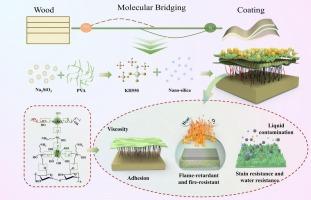
高性能水性硅酸钠木器涂料的三级梯度设计及界面结合机理
为了解决传统硅酸钠涂层水溶性高、附着力差、功能单一的局限性,本研究引入了“分子桥接-微孔填充-功能耦合”的三阶段梯度策略。以硅酸钠溶液为基材,通过有机-无机杂化法制备了硅酸钠-聚乙烯醇复合涂层。通过引入硅烷偶联剂KH550改性的纳米sio2对改性涂层进行强化,构建了高性能的水基复合涂层体系。结果表明:通过对KH550的分子调控,实现了其有机端和无机端空间取向,有效抑制了纳米sio2团聚,并在木漆界面处建立了分子水平的连接;纳米sio2填充涂层微孔,显著提高交联密度和力学性能;通过纳米sio2 /PVA/2NH2-PDMS复合体系的协同作用,构建了“刚性Si-O-Si -型硅氧烷”双网络结构,解决了传统涂料硬脆的缺点;该复合材料具有优异的性能:增强的机械性能(耐磨性:0.083 g/r,硬度:6H),附着力达到一级标准,基本上没有可乐,酱油或香油的残留污染,快速,无烟自熄。完全满足家具、室内装饰、建筑等领域的应用需求,为生物基材料的高价值利用提供了一条新途径。
本文章由计算机程序翻译,如有差异,请以英文原文为准。
求助全文
约1分钟内获得全文
求助全文
来源期刊
Applied Surface Science
工程技术-材料科学:膜
CiteScore
12.50
自引率
7.50%
发文量
3393
审稿时长
67 days
期刊介绍:
Applied Surface Science covers topics contributing to a better understanding of surfaces, interfaces, nanostructures and their applications. The journal is concerned with scientific research on the atomic and molecular level of material properties determined with specific surface analytical techniques and/or computational methods, as well as the processing of such structures.
 求助内容:
求助内容: 应助结果提醒方式:

 京公网安备 11010802042870号


