
Constructed WS2-TiO2 model for robust interfacial charge transfer modulation via facet-dependent strategy

IF 6.9 2区 材料科学 Q2 CHEMISTRY, PHYSICAL
Applied Surface Science Pub Date : 2026-06-01 Epub Date: 2026-02-08 DOI:10.1016/j.apsusc.2026.166247
Yue Xing , Jianxin Hua , Wenzhe Fu , Miaomiao Xiang , Chenxi Huang , Kai Wu , Xiang Shao
{"title":"Constructed WS2-TiO2 model for robust interfacial charge transfer modulation via facet-dependent strategy","authors":"Yue Xing ,&nbsp;Jianxin Hua ,&nbsp;Wenzhe Fu ,&nbsp;Miaomiao Xiang ,&nbsp;Chenxi Huang ,&nbsp;Kai Wu ,&nbsp;Xiang Shao","doi":"10.1016/j.apsusc.2026.166247","DOIUrl":null,"url":null,"abstract":"<div><div>Regulating interfacial charge transfer is vital for the optoelectronic and photocatalytic applications of semiconductive heterostructures consisting of transition metal dichalcogenides (TMDCs) and transitional metal oxides (TMOs). This process typically relies on external field modulation and materials design. However, limited synthetic approaches and microscopic investigations have hindered the fundamental understanding of facet-dependent effects in TMDCs/TMO. In this study, we have fabricated the high-quality WS<sub>2</sub>/TiO<sub>2</sub> model system, combining monolayer WS<sub>2</sub> nanosheets on atomically flat rutile TiO<sub>2</sub> single-crystal substrates with distinct facets through a chemical vapor deposition (CVD) method. Photoluminescence (PL) spectroscopy shows that the excitonic response of WS<sub>2</sub> is facet-dependent, with A<sup>0</sup>/A<sup>−</sup> exciton ratio decreasing in the order (1<!--> <!-->0<!--> <!-->0) &gt; (1<!--> <!-->1<!--> <!-->0) &gt; (1<!--> <!-->1<!--> <!-->1) &gt; (0<!--> <!-->0<!--> <!-->1), indicating that charge transfer follows the evolution of crystallographic orientation. Kelvin probe force microscopy (KPFM) reveals the same sequence in interfacial electric fields, reflecting facet-dependent charge-transfer efficiency. Under ultraviolet illumination, the surface-potential dynamics further demonstrate enhanced interfacial charge transfer. A similar interfacial charge transfer regulation process has been further extended to the MoS<sub>2</sub>/TiO<sub>2</sub> system. These findings underline the oxide facet engineering as a potential strategy for optimizing the interfacial effect in TMDCs/TMO heterostructures, which also paves the way for their applications in energy conversion and catalysis.</div></div>","PeriodicalId":247,"journal":{"name":"Applied Surface Science","volume":"730 ","pages":"Article 166247"},"PeriodicalIF":6.9000,"publicationDate":"2026-06-01","publicationTypes":"Journal Article","fieldsOfStudy":null,"isOpenAccess":false,"openAccessPdf":"","citationCount":"0","resultStr":null,"platform":"Semanticscholar","paperid":null,"PeriodicalName":"Applied Surface Science","FirstCategoryId":"88","ListUrlMain":"https://www.sciencedirect.com/science/article/pii/S0169433226004514","RegionNum":2,"RegionCategory":"材料科学","ArticlePicture":[],"TitleCN":null,"AbstractTextCN":null,"PMCID":null,"EPubDate":"2026/2/8 0:00:00","PubModel":"Epub","JCR":"Q2","JCRName":"CHEMISTRY, PHYSICAL","Score":null,"Total":0}
引用次数: 0

Abstract

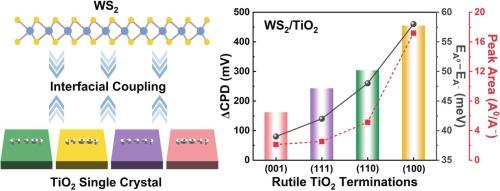
Regulating interfacial charge transfer is vital for the optoelectronic and photocatalytic applications of semiconductive heterostructures consisting of transition metal dichalcogenides (TMDCs) and transitional metal oxides (TMOs). This process typically relies on external field modulation and materials design. However, limited synthetic approaches and microscopic investigations have hindered the fundamental understanding of facet-dependent effects in TMDCs/TMO. In this study, we have fabricated the high-quality WS2/TiO2 model system, combining monolayer WS2 nanosheets on atomically flat rutile TiO2 single-crystal substrates with distinct facets through a chemical vapor deposition (CVD) method. Photoluminescence (PL) spectroscopy shows that the excitonic response of WS2 is facet-dependent, with A0/A exciton ratio decreasing in the order (1 0 0) > (1 1 0) > (1 1 1) > (0 0 1), indicating that charge transfer follows the evolution of crystallographic orientation. Kelvin probe force microscopy (KPFM) reveals the same sequence in interfacial electric fields, reflecting facet-dependent charge-transfer efficiency. Under ultraviolet illumination, the surface-potential dynamics further demonstrate enhanced interfacial charge transfer. A similar interfacial charge transfer regulation process has been further extended to the MoS2/TiO2 system. These findings underline the oxide facet engineering as a potential strategy for optimizing the interfacial effect in TMDCs/TMO heterostructures, which also paves the way for their applications in energy conversion and catalysis.
Abstract Image

基于面相关策略构建WS2-TiO2界面电荷转移调制模型
调节界面电荷转移对于过渡金属二硫族化合物(TMDCs)和过渡金属氧化物(TMOs)组成的半导体异质结构的光电和光催化应用至关重要。这一过程通常依赖于外场调制和材料设计。然而,有限的合成方法和微观研究阻碍了对TMDCs/TMO中面依赖性效应的基本理解。在这项研究中,我们通过化学气相沉积(CVD)方法,将单层WS2纳米片结合在具有不同表面的金红石型TiO2单晶衬底上,制备了高质量的WS2/TiO2模型体系。光致发光(PL)光谱显示WS2的激子响应是面相关的,A0/A−激子比依次递减,顺序为(1 0 0)> (1 1 0 0) > (1 1 1) >(0 0 0 1),表明电荷转移遵循晶体取向的演化。开尔文探针力显微镜(KPFM)在界面电场中显示了相同的序列,反映了面相关的电荷转移效率。在紫外线照射下,表面电位动力学进一步证明了界面电荷转移的增强。类似的界面电荷转移调节过程进一步扩展到MoS2/TiO2体系。这些发现强调了氧化面工程作为优化TMDCs/TMO异质结构界面效应的潜在策略,也为其在能量转换和催化方面的应用铺平了道路。
本文章由计算机程序翻译,如有差异,请以英文原文为准。
求助全文
约1分钟内获得全文 求助全文
来源期刊
Applied Surface Science
Applied Surface Science 工程技术-材料科学:膜
CiteScore
12.50
自引率
7.50%
发文量
3393
审稿时长
67 days
期刊介绍: Applied Surface Science covers topics contributing to a better understanding of surfaces, interfaces, nanostructures and their applications. The journal is concerned with scientific research on the atomic and molecular level of material properties determined with specific surface analytical techniques and/or computational methods, as well as the processing of such structures.

×
引用
GB/T 7714-2015
复制
MLA
复制
APA
复制
导出至
BibTeX EndNote RefMan NoteFirst NoteExpress
×
提示
您的信息不完整,为了账户安全,请先补充。
现在去补充
×
提示
您因"违规操作"
具体请查看互助需知
我知道了
×
提示
确定
请完成安全验证×
copy
已复制链接
快去分享给好友吧!
我知道了
右上角分享
点击右上角分享
0
联系我们:info@booksci.cn Book学术提供免费学术资源搜索服务,方便国内外学者检索中英文文献。致力于提供最便捷和优质的服务体验。 Copyright © 2023 布克学术 All rights reserved.
京ICP备2023020795号-1
ghs 京公网安备 11010802042870号
Book学术文献互助
Book学术文献互助群
群 号:604180095
Book学术官方微信
小红书


