
Ammonium salt-mediated antisolvent separation of valuable benzene pentacarboxylic and hexacarboxylic acids from the oxidative depolymerization product mixture of lignite
IF 5.1
2区 工程技术
Q2 ENGINEERING, CHEMICAL
Chemical Engineering Science
Pub Date : 2026-05-15
Epub Date: 2026-02-07
DOI:10.1016/j.ces.2026.123556
引用次数: 0
Abstract
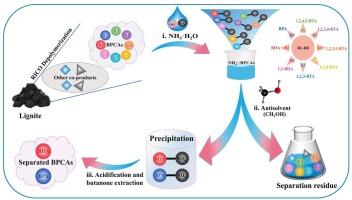
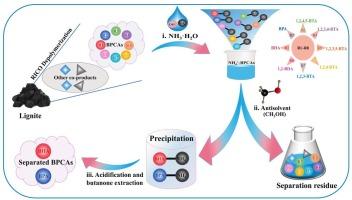
Oxidative depolymerization of lignite into valuable chemicals such as benzene polycarboxylic acids (BPCAs) is a potential pathway for the high-value and non-energy utilization of lignite. Up to now, the selective separation of BPCAs from the complex depolymerization product mixtures remains a huge challenge and impedes the development of this route. BPA and BHA are key platform molecules for constructing high performance and functional materials. In this work, based on the differences in physical and chemical properties of BPCAs, ammonium salt-mediated antisolvent separation of BPCAs from the depolymerization products mixture of lignite was developed. The effects of different separation parameters on the separation efficiency were systematically studied. The results showed that the route could selectively separate benzene hexacarboxylic acid (BHA) and benzene pentacarboxylic acid (BPA) from both the simulated solution and the real lignite depolymerization products. For the real system, the separation yields of BHA and BPA were 76.0 % and 90.0 %, respectively. BHA and BPA accounted for 93.0 % among all BPCAs in the separated solution, indicating an enhanced purity compared to the initial depolymerized product mixture. The antisolvent methanol had high selectivity for BHA and BPA, and the separation selectivity could be tuned by optimizing the ammonia dosage, antisolvent methanol dosage, and the pH of the mother solution. As far as we know, this is the first report fulfilling the selective separation of the valuable BHA and BPA from the real complex depolymerized product mixture of lignite. This work contributes new separation route to promote the depolymerization utilization of lignite.
铵盐介导反溶剂分离褐煤氧化解聚产物混合物中有价苯五羧酸和六羧酸
褐煤氧化解聚生成苯多羧酸(BPCAs)等有价值的化学物质是褐煤高价值和非能源利用的潜在途径。到目前为止,从复杂的解聚产物混合物中选择分离双聚物仍然是一个巨大的挑战,阻碍了这一途径的发展。BPA和BHA是构建高性能功能材料的关键平台分子。本研究基于褐煤解聚产物混合物中BPCAs的物理和化学性质的差异,研究了铵盐对BPCAs的反溶剂分离。系统研究了不同分离参数对分离效率的影响。结果表明,该方法可以从模拟溶液和实际褐煤解聚产物中选择性分离出六羧酸苯(BHA)和五羧酸苯(BPA)。在实际体系中,BHA和BPA的分离率分别为76.0 %和90.0 %。分离后的溶液中BHA和BPA占所有BPCAs的93.0 %,与初始解聚产物混合物相比,纯度有所提高。抗溶剂甲醇对BHA和BPA具有较高的选择性,可通过优化氨用量、抗溶剂甲醇用量和母液pH来调节分离选择性。据我们所知,这是第一个从真正复杂的褐煤解聚产物混合物中实现有价值的BHA和BPA选择性分离的报道。本研究为促进褐煤解聚利用提供了新的分离途径。
本文章由计算机程序翻译,如有差异,请以英文原文为准。
求助全文
约1分钟内获得全文
求助全文
来源期刊
Chemical Engineering Science
工程技术-工程:化工
CiteScore
7.50
自引率
8.50%
发文量
1025
审稿时长
50 days
期刊介绍:
Chemical engineering enables the transformation of natural resources and energy into useful products for society. It draws on and applies natural sciences, mathematics and economics, and has developed fundamental engineering science that underpins the discipline.
Chemical Engineering Science (CES) has been publishing papers on the fundamentals of chemical engineering since 1951. CES is the platform where the most significant advances in the discipline have ever since been published. Chemical Engineering Science has accompanied and sustained chemical engineering through its development into the vibrant and broad scientific discipline it is today.
 求助内容:
求助内容: 应助结果提醒方式:

 京公网安备 11010802042870号


