
Green ultrasound-assisted extraction for efficient carotenoid profiling of calamansi (Citrofortunella microcarpa)
IF 10.2
1区 化学
Q1 ACOUSTICS
Ultrasonics Sonochemistry
Pub Date : 2026-04-01
Epub Date: 2026-02-07
DOI:10.1016/j.ultsonch.2026.107764
引用次数: 0
Abstract
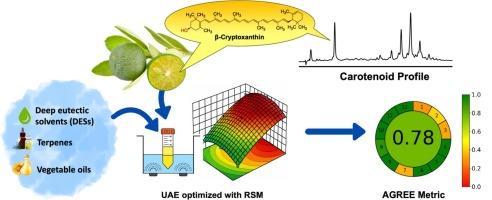
Calamansi (Citrofortunella microcarpa), a small citrus fruit valued for its unique flavor, is a rich source of bioactive carotenoids that have not yet been individually identified. An efficient carotenoid extraction method, together with knowledge of its carotenoid compositions, is essential to support broader utilization of this intriguing fruit. Herein, we present a sustainable and efficient carotenoid extraction method by integrating ultrasound-assisted extraction (UAE) with green solvent systems. Seven solvent systems were initially screened for their extraction efficiencies with and without UAE. Among them, a deep eutectic solvent, 1:1 menthol:camphor (Men:Cam), stood out as an effective solvent. Interestingly, UAE also dramatically improved the efficiency of edible oils, e.g., sunflower oil. Response surface methodology (RSM) was then employed to elucidate the correlations among parameters (solvent ratio, temperature, and time) that affect the extraction efficiency in selected systems. For example, the optimal condition for Men:Cam (1:2, 39 °C, 32 min) yielded predicted total carotenoid contents (1.87 ± 0.06 µg/mL) with only 10.4% deviation from experimental values, hence demonstrating the robustness of this approach. Importantly, liquid chromatography – mass spectrometry (LC-MS) revealed a unique carotenoid profile of calamansi juice, which consisted of lutein, β-cryptoxanthin, and their esterified derivatives (C10:0 – C18:0). Last but not least, greenness evaluation using the AGREE metric confirmed significant improvement of the optimized 1:1 Men:Cam system over the conventional extraction. Overall, this work demonstrates that UAE combined with green solvent systems is a practical tool for sustainable carotenoid extraction from valuable agricultural products.
绿色超声辅助提取菖蒲类胡萝卜素的高效谱分析
鱿鱼(Citrofortunella microcarpa)是一种小型柑橘类水果,因其独特的风味而受到重视,是生物活性类胡萝卜素的丰富来源,但尚未单独鉴定。一种有效的类胡萝卜素提取方法,连同其类胡萝卜素成分的知识,是必不可少的,以支持更广泛地利用这种有趣的水果。在此,我们提出了一种可持续和高效的类胡萝卜素提取方法,将超声辅助提取(UAE)与绿色溶剂系统相结合。对7种溶剂体系进行了初步筛选,以确定它们在加和不加UAE时的萃取效率。其中,深共晶溶剂薄荷醇:樟脑(Men:Cam)为一种有效溶剂。有趣的是,阿联酋还极大地提高了食用油的效率,例如葵花籽油。然后采用响应面法(RSM)阐明了在选定的体系中影响提取效率的参数(溶剂比、温度和时间)之间的相关性。例如,Men:Cam(1:2, 39°C, 32 min)的最佳条件产生的预测总类胡萝卜素含量(1.87±0.06µg/mL)与实验值的偏差仅为10.4%,从而证明了该方法的鲁棒性。重要的是,液相色谱-质谱(LC-MS)揭示了菖蒲汁独特的类胡萝卜素特征,它由叶黄素、β-隐黄质及其酯化衍生物(C10:0 - C18:0)组成。最后但并非最不重要的是,使用AGREE度量的绿色评估证实了优化的1:1 Men:Cam系统比传统提取有显着改善。总的来说,这项工作表明,阿联酋结合绿色溶剂系统是一个实用的工具,可持续的类胡萝卜素提取有价值的农产品。
本文章由计算机程序翻译,如有差异,请以英文原文为准。
求助全文
约1分钟内获得全文
求助全文
来源期刊
Ultrasonics Sonochemistry
化学-化学综合
CiteScore
15.80
自引率
11.90%
发文量
361
审稿时长
59 days
期刊介绍:
Ultrasonics Sonochemistry stands as a premier international journal dedicated to the publication of high-quality research articles primarily focusing on chemical reactions and reactors induced by ultrasonic waves, known as sonochemistry. Beyond chemical reactions, the journal also welcomes contributions related to cavitation-induced events and processing, including sonoluminescence, and the transformation of materials on chemical, physical, and biological levels.
Since its inception in 1994, Ultrasonics Sonochemistry has consistently maintained a top ranking in the "Acoustics" category, reflecting its esteemed reputation in the field. The journal publishes exceptional papers covering various areas of ultrasonics and sonochemistry. Its contributions are highly regarded by both academia and industry stakeholders, demonstrating its relevance and impact in advancing research and innovation.
 求助内容:
求助内容: 应助结果提醒方式:

 京公网安备 11010802042870号


