
The dual role of trace Cu in the corrosion mechanism of Zn4Al alloy: Insights from microstructural characterization and electrochemical performance

IF 6.9 2区 材料科学 Q2 CHEMISTRY, PHYSICAL
Applied Surface Science Pub Date : 2026-06-01 Epub Date: 2026-02-08 DOI:10.1016/j.apsusc.2026.166263
Hongxin Zhang , Hainan Wang , Chenfeng Pan , Wei Jian , Lu Ren
{"title":"The dual role of trace Cu in the corrosion mechanism of Zn4Al alloy: Insights from microstructural characterization and electrochemical performance","authors":"Hongxin Zhang ,&nbsp;Hainan Wang ,&nbsp;Chenfeng Pan ,&nbsp;Wei Jian ,&nbsp;Lu Ren","doi":"10.1016/j.apsusc.2026.166263","DOIUrl":null,"url":null,"abstract":"<div><div>Zn alloys are valued in casting for their low melting point, excellent casting performance, and dimensional stability. Zn-Al-Cu alloys offer outstanding mechanical properties, yet their corrosion behavior remains insufficiently studied. This work investigates the corrosion behavior of Zn4Al and Zn4Al0.5Cu alloys in 3.5 wt% NaCl solution, revealing changes in their microstructure and corrosion mechanisms. Results show that trace Cu addition refines the microstructure without forming Cu-related intermetallic compound, but creates significant potential difference between Cu-rich regions and the surrounding matrix. Polarization curves indicate the corrosion current density of Zn4Al0.5Cu (46.533 μA/cm<sup>2</sup>) is notably higher than Zn4Al (21.638 μA/cm<sup>2</sup>). In the electrochemical impedance spectrum, Zn4Al0.5Cu exhibits inductive behavior, confirming enhanced micro-galvanic effects. Electrochemical noise demonstrates that the localized corrosion growth probability of Zn4Al0.5Cu is suppressed at the early stage due to eutectic refinement. However, with prolonged exposure, insufficient stability of the corrosion product layer leads to the reinitiation of localized corrosion. Overall, the galvanic corrosion and corrosion product layer instability induced by Cu primarily contribute to reduced anti-corrosive properties. This study elucidates the dual role of trace Cu in the corrosion mechanism of Zn4Al alloy, offering a new theoretical foundation for the engineering application of Zn–based protective materials in corrosive environments.</div></div>","PeriodicalId":247,"journal":{"name":"Applied Surface Science","volume":"730 ","pages":"Article 166263"},"PeriodicalIF":6.9000,"publicationDate":"2026-06-01","publicationTypes":"Journal Article","fieldsOfStudy":null,"isOpenAccess":false,"openAccessPdf":"","citationCount":"0","resultStr":null,"platform":"Semanticscholar","paperid":null,"PeriodicalName":"Applied Surface Science","FirstCategoryId":"88","ListUrlMain":"https://www.sciencedirect.com/science/article/pii/S0169433226004678","RegionNum":2,"RegionCategory":"材料科学","ArticlePicture":[],"TitleCN":null,"AbstractTextCN":null,"PMCID":null,"EPubDate":"2026/2/8 0:00:00","PubModel":"Epub","JCR":"Q2","JCRName":"CHEMISTRY, PHYSICAL","Score":null,"Total":0}
引用次数: 0

Abstract

Zn alloys are valued in casting for their low melting point, excellent casting performance, and dimensional stability. Zn-Al-Cu alloys offer outstanding mechanical properties, yet their corrosion behavior remains insufficiently studied. This work investigates the corrosion behavior of Zn4Al and Zn4Al0.5Cu alloys in 3.5 wt% NaCl solution, revealing changes in their microstructure and corrosion mechanisms. Results show that trace Cu addition refines the microstructure without forming Cu-related intermetallic compound, but creates significant potential difference between Cu-rich regions and the surrounding matrix. Polarization curves indicate the corrosion current density of Zn4Al0.5Cu (46.533 μA/cm2) is notably higher than Zn4Al (21.638 μA/cm2). In the electrochemical impedance spectrum, Zn4Al0.5Cu exhibits inductive behavior, confirming enhanced micro-galvanic effects. Electrochemical noise demonstrates that the localized corrosion growth probability of Zn4Al0.5Cu is suppressed at the early stage due to eutectic refinement. However, with prolonged exposure, insufficient stability of the corrosion product layer leads to the reinitiation of localized corrosion. Overall, the galvanic corrosion and corrosion product layer instability induced by Cu primarily contribute to reduced anti-corrosive properties. This study elucidates the dual role of trace Cu in the corrosion mechanism of Zn4Al alloy, offering a new theoretical foundation for the engineering application of Zn–based protective materials in corrosive environments.

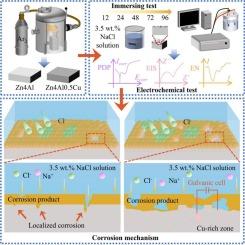
Abstract Image

Abstract Image

微量Cu在Zn4Al合金腐蚀机制中的双重作用:来自微观结构表征和电化学性能的见解
锌合金因其熔点低、铸造性能好、尺寸稳定等优点而在铸造中受到重视。Zn-Al-Cu合金具有优异的力学性能,但对其腐蚀行为的研究还不够充分。研究了Zn4Al和Zn4Al0.5Cu合金在3.5 wt% NaCl溶液中的腐蚀行为,揭示了它们的组织变化和腐蚀机理。结果表明,微量Cu的加入细化了合金的微观结构,但没有形成与Cu相关的金属间化合物,但在富Cu区和周围基体之间产生了显著的电位差。极化曲线表明,Zn4Al0.5Cu的腐蚀电流密度(46.533 μA/cm2)明显高于Zn4Al(21.638 μA/cm2)。在电化学阻抗谱中,Zn4Al0.5Cu表现出感应行为,证实了微电效应的增强。电化学噪声表明,由于共晶细化,Zn4Al0.5Cu的局部腐蚀生长概率在早期被抑制。然而,随着暴露时间的延长,腐蚀产物层的稳定性不足导致局部腐蚀的重新开始。总体而言,Cu引起的电偶腐蚀和腐蚀产物层不稳定是导致抗腐蚀性能下降的主要原因。本研究阐明了微量Cu在Zn4Al合金腐蚀机理中的双重作用,为锌基防护材料在腐蚀环境中的工程应用提供了新的理论基础。
本文章由计算机程序翻译,如有差异,请以英文原文为准。
求助全文
约1分钟内获得全文 求助全文
来源期刊
Applied Surface Science
Applied Surface Science 工程技术-材料科学:膜
CiteScore
12.50
自引率
7.50%
发文量
3393
审稿时长
67 days
期刊介绍: Applied Surface Science covers topics contributing to a better understanding of surfaces, interfaces, nanostructures and their applications. The journal is concerned with scientific research on the atomic and molecular level of material properties determined with specific surface analytical techniques and/or computational methods, as well as the processing of such structures.

×
引用
GB/T 7714-2015
复制
MLA
复制
APA
复制
导出至
BibTeX EndNote RefMan NoteFirst NoteExpress
×
提示
您的信息不完整,为了账户安全,请先补充。
现在去补充
×
提示
您因"违规操作"
具体请查看互助需知
我知道了
×
提示
确定
请完成安全验证×
copy
已复制链接
快去分享给好友吧!
我知道了
右上角分享
点击右上角分享
0
联系我们:info@booksci.cn Book学术提供免费学术资源搜索服务,方便国内外学者检索中英文文献。致力于提供最便捷和优质的服务体验。 Copyright © 2023 布克学术 All rights reserved.
京ICP备2023020795号-1
ghs 京公网安备 11010802042870号
Book学术文献互助
Book学术文献互助群
群 号:604180095
Book学术官方微信
小红书


