
Diversity and activity of group 5/1h high-affinity H2 oxidizing bacteria is non-responsive to pH
IF 10.3
1区 农林科学
Q1 SOIL SCIENCE
Soil Biology & Biochemistry
Pub Date : 2026-05-01
Epub Date: 2026-02-05
DOI:10.1016/j.soilbio.2026.110111
引用次数: 0
Abstract
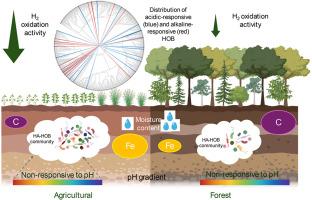
Biological high-affinity H2 uptake in soil is the largest global sink for atmospheric H2. Soil pH often influences soil biological activity but the impact of pH on high-affinity H2 oxidizing bacteria (HOB) was not confirmed. We compared the activity and diversity of group 5/1h HOB in agricultural and forest soils across a gradient from pH 4 to pH 8. The potential H2 uptake activity was approximately 2 times higher in agricultural soil than in forest soil across the pH gradient. Both H2 oxidizing activity and HOB community structure were non-responsive to pH adjustment in these soils, and no pH optima was observed. Greater H2 oxidizing activity was associated with higher iron content and lower carbon and nitrogen concentrations in soil. Catabolic repression of HOB was likely triggered when more organic carbon was present, due to the mixotrophic metabolism in the HOB community. A few hhyL genotypes (5%) responded to pH manipulation, but preference for acidic or alkaline pH was not consistent at the HOB taxonomic level. We conclude that pH preference is not an ecological trait that predicts group 5/1h HOB distribution in soil.

5/1h组高亲和H2氧化菌的多样性和活性对pH无响应
土壤生物高亲和H2吸收是全球最大的大气H2汇。土壤pH经常影响土壤生物活性,但pH对高亲和H2氧化菌(HOB)的影响尚未得到证实。我们比较了在pH 4 ~ pH 8梯度下农业和森林土壤中5/1h群HOB的活性和多样性。在不同的pH梯度下,农业土壤的潜在H2吸收活性大约是森林土壤的2倍。H2氧化活性和HOB群落结构均不受pH调节的影响,不存在最优pH值。土壤H2氧化活性越强,铁含量越高,碳氮浓度越低。由于HOB群落的混合营养代谢,当存在更多有机碳时,可能会触发HOB的分解代谢抑制。少数hhyL基因型(5%)对pH操纵有反应,但在HOB分类水平上对酸性或碱性pH的偏好并不一致。因此,pH偏好并不是预测5/1h HOB在土壤中分布的生态性状。
本文章由计算机程序翻译,如有差异,请以英文原文为准。
求助全文
约1分钟内获得全文
求助全文
来源期刊
Soil Biology & Biochemistry
农林科学-土壤科学
CiteScore
16.90
自引率
9.30%
发文量
312
审稿时长
49 days
期刊介绍:
Soil Biology & Biochemistry publishes original research articles of international significance focusing on biological processes in soil and their applications to soil and environmental quality. Major topics include the ecology and biochemical processes of soil organisms, their effects on the environment, and interactions with plants. The journal also welcomes state-of-the-art reviews and discussions on contemporary research in soil biology and biochemistry.
 求助内容:
求助内容: 应助结果提醒方式:

 京公网安备 11010802042870号


