
Photoacoustic imaging and biodistribution analysis of trimethyl chitosan-stabilized ZnO nanoparticles embedded in nanofiber scaffolds for diabetic wound healing

IF 4.6 2区 医学 Q2 MEDICINE, RESEARCH & EXPERIMENTAL
Ankit Kumar Malik , Pooja Goswami , Vaishali , Rajesh Saini , Datta Maroti Pawde , Aseem Setia , Biplob Koch , Madaswamy S. Muthu
{"title":"Photoacoustic imaging and biodistribution analysis of trimethyl chitosan-stabilized ZnO nanoparticles embedded in nanofiber scaffolds for diabetic wound healing","authors":"Ankit Kumar Malik ,&nbsp;Pooja Goswami ,&nbsp;Vaishali ,&nbsp;Rajesh Saini ,&nbsp;Datta Maroti Pawde ,&nbsp;Aseem Setia ,&nbsp;Biplob Koch ,&nbsp;Madaswamy S. Muthu","doi":"10.1016/j.nano.2026.102908","DOIUrl":null,"url":null,"abstract":"<div><div>Chronic wounds associated with diabetes represent a persistent clinical challenge, primarily due to their delayed healing dynamics and heightened vulnerability to microbial invasion, which can precipitate serious adverse outcomes. In response to these issues, we have developed a nanofiber scaffold loaded with trimethyl chitosan-derived ZnO nanoparticles (ZnO-TMC-NPs-NFs) to enhance diabetic wound-healing therapy. The developed nanoparticle (ZnO-TMC-NPs) has a size of 16.1 ± 3.7 nm and a zeta potential of +26.3 ± 1.7 mV. Integration of ZnO-TMC-NPs into chitosan poly(vinyl-alcohol) nanofiber scaffolds was performed to develop nanoformulation ranging between 120 and 240 nm. Moreover, the robustness of this research is enhanced by <em>in vitro</em> cell line evaluations using L929 mouse fibroblast and A549 lung cancer cell lines, and by integrating <em>in vivo</em> optical modalities with advanced ultrasound/photoacoustic (PA) imaging. Collectively, the results underscore the therapeutic promise of this nanofibrous scaffold, particularly when functionalized with TMC-ZnO, as a viable intervention for diabetic wound management.</div></div>","PeriodicalId":19050,"journal":{"name":"Nanomedicine : nanotechnology, biology, and medicine","volume":"72 ","pages":"Article 102908"},"PeriodicalIF":4.6000,"publicationDate":"2026-03-01","publicationTypes":"Journal Article","fieldsOfStudy":null,"isOpenAccess":false,"openAccessPdf":"","citationCount":"0","resultStr":null,"platform":"Semanticscholar","paperid":null,"PeriodicalName":"Nanomedicine : nanotechnology, biology, and medicine","FirstCategoryId":"3","ListUrlMain":"https://www.sciencedirect.com/science/article/pii/S1549963426000092","RegionNum":2,"RegionCategory":"医学","ArticlePicture":[],"TitleCN":null,"AbstractTextCN":null,"PMCID":null,"EPubDate":"2026/2/3 0:00:00","PubModel":"Epub","JCR":"Q2","JCRName":"MEDICINE, RESEARCH & EXPERIMENTAL","Score":null,"Total":0}
引用次数: 0

Abstract

Chronic wounds associated with diabetes represent a persistent clinical challenge, primarily due to their delayed healing dynamics and heightened vulnerability to microbial invasion, which can precipitate serious adverse outcomes. In response to these issues, we have developed a nanofiber scaffold loaded with trimethyl chitosan-derived ZnO nanoparticles (ZnO-TMC-NPs-NFs) to enhance diabetic wound-healing therapy. The developed nanoparticle (ZnO-TMC-NPs) has a size of 16.1 ± 3.7 nm and a zeta potential of +26.3 ± 1.7 mV. Integration of ZnO-TMC-NPs into chitosan poly(vinyl-alcohol) nanofiber scaffolds was performed to develop nanoformulation ranging between 120 and 240 nm. Moreover, the robustness of this research is enhanced by in vitro cell line evaluations using L929 mouse fibroblast and A549 lung cancer cell lines, and by integrating in vivo optical modalities with advanced ultrasound/photoacoustic (PA) imaging. Collectively, the results underscore the therapeutic promise of this nanofibrous scaffold, particularly when functionalized with TMC-ZnO, as a viable intervention for diabetic wound management.
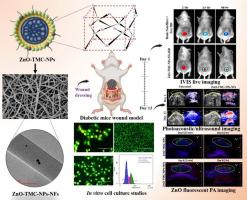
Abstract Image

纳米纤维支架中三甲基壳聚糖稳定ZnO纳米粒子的光声成像和生物分布分析
糖尿病相关的慢性伤口是一个持续的临床挑战,主要是因为它们的愈合动力学延迟和对微生物入侵的脆弱性增加,这可能导致严重的不良后果。针对这些问题,我们开发了一种负载三甲基壳聚糖衍生ZnO纳米颗粒(ZnO- tmc - nps - nfs)的纳米纤维支架,以增强糖尿病伤口愈合治疗。纳米粒子(ZnO-TMC-NPs)粒径为16.1 ± 3.7 nm, zeta电位为+26.3 ± 1.7 mV。将ZnO-TMC-NPs整合到壳聚糖聚乙烯醇纳米纤维支架中,得到了120 ~ 240 nm的纳米配方。此外,通过使用L-929小鼠成纤维细胞和A-549肺癌细胞系进行体外细胞系评估,以及将体内光学模式与先进的超声/光声(PA)成像相结合,增强了本研究的稳健性。总的来说,这些结果强调了这种纳米纤维支架的治疗前景,特别是当与TMC-ZnO功能化时,作为糖尿病伤口管理的可行干预措施。
本文章由计算机程序翻译,如有差异,请以英文原文为准。
求助全文
约1分钟内获得全文 求助全文
来源期刊
CiteScore
11.10
自引率
0.00%
发文量
133
审稿时长
42 days
期刊介绍: The mission of Nanomedicine: Nanotechnology, Biology, and Medicine (Nanomedicine: NBM) is to promote the emerging interdisciplinary field of nanomedicine. Nanomedicine: NBM is an international, peer-reviewed journal presenting novel, significant, and interdisciplinary theoretical and experimental results related to nanoscience and nanotechnology in the life and health sciences. Content includes basic, translational, and clinical research addressing diagnosis, treatment, monitoring, prediction, and prevention of diseases.

×
引用
GB/T 7714-2015
复制
MLA
复制
APA
复制
导出至
BibTeX EndNote RefMan NoteFirst NoteExpress
×
提示
您的信息不完整,为了账户安全,请先补充。
现在去补充
×
提示
您因"违规操作"
具体请查看互助需知
我知道了
×
提示
确定
请完成安全验证×
copy
已复制链接
快去分享给好友吧!
我知道了
右上角分享
点击右上角分享
0
联系我们:info@booksci.cn Book学术提供免费学术资源搜索服务,方便国内外学者检索中英文文献。致力于提供最便捷和优质的服务体验。 Copyright © 2023 布克学术 All rights reserved.
京ICP备2023020795号-1
ghs 京公网安备 11010802042870号
Book学术文献互助
Book学术文献互助群
群 号:604180095
Book学术官方微信
小红书


