
Revisiting plant isoprene emission: From atmospheric chemistry to plant stress resilience
IF 4.8
3区 生物学
Q1 PLANT SCIENCES
Journal of plant physiology
Pub Date : 2026-03-01
Epub Date: 2026-01-29
DOI:10.1016/j.jplph.2026.154712
引用次数: 0
Abstract
The emission of isoprene from plants was first discovered in the 1950s but was relatively unknown in the plant science community until the 1990s. Isoprene is the five-carbon branched molecule that is the root member of the extensive family of isoprenoids. The amount of isoprene from plants exceeds all other hydrocarbon inputs to the atmosphere. Plant-emitted isoprene can affect ozone formation and often increases (but can decrease) growth of aerosols (particles in the atmosphere). The rate of isoprene emission is estimated using empirical or mechanistic modeling has been used to predict global emissions. Beyond its atmospheric role, isoprene can improve plant resilience to biotic and abiotic stress, likely through interactions with transcriptional networks that regulate plant growth and defense. Isoprene has all the properties of the five compounds classically described as plant hormones. These and an additional four molecules are now called small molecule plant growth regulators, and we propose that isoprene also belongs to this group. Plants previously thought to lack the capacity for isoprene emission have now been found that make isoprene in response to leaf damage. This discovery suggests that many plants once classified as non-emitters likely have the capacity to emit isoprene under specific conditions. This review summarizes past and current understanding of the biosynthesis and regulatory mechanisms, atmospheric significance, and physiological roles of isoprene emitted from plants.
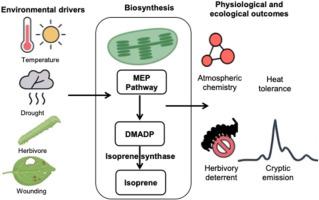
重访植物异戊二烯排放:从大气化学到植物抗逆性。
从植物中排放异戊二烯是在20世纪50年代首次被发现的,但直到20世纪90年代,植物科学界才对其知之甚少。异戊二烯是五碳支链分子,是类异戊二烯家族的根成员。来自植物的异戊二烯的数量超过了所有其他向大气输入的碳氢化合物。植物排放的异戊二烯可以影响臭氧的形成,并经常增加(但也可能减少)气溶胶(大气中的颗粒)的增长。异戊二烯的排放率是利用经验或机制模式估计的,这种模式已用于预测全球排放量。除了在大气中的作用,异戊二烯还可以提高植物对生物和非生物胁迫的适应能力,这可能是通过与调节植物生长和防御的转录网络相互作用实现的。异戊二烯具有五种经典植物激素化合物的所有特性。这些和另外四个分子现在被称为小分子植物生长调节剂,我们认为异戊二烯也属于这一类。以前被认为缺乏异戊二烯排放能力的植物现在被发现在叶片受损时产生异戊二烯。这一发现表明,许多曾经被归类为非排放者的植物在特定条件下可能有能力排放异戊二烯。本文综述了植物释放异戊二烯的生物合成和调控机制、大气意义和生理作用等方面的研究进展。
本文章由计算机程序翻译,如有差异,请以英文原文为准。
求助全文
约1分钟内获得全文
求助全文
来源期刊
Journal of plant physiology
生物-植物科学
CiteScore
7.20
自引率
4.70%
发文量
196
审稿时长
32 days
期刊介绍:
The Journal of Plant Physiology is a broad-spectrum journal that welcomes high-quality submissions in all major areas of plant physiology, including plant biochemistry, functional biotechnology, computational and synthetic plant biology, growth and development, photosynthesis and respiration, transport and translocation, plant-microbe interactions, biotic and abiotic stress. Studies are welcome at all levels of integration ranging from molecules and cells to organisms and their environments and are expected to use state-of-the-art methodologies. Pure gene expression studies are not within the focus of our journal. To be considered for publication, papers must significantly contribute to the mechanistic understanding of physiological processes, and not be merely descriptive, or confirmatory of previous results. We encourage the submission of papers that explore the physiology of non-model as well as accepted model species and those that bridge basic and applied research. For instance, studies on agricultural plants that show new physiological mechanisms to improve agricultural efficiency are welcome. Studies performed under uncontrolled situations (e.g. field conditions) not providing mechanistic insight will not be considered for publication.
The Journal of Plant Physiology publishes several types of articles: Original Research Articles, Reviews, Perspectives Articles, and Short Communications. Reviews and Perspectives will be solicited by the Editors; unsolicited reviews are also welcome but only from authors with a strong track record in the field of the review. Original research papers comprise the majority of published contributions.
 求助内容:
求助内容: 应助结果提醒方式:

 京公网安备 11010802042870号


