
In situ trace element and sulfur isotope characteristics of pyrite from the Dapingzhang Cu − Au polymetallic deposit: Insights into Au mineralization processes
IF 3.6
2区 地球科学
Q1 GEOLOGY
引用次数: 0
Abstract
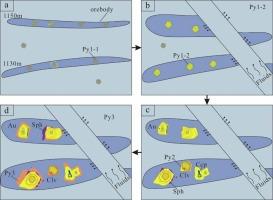
The Dapingzhang Cu − Au polymetallic deposit is a large volcanogenic massive sulfide (VMS) deposit formed during the Proto − Tethyan stage in western Yunnan Province, SW China, and exhibits a stratified distribution with upper massive orebodies (V1) and lower veinlet orebodies (V2). Au − rich orebodies predominantly occur within the massive orebodies near the 16# exploration line. This study investigates the microstructures, trace elemental, and sulfur isotopic compositions of pyrite, chalcopyrite, and sphalerite from the Au − rich orebodies at 1150 m and 1130 m levels to constrain the Au-bearing hydrothermal fluid sources, migration, and ore genesis. Four pyrite types were identified, representing three mineralization stages: (1) early-stage Py1 − 1 with sedimentary-formed strawberry − like textures; (2) late-stage Py1 − 2 formed through Py1 − 1 aggregation into irregular or euhedral crystals; and (3) Py2 (first-order zoning on Py1 − 2) and Py3 (second-order zoning on Py2). All Py1 − 2, Py2, and Py3 are hydrothermal in origin. Trace elemental composition reveals higher Sb concentrations in pyrite at the 1150 m level compared to those at the 1130 m level, with similar concentrating trends of Cu, Pb, Au, and Se. Evolutionary sequence analysis shows increasing Cu and Au concentrations but decreasing Co and Se concentrations in Py1 − 2, Py2, and Py3 across both the 1150 m and 1130 m levels. All pyrites are enriched in Au, Cu, Pb, Zn, and Sb but are depleted in Co, Ni, Tl, Se, Ti, and Sn. Sulfur isotope values (δ34S = − 2.63 to + 1.12‰) of pyrite, chalcopyrite, and sphalerite suggest a magmatic sulfur affinity. Gold mineralization is associated with E − W-trending ore-conducting faults. Au − rich fluids migrated upward through fractures, leaching Py1 − 1 to form inclusion textures and causing localized recrystallization that produced Au − enriched Py1 − 2. Continuous fluid replenishment generated Au − rich Py2. Since Py2 − forming fluids were not fully consumed, Py3 − forming fluids added more Au, reaching supersaturation and precipitating native gold and calaverite within Py2 − Py3 intergrowths and fractures. Sustained fluid supply ultimately formed the Au − rich orebodies.
大坪章铜金多金属矿床黄铁矿原位微量元素及硫同位素特征:对金成矿过程的启示
大坪章铜金多金属矿床是滇西原特提斯期形成的大型火山成因块状硫化物矿床,呈上块状矿体(V1)下脉状矿体(V2)层状分布。富金矿体主要产于16#探矿线附近块状矿体内。本文研究了1150 m和1130 m富金矿体中黄铁矿、黄铜矿和闪锌矿的微观结构、微量元素和硫同位素组成,以约束含金热液的来源、运移和矿床成因。鉴定出4种黄铁矿类型,分别代表3个成矿阶段:(1)早期Py1−1期,具有沉积形成的草莓状结构;(2)晚期Py1−2通过Py1−1聚集形成不规则或自面体晶体;Py2 (Py1−2上的一级分区)和Py3 (Py2上的二级分区)。Py1−2、Py2和Py3均为热液成因。微量元素组成表明,1150 m水平黄铁矿中Sb含量高于1130 m水平,Cu、Pb、Au和Se富集趋势相似。演化序列分析表明,在1150 m和1130 m水平上,Py1−2、Py2和Py3中Cu和Au浓度升高,Co和Se浓度降低。所有黄铁矿均富集Au、Cu、Pb、Zn和Sb,而富集Co、Ni、Tl、Se、Ti和Sn。黄铁矿、黄铜矿和闪锌矿的硫同位素值(δ34S =−2.63 ~ + 1.12‰)表明它们具有岩浆硫亲和作用。金矿化与E - w向导矿断裂有关。富金流体通过裂缝向上运移,浸出Py1−1形成包裹体,局部再结晶生成富金Py1−2。连续补充流体生成富Au−Py2。由于形成Py2−的流体消耗不完全,形成Py3−的流体添加了更多的金,达到过饱和状态,在Py2−Py3共生体和裂缝中析出天然金和钙钙石。持续的流体供给最终形成了富金矿体。
本文章由计算机程序翻译,如有差异,请以英文原文为准。
求助全文
约1分钟内获得全文
求助全文
来源期刊
Ore Geology Reviews
地学-地质学
CiteScore
6.50
自引率
27.30%
发文量
546
审稿时长
22.9 weeks
期刊介绍:
Ore Geology Reviews aims to familiarize all earth scientists with recent advances in a number of interconnected disciplines related to the study of, and search for, ore deposits. The reviews range from brief to longer contributions, but the journal preferentially publishes manuscripts that fill the niche between the commonly shorter journal articles and the comprehensive book coverages, and thus has a special appeal to many authors and readers.
 求助内容:
求助内容: 应助结果提醒方式:

 京公网安备 11010802042870号


