
Swipe for sleep - a standardized evaluation of mobile health apps for insomnia in children and adolescents
IF 3.4
2区 医学
Q1 CLINICAL NEUROLOGY
引用次数: 0
Abstract
Introduction
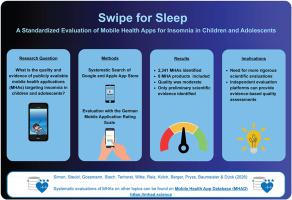
Access to cognitive behavioral therapy for insomnia (CBT-I) in children and adolescents is limited. Mobile health applications (MHAs) available in app stores may provide an accessible and scalable option for delivering CBT-I. This study systematically evaluated the quality of MHAs targeting insomnia in children and adolescents and examined their evidence base and treatment components.
Methods
In November 2024, a systematic search of the Google Play and Apple App Stores was conducted to identify MHAs targeting insomnia in children and adolescents. MHAs were screened for eligibility in a two-level process: first based on app store descriptions, then after downloading the MHA. Eligible MHAs were independently evaluated using the German Mobile Application Rating Scale (MARS-G), which rates MHAs from 1 (inadequate) to 5 (excellent) across the subscales engagement, functionality, aesthetics, and information. Additionally, the featured treatment components and supporting scientific evidence were assessed.
Results
Of 2341 MHAs initially identified, eight MHA products met the inclusion criteria. The overall quality was moderate (mean = 3.5, SD = 0.4). Among the subscales, functionality was rated highest (mean = 3.8, SD = 0.6), followed by aesthetics (mean = 3.6, SD = 0.6), engagement (mean = 3.3, SD = 0.4), and information (mean = 3.1, SD = 0.8). Sleep hygiene was the most commonly featured treatment component (seven MHA products). While scientific evidence was identified for five MHA products, none specifically evaluated insomnia in the target population.
Conclusion
Although many MHAs claim to target sleep in children and adolescents, few incorporate CBT-I components beyond sleep hygiene. The moderate quality and limited evidence base underscore the need for theory-driven, rigorously evaluated MHAs tailored to this age group.
滑动睡眠-对儿童和青少年失眠的移动健康应用程序的标准化评估。
儿童和青少年失眠的认知行为疗法(CBT-I)是有限的。应用程序商店中提供的移动健康应用程序(MHAs)可能为提供CBT-I提供可访问和可扩展的选择。本研究系统地评估了针对儿童和青少年失眠的MHAs的质量,并检查了它们的证据基础和治疗成分。方法:于2024年11月对谷歌Play和Apple App store进行系统搜索,以确定针对儿童和青少年失眠的mha。MHA的资格筛选分为两个阶段:首先是基于应用商店的描述,然后是下载MHA之后。使用德国移动应用评级量表(MARS-G)对合格的mha进行独立评估,该量表将mha在参与、功能、美学和信息的子量表上从1(不足)到5(优秀)进行评级。此外,还评估了特色治疗成分和支持科学证据。结果:在初步鉴定的2341个MHA产品中,有8个产品符合纳入标准。总体质量为中等(mean = 3.5, SD = 0.4)。在子量表中,功能性评分最高(平均3.8,SD = 0.6),其次是美学(平均3.6,SD = 0.6),参与度(平均3.3,SD = 0.4)和信息(平均3.1,SD = 0.8)。睡眠卫生是最常见的治疗成分(7种MHA产品)。虽然已经确定了五种MHA产品的科学证据,但没有一种是专门评估目标人群失眠的。结论:尽管许多MHAs声称针对儿童和青少年的睡眠,但很少有CBT-I超出睡眠卫生的成分。中等质量和有限的证据基础强调需要理论驱动,严格评估适合该年龄组的MHAs。
本文章由计算机程序翻译,如有差异,请以英文原文为准。
求助全文
约1分钟内获得全文
求助全文
来源期刊
Sleep medicine
医学-临床神经学
CiteScore
8.40
自引率
6.20%
发文量
1060
审稿时长
49 days
期刊介绍:
Sleep Medicine aims to be a journal no one involved in clinical sleep medicine can do without.
A journal primarily focussing on the human aspects of sleep, integrating the various disciplines that are involved in sleep medicine: neurology, clinical neurophysiology, internal medicine (particularly pulmonology and cardiology), psychology, psychiatry, sleep technology, pediatrics, neurosurgery, otorhinolaryngology, and dentistry.
The journal publishes the following types of articles: Reviews (also intended as a way to bridge the gap between basic sleep research and clinical relevance); Original Research Articles; Full-length articles; Brief communications; Controversies; Case reports; Letters to the Editor; Journal search and commentaries; Book reviews; Meeting announcements; Listing of relevant organisations plus web sites.
 求助内容:
求助内容: 应助结果提醒方式:

 京公网安备 11010802042870号


