Ketamine as primary anesthetic for upper limb trauma during war: a case series of 100 surgeries at Rafik Hariri University Hospital, Lebanon's National War Trauma Referral Center.
{"title":"Ketamine as primary anesthetic for upper limb trauma during war: a case series of 100 surgeries at Rafik Hariri University Hospital, Lebanon's National War Trauma Referral Center.","authors":"Mustapha Nahle, Miguel Nunez, Mayyas Msheik","doi":"10.1080/20565623.2026.2622334","DOIUrl":null,"url":null,"abstract":"<p><strong>Background: </strong>The Beirut pager explosions on September 17, 2024 resulted in mass casualties with severe upper limb trauma admitted to Rafik Hariri University Hospital (RHUH), Lebanon's national war trauma referral center. Initial opioid-based anesthesia was associated with postoperative respiratory complications and high opioid requirements. Ketamine became available the following day through the International Committee of the Red Cross (ICRC). This study evaluates the transition to ketamine as a primary anesthetic and its effects on pain control, hemodynamics, respiration, and opioid use.</p><p><strong>Methods: </strong>We retrospectively reviewed 100 hand and finger amputation surgeries. Patients initially received fentanyl intraoperatively and opioids postoperatively. Ketamine was subsequently introduced as the primary anesthetic. Pain was assessed using the Visual Analog Scale (VAS), while respiratory and hemodynamic parameters were monitored perioperatively.</p><p><strong>Results: </strong>Ketamine was associated with significantly lower VAS scores (3.2 vs 7.8; p < 0.001), no respiratory complications (0 vs 18 cases), stable mean arterial pressure in 94% of patients, and reduced postoperative opioid use (5% vs 65%).</p><p><strong>Conclusion: </strong>Ketamine is a safe, effective, opioid-sparing anesthetic and should be prioritized in conflict and resource-limited trauma settings.</p>","PeriodicalId":12568,"journal":{"name":"Future Science OA","volume":"12 1","pages":"2622334"},"PeriodicalIF":2.1000,"publicationDate":"2026-12-01","publicationTypes":"Journal Article","fieldsOfStudy":null,"isOpenAccess":false,"openAccessPdf":"https://www.ncbi.nlm.nih.gov/pmc/articles/PMC12885423/pdf/","citationCount":"0","resultStr":null,"platform":"Semanticscholar","paperid":null,"PeriodicalName":"Future Science OA","FirstCategoryId":"1085","ListUrlMain":"https://doi.org/10.1080/20565623.2026.2622334","RegionNum":0,"RegionCategory":null,"ArticlePicture":[],"TitleCN":null,"AbstractTextCN":null,"PMCID":null,"EPubDate":"2026/2/4 0:00:00","PubModel":"Epub","JCR":"Q3","JCRName":"MEDICINE, RESEARCH & EXPERIMENTAL","Score":null,"Total":0}
引用次数: 0
Abstract
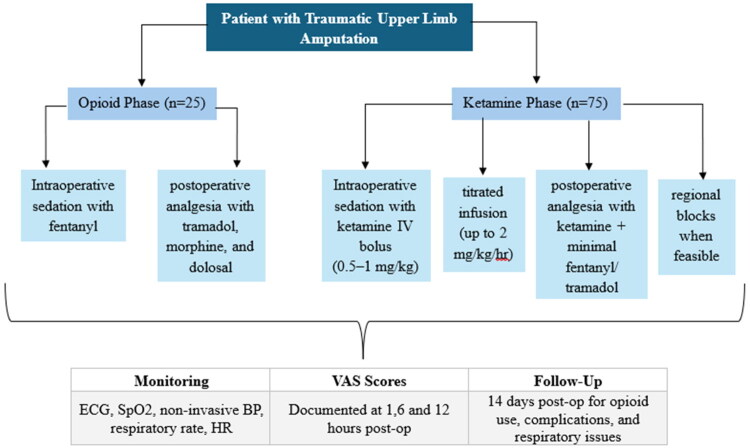
Background: The Beirut pager explosions on September 17, 2024 resulted in mass casualties with severe upper limb trauma admitted to Rafik Hariri University Hospital (RHUH), Lebanon's national war trauma referral center. Initial opioid-based anesthesia was associated with postoperative respiratory complications and high opioid requirements. Ketamine became available the following day through the International Committee of the Red Cross (ICRC). This study evaluates the transition to ketamine as a primary anesthetic and its effects on pain control, hemodynamics, respiration, and opioid use.
Methods: We retrospectively reviewed 100 hand and finger amputation surgeries. Patients initially received fentanyl intraoperatively and opioids postoperatively. Ketamine was subsequently introduced as the primary anesthetic. Pain was assessed using the Visual Analog Scale (VAS), while respiratory and hemodynamic parameters were monitored perioperatively.
Results: Ketamine was associated with significantly lower VAS scores (3.2 vs 7.8; p < 0.001), no respiratory complications (0 vs 18 cases), stable mean arterial pressure in 94% of patients, and reduced postoperative opioid use (5% vs 65%).
Conclusion: Ketamine is a safe, effective, opioid-sparing anesthetic and should be prioritized in conflict and resource-limited trauma settings.
背景:黎巴嫩国家战争创伤转诊中心拉菲克·哈里里大学医院(RHUH)于2024年9月17日在贝鲁特发生寻呼机爆炸事件,造成大量人员伤亡,上肢严重创伤。初始阿片类药物麻醉与术后呼吸并发症和高阿片类药物需求相关。克他命于第二天通过红十字国际委员会(红十字委员会)供应。本研究评估了氯胺酮作为主要麻醉剂的过渡及其对疼痛控制、血液动力学、呼吸和阿片类药物使用的影响。方法:回顾性分析100例手部和手指截肢手术。患者最初在术中使用芬太尼,术后使用阿片类药物。随后,氯胺酮被引入作为主要麻醉剂。采用视觉模拟评分(VAS)评估疼痛,同时监测呼吸和血流动力学参数。结果:氯胺酮显著降低VAS评分(3.2 vs 7.8); p结论:氯胺酮是一种安全、有效、节省阿片类药物的麻醉剂,在冲突和资源有限的创伤环境中应优先使用。
期刊介绍:
Future Science OA is an online, open access, peer-reviewed title from the Future Science Group. The journal covers research and discussion related to advances in biotechnology, medicine and health. The journal embraces the importance of publishing all good-quality research with the potential to further the progress of research in these fields. All original research articles will be considered that are within the journal''s scope, and have been conducted with scientific rigour and research integrity. The journal also features review articles, editorials and perspectives, providing readers with a leading source of commentary and analysis. Submissions of the following article types will be considered: -Research articles -Preliminary communications -Short communications -Methodologies -Trial design articles -Trial results (including early-phase and negative studies) -Reviews -Perspectives -Commentaries



 求助内容:
求助内容: 应助结果提醒方式:

 京公网安备 11010802042870号


